




Death, in guerdon of her wrongs,
Gives her fame which never dies.
— Much Ado About Nothing
Swan Song: Diana, My Sister may be the greatest book written about Princess Diana. This year. Countless other books on the same subject have seen publication over the 29 years since Diana died. But the commotion Earl Spencer’s memoir caused suggests that the spell she held over the world in the 1990s is still strong. The market demographic is growing older, of course, but the fascination remains. And the market possibilities are abundant. Why?
Diana Inc.
Princess Diana’s death in 1997 changed the rules of celebrity culture, some would say for the worse. In the 29 years since, commercial enterprises, products and cultural projects built around her have proliferated, creating what might reasonably be called Diana Inc.
The precise annual turnover is impossible to calculate because the activity is so diffuse, but $200 million to $300 million a year would not be wildly unrealistic. The figures indicate the scale of an enterprise that was already substantial within a few years of her death.
Marilyn Monroe and Elvis Presley, who died in 1962 and 1977, respectively, also had lucrative commercial afterlives. Their images, voices and performances continued to propel record sales, box office receipts, posters and miscellaneous merchandise; the arrival of home video allowed performances and images to be retrieved, reproduced and consumed in new formats. Their spirits, so to speak, remained economically productive. But neither quite approached Diana as a market force.
The difference is not the amount of money involved, immense as it is. Nor even the industry’s capacity for renewal. Diana Inc. doesn’t merely reproduce the products of a dead celebrity; it continually enables fans to make new ones. Diana may be silent, but audiences are still responsive.
This gives the Diana industry a singular dynamism: Audiences do the work. They buy the books to read, pay admission for the movies, subscribe to streamers, perhaps even bid for clothes. Then they use them to exchange ideas with others, share memories, debate theories and construct new narratives, all the time magicking into being new versions of Diana. Her followers are, for sure, consumers, but they’re also custodians, curators and occasionally saboteurs. The industry just supplies the raw material.
No dead celebrity can participate in their own continuing manufacture. They can’t approve the biography, challenge the documentary, correct the photograph or explain the latest revelation. Yet the industrial machinery continues. Diana has become not simply a celebrity who survives death but a cultural figure whose afterlife is continually being made and remade by people who never knew her. How? And why? I have answers, but first an example.
Silent scream
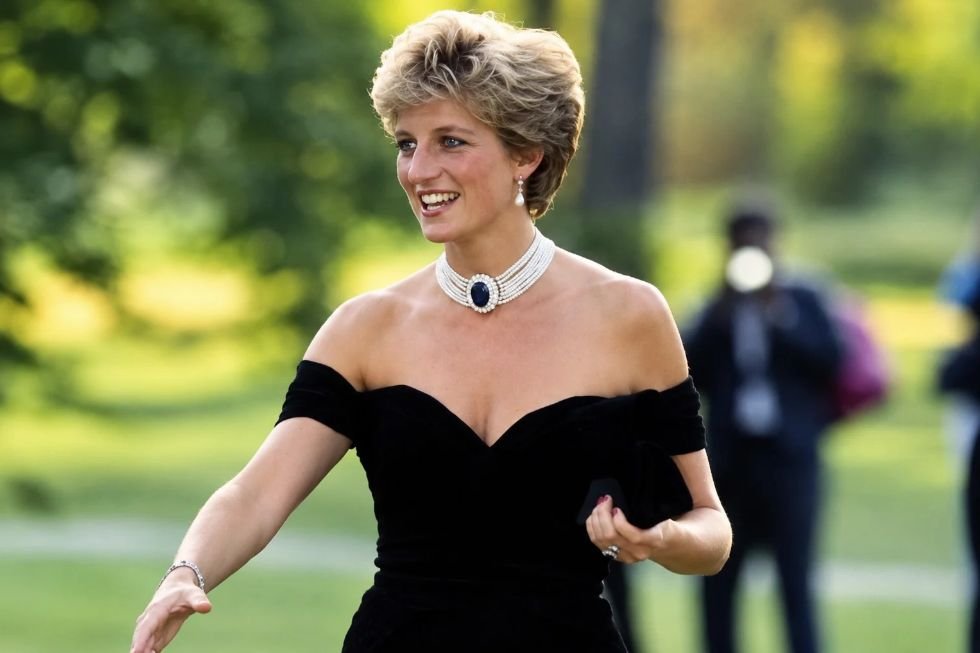
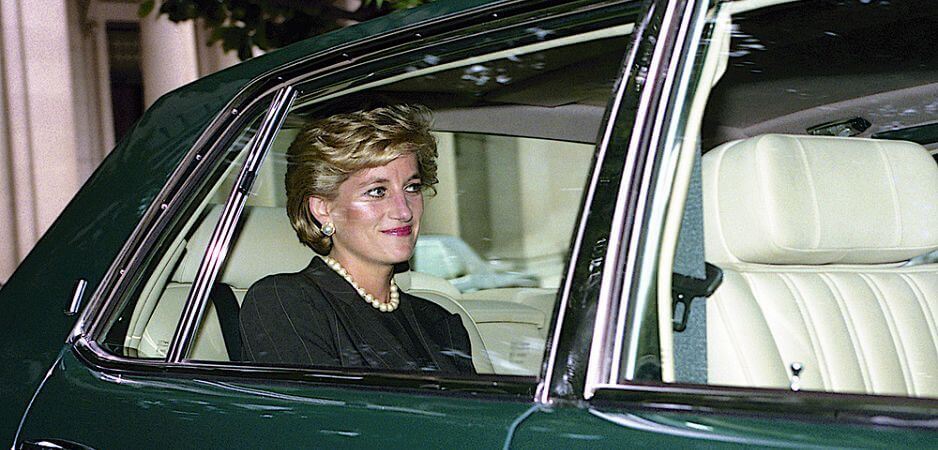
On December 9, Sotheby’s will auction a history-rich garment, this one known as the “revenge dress” (pictured above). Diana wore it on a summer’s evening in 1994 at a fundraising dinner in London. Arriving to the usual eruption of flash cameras, Diana wore a pearl choker with an oval sapphire to accessorize her black off-the-shoulder cocktail dress by Greek designer Christina Stambolian. Her nails were painted scarlet.
The auction estimate is $150,000–$300,000, though it will surprise no one if the bids reach ten times that estimate. Why? Because the dress secretes a story of infidelity, betrayal and a loveless marriage.
(For comparison: In 2016, the museum chain Ripley’s Believe It or Not! bought the crystal-beaded “naked” gown Marilyn wore to sing “Happy Birthday Mister President” to John F. Kennedy in 1962 for $4.8 million. A Hermès bag once owned by Jane Birkin went for €8.6 million, or $10.1 million, in 2025.)
On June 29, 1994, the then-Prince (now King) Charles appeared in a television interview that aired in Britain. In the course of the interview, Charles confessed that he had been unfaithful to Diana during their marriage. Diana had scheduled to attend the fundraiser on the same night but planned to wear a conservative Valentino gown. After Charles’ revelation, she changed her mind and opted for the asymmetric silk, shorter, strapless and altogether more risqué number.
The following day, newspapers around the world featured images of the confident-looking Diana, effectively overshadowing Charles’ broadcast. The dress was interpreted as Diana’s payback for his admission and his infidelity, as if she were silently screaming, “Look what you’re missing!” The interpretation stuck. The dress became one of the most enduring symbols of Diana’s defiance. But remember: Diana never uttered a word about that dress.
Tabula rasa
Diana died leaving more than a legacy: She left the prospect of an industry based on her ghost, a ghost that’s become arguably more captivating than the woman. After all, Diana didn’t bequeath the world a back catalog of music or an oeuvre of films, books or other products of her creation. She spoke infrequently, championed good causes and dressed in ways people admired. She appeared.
But that’s all some celebrities need to do: stay visible. Presenting herself but without saying or doing much meant Diana let audiences add detail. It was as if she was a tabula rasa, a blank slate. Never splashed across headlines for using cocaine. Or upsetting the Pope. Or having wardrobe malfunctions. The relative absence of controversy made her all the more compelling. It charged otherwise insignificant items — a glance, a gesture, a garment — with meanings that followers could decode and discuss. Diana supplied the image; audiences supplied the meaning. And, when she could no longer provide the image, Diana Inc. took over.
Authors write books about her, publishers sell them, filmmakers make documentaries and biopics, television executives commission programs, photographers circulate images and auction houses turn possessions into commodities. Audiences consume the products, but they do something else, too: They create Dianas, limitless numbers that exist independently of time and space because they reside in fans’ imaginations.
To an extent, all followers of celebrities today do this, but they mostly have actual celebrities to confirm, undermine, modify or in some other way keep audience conceptions anchored in reality. Diana’s followers have no comparable restrictions. It’s not hard to see why the Diana industry is prodigiously productive year after year.
In this sense, the Diana industry is unusual. The industry supplies the material, but the spectral Diana that emerges from it is an amalgam of what the industry produces and what audiences make of it.
The relationship is almost syncretic. Different stories and interpretations accumulate around the same absent person: biography, gossip, fashion, motherhood, sexuality, philanthropy, victimhood, rebellion, romance and monarchy. Each new representation adds something to the collection, but audiences help determine which additions become part of their Diana.
Without fear of contradiction
Audiences have performed a kind of CPR, bringing Diana back from the dead — not as she was, but as they want her. She hasn’t attracted the kind of acerbic condemnation Michael Jackson does, but neither has her posthumous reputation been left untouched by scurrilous speculation. The public has unsympathetically examined her lovers, her marriage, her motives and even the paternity of her sons.
The old tabloid allegation that Major James Hewitt was Prince Harry’s biological father has resurfaced repeatedly over the years, despite the chronology that puts Harry’s birth before Diana’s relationship with Hewitt. Harry was born September 15, 1984. Diana did not meet Hewitt until the summer of 1986 at a party. Harry addressed the rumor in his 2023 memoir, Spare. But, of course, Diana can’t respond to this or any other rumor.
Diana’s death was extraordinarily, ghoulishly advantageous for the celebrity industry. A living celebrity can interrupt a good story, denying an allegation, correcting a biographer, providing alternative accounts and so on. Diana can do none of these things. Every book, documentary, film or tabloid story can offer another edition of her without fear of contradiction from its subject. The truth, falsity or indeterminacy of a story matters much less than its capacity to keep Diana alive in the popular imagination.
Posthumous but vigorous
We’ve reached a phase in celebrity culture where death is terminal only for the flesh-and-blood mortal. The celebrity lives on. This isn’t because fans are worshipful. They’re not apostles, and celebrities are not deities. Modern audiences can be fascinated by flaws, weaknesses, contradictions and transgressions. What could be duller than a goody-two-shoes celebrity?
Diana may have approached beatification while she was alive. She could have been the model for the Grimm brothers’ Rapunzel, a beautiful princess locked away in a tower. Except that Diana’s tower was a loveless marriage from which there seemed to be no obvious escape. Rapunzel’s captor was an evil witch. Diana’s was the Royal Family. The fairytale worked beautifully while Diana was alive. Then she died, and the fairytale stopped being told. Or, more precisely, it became only one story among many.
The industry has produced several different Dianas, some less flattering than others. That’s one of the peculiar advantages of a dead celebrity: There can be any number of them. They no longer have to exist in chronological time or even agree with one another. They exist in the imagination, where Diana can be the wronged wife, the devoted mother, the adulteress, the rebel, the saint, the manipulator, the fashion icon, the victim or all of these and more.
There’s nothing new about fame after death. Jane Austen’s nephew James Edward Austen-Leigh observed of his aunt that “even her fame may be said to have been posthumous: it did not attain to any vigorous life till she had ceased to exist.” Diana’s case is somewhat different in the sense that her living fame was not only matched but eclipsed by her postmortem renown and by the extraordinary capacity of modern celebrity culture to keep producing new versions of her. Austen’s fame grew after her death; Diana’s has become an ongoing cultural production.
[Ellis Cashmore is the author of Celebrity Culture.]
[Lee Thompson-Kolar edited this piece.]
The views expressed in this article are the author’s own and do not necessarily reflect Fair Observer’s editorial policy.
Would Michael Jackson Have Survived in the #MeToo Era?
Director Antoine Fuqua’s Michael Jackson biopic, Michael, opens on April 24, a year later than scheduled. Parts of the film...
Diana’s Ghost Haunts Britain’s Royals
Diana, Princess of Wales, transformed the British monarchy’s relationship with the media by introducing unprecedented openness and emotional vulnerability. This...
A Century of Royal Scandal: Britain’s Shocking Monarchy
Explore a century of royal scandals that have shaken the House of Windsor, from Prince Andrew’s ties to Jeffrey Epstein...
The Afterlife of Michael Jackson
The king of pop died 12 years ago, but there has been plenty of life after death.
Support Fair Observer
We rely on your support for our independence, diversity and quality.
For more than 10 years, Fair Observer has been free, fair and independent. No billionaire owns us, no advertisers control us. We are a reader-supported nonprofit. Unlike many other publications, we keep our content free for readers regardless of where they live or whether they can afford to pay. We have no paywalls and no ads.
In the post-truth era of fake news, echo chambers and filter bubbles, we publish a plurality of perspectives from around the world. Anyone can publish with us, but everyone goes through a rigorous editorial process. So, you get fact-checked, well-reasoned content instead of noise.
We publish 3,000+ voices from 90+ countries. We also conduct education and training programs
on subjects ranging from digital media and journalism to writing and critical thinking. This
doesn’t come cheap. Servers, editors, trainers and web developers cost
money.
Please consider supporting us on a regular basis as a recurring donor or a
sustaining member.
Will you support FO’s journalism?
We rely on your support for our independence, diversity and quality.




Comment