Dear FO° Reader,
Since July, India has experienced protests across the country. A recent graduate of Boston University began the Cockroach Janta Party (CJP) after the Chief Justice of India Surya Kant called unemployed youth cockroaches in an intemperate remark. This graduate named Abhijeet Dipke has emerged as national leader, and the CJP are participating in protests, which are now being led by Rahul Gandhi, the leader of the historic Indian National Congress (INC).
Gandhi comes from India’s leading political dynasty. His great-grandfather Jawaharlal Nehru was India’s first prime minister. His grandmother Indira Gandhi led India to victory over Pakistan in 1971, liberating Bangladesh from Islamabad. His father Rajiv Gandhi was once the great modernizing hope for Indian society. Now, Gandhi has summoned thousands to the streets and thrown the gauntlet to Prime Minister Narendra Modi of the ruling Bharatiya Janata Party (BJP).
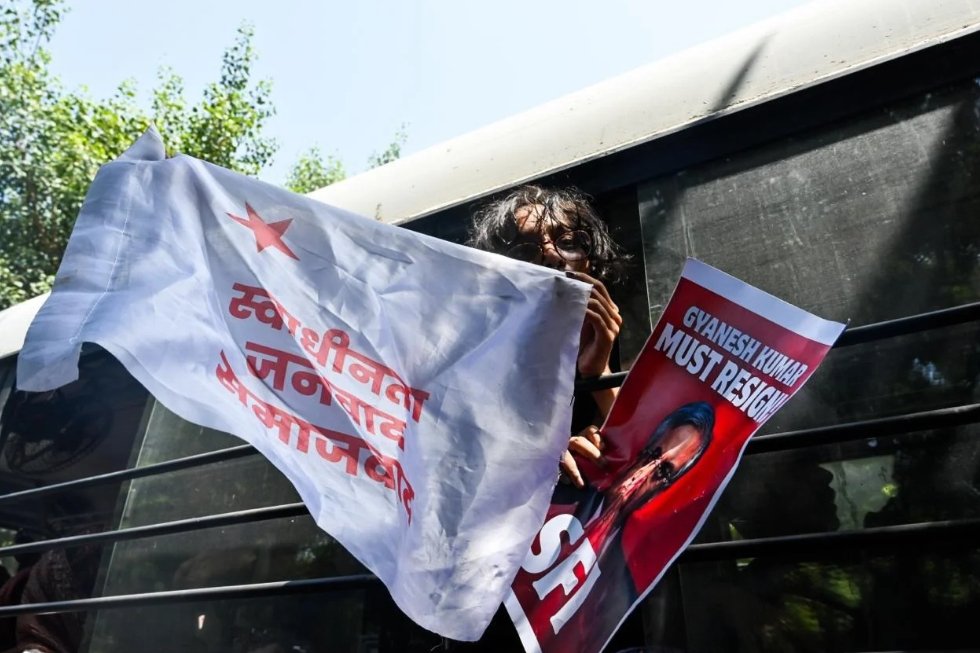
In October, Gandhi, supported by other opposition leaders and Dipke, challenged the validity of the recent elections. Street protests have replaced the ballot box as the theater of political competition. Protesters are demanding the resignation of Chief Election Commissioner Gyanesh Kumar. The Election Commission of India (ECI) is a constitutional body responsible for conducting elections. In the past, the ECI had a reputation for independence and competence. Now, opposition parties and protesters suspect that the ECI is beholden to Modi and tips the electoral scales.
 via shutterstock
The ECI has removed no less than 130 million names from India’s electoral rolls. There is an overwhelming suspicion that the ECI has taken away the right to vote of opposition supporters so that the BJP can win elections at a time of falling popularity. Note that the BJP won only 240 out of 543 seats in the lower house of parliament in 2024 and is in power thanks to the support of coalition partners. In 2019, the BJP had won 303 seats, and 2024 was a big blow to Modi’s party.
The July protests erupted because of persistent leaks of national exams. The Modi government’s arrogance exacerbated the issue. The CJP demanded the resignation of the education minister and achieved its goal. This was the first time a minister resigned in the Modi government, which has been in power since 2014.
These protests have erupted over the Special Intensive Revision (SIR) of the voter list by the ECI. The trigger for people taking the streets was thanks to a courageous journalist. Ritika Chopra of The Indian Express published a series of brilliant investigative stories about irregularities in the ECI and serious questions about Kumar’s actions. Earlier elections in the states of West Bengal and Bihara are now in question. The CJP and the Gandhi-led opposition have since taken to the streets to demand Kumar’s resignation.
Sources:
Read All The Stories Written by Ritika Chopra I The Indian Express
FO Talks: Make Sense of India’s Youth Cockroach Protests | Fair Observer
This carnival of protests on the streets of Delhi has shaken Narendra Modi like nothing before | The Guardian
India’s education minister resigns after days of ‘Cockroach’ youth protests over exam paper links | CNN World
India’s opposition parties march to top court as protests over voter lists escalate | AP
BJP-ruled Centre took away people’s right to vote under SIR: Congress’ Shashi Tharoor | The Economic Times
What did Ritika Chopra actually find?
Chopra reported that the ECI’s SIR has removed more than 130 million names from the draft voter rolls since June 2025. She found that two election commissioners formally objected at least 14 times to decisions and orders from the ECI chief, Kumar. Although the SIR is under the supervision of all three commissioners and they are supposed to work on the majority principle, the two junior commissioners claimed that Kumar illegally acted against their advice and ran the ECI on his own.
Voter rolls were previously decentralized, with individual state-level election officials able to make changes to the database. The ECI’s IT division restricted Electoral Registration Officers’ (EROs) access to their own constituency’s voter lists. Many question whether defenses against electoral rigging are weakening as a result. Thanks to software glitches, many bona fide voters have disappeared from electoral rolls.
New voter registration forms also ask new applicants if their parents were in the “electoral roll of [the] last SIR.” The form stops them from proceeding without an answer despite the two junior commissioners flagging the question as unauthorized. Critics say these revisions are politically motivated, favor the ruling BJP and have helped the party win recent state elections. Note that Chopra does not provide evidence that the SIR impacted election outcomes in recent state elections. Opposition parties are convinced that the SIR has unfairly and illegally enabled BJP victories.
The ECI also flagged many people for “logical discrepancies” in their voter status, promptly deleting almost half of the flagged names. Despite the Supreme Court of India ruling that voters in Goa must be allowed a hearing before the final voter roll is published, the EROs’ attempts to reverse the deletions of valid voters went unheard. Independent analysts point out that the ECI has centralized power to an unprecedented extent. The ECI, not EROs, now control electoral rolls, and voters in faraway states or even nearby villages do not really have any means of redressal. Per Chopra, the ECI has caused the disenfranchisement of millions of Indian citizens.
Sources:
14 times in 10 months, two Election Commissioners objected on record to poll panel steps | The Indian Express
What Election Commission rift reveals: Cloud over its conduct | The Indian Express
‘Illegal, unauthorised’: Election Commissioners objected to Form 6 change | The Indian Express
Election Commissioners knocked on Cabinet Secretary’s door over voter software integrity | The Indian Express
8 emails in 7 days, but valid Goa voters still left out: EC’s flawed system | The Indian Express
Concerns other than voter disenfranchisement and electoral manipulation drive mass protests as well. Indians have long faced massive government corruption, mass unemployment and growing inequality. An extractive colonial-era bureaucracy and a dysfunctional judiciary mean that corrupt officials operate with impunity. Modi’s arbitrary policies have destroyed small- and medium-sized businesses, benefiting oligarchs. Extortionate taxation has made life tough for most families who are straining under a cost-of-living crisis. Additionally, the US/Israel–Iran War has unleashed inflation, with food prices shooting up significantly. Data shows that income inequality in 2022-23 was higher than during the inter-war colonial period. Tensions were at a boiling point, and Chopra’s investigation triggered a national revolt.
Sources:
When Elections Become a Sham, Democracy Is at Stake | Frontline
Governance in India: Corruption | Council on Foreign Relations
INCOME AND WEALTH INEQUALITY IN INDIA, 1922-2023: THE RISE OF THE BILLIONAIRE RAJ | World Inequality Lab
Why India’s tens of millions of voter deletions have led to widespread protests | Reuters
The Dialectic: Narendra Modi’s Vegetarian Stalinism Has Ruined the Indian Economy | Fair Observer
Furious protests and fierce repression
In India’s biggest cities, protestors have scaled barricades and confronted tens of thousands of police. Protests have brought life in the national capital to a standstill. Protesters have marched to the Supreme Court and Parliament of India, and congregated at a historic observatory in the heart of Delhi called Jantar Mantar. In response, the police have blocked the street with multiple layers of barricades to keep protesters at bay. The Modi government has also shut down metro stations and the internet in the heart of Delhi, rounded up protesters, loaded them into buses and taken them away to unknown destinations.
In Delhi, the police have already detained over 7,000 journalists, lawyers, members of political parties and the youth, even if briefly. Reports of ill-treatment, sexual harassment and other forms of police violence abound, and international human rights groups have taken note. This violence is emblematic of a wider pattern. The V-Dem Institute in Stockholm currently classifies India as an “electoral autocracy,” which means that, although India holds regular elections, it fails to uphold basic democratic conventions such as legislative and judicial checks.
Some BJP leaders liken the protestors to “anarchists” backed by foreign powers. They point to Bangladesh youth protests that unseated Sheikh Hasina in 2024 as a terrible precedent for India. These responses diminish real concerns of the youth who now make up almost 25% of India’s voters. The Modi government is also refusing to engage with opposition parties or address their concerns. Political analysts point out this is unwise. Gandhi is the equivalent of royalty in India and is rising in popularity. Even at its lowest ebb in 2019, the INC got 19.5% of the vote. One in five Indians voted for the grand old party of India that led the struggle for independence and then ruled India for decades after 1947, even when Modi was at his zenith.
Sources:
Modi’s predicament: Gen Z pours out on India’s streets as dissent surges | Reuters
‘How do you explain the deletion of 130 million names?’: why Indian voters are on the streets | The Guardian
Indian police accused of sexual harassment against journalists at protest | BBC
India: UN experts alarmed by fresh crackdown on protests and rights violations | OHCHR
What BBC saw during police crackdown on India’s ‘Cockroach’ protesters | BBC News India
Democracy Report 2026: Unravelling The Democratic Era? | V-Dem Institute
“Bahot ho gaya tera, bahot der se journalist journalist kar rahi hai.” | altnews.in
India’s future is up in the air
In the words of Editor-in-Chief Atul Singh, India is an elected monarchy, not a democracy. The prime minister of the country and the chief minister of the states rule India like modern day kings. The elite officers of the Indian Administrative Service (IAS) occupy the commanding heights of the state from the Ministry of Finance to the Archeological Survey of India. IAS officers, not elected mayors, hold power in cities and districts. Since they report upwards, not downwards, citizens have no power over them. Once the steel frame of the British Raj, the IAS is now the “steel frame” of India.
Hundreds of millions of young Indians have had enough. The opposition has seized on an issue that has inflamed passions and brought thousands to the streets. Frustrations building for over a decade have now led to an explosion. In the region, the governments of Nepal, Sri Lanka and Bangladesh fell after mass protests.
Some believe that Modi’s hold on power is secure. The opposition is divided, and Gandhi is no Nehru. Furthermore, oligarchs pump a lot of money into the BJP, which has compromised the ECI and can “manage elections” to retain its hold on power. Others point out that even Indira Gandhi lost power in India. Modi is aging and so is his inner coterie. They argue that India now feels like the Soviet Union during the end of the Leonid Brezhnev era. Time will tell who is right.
Sources:
Indians’ rights have been chipped away for decades | The Economist
4 years, 3 protest movements: How public fury toppled leaders in Nepal, Sri Lanka and Bangladesh | AP
Aliyah A. Omar, Alexandros Ouzounis
Assistant Editors













Comment