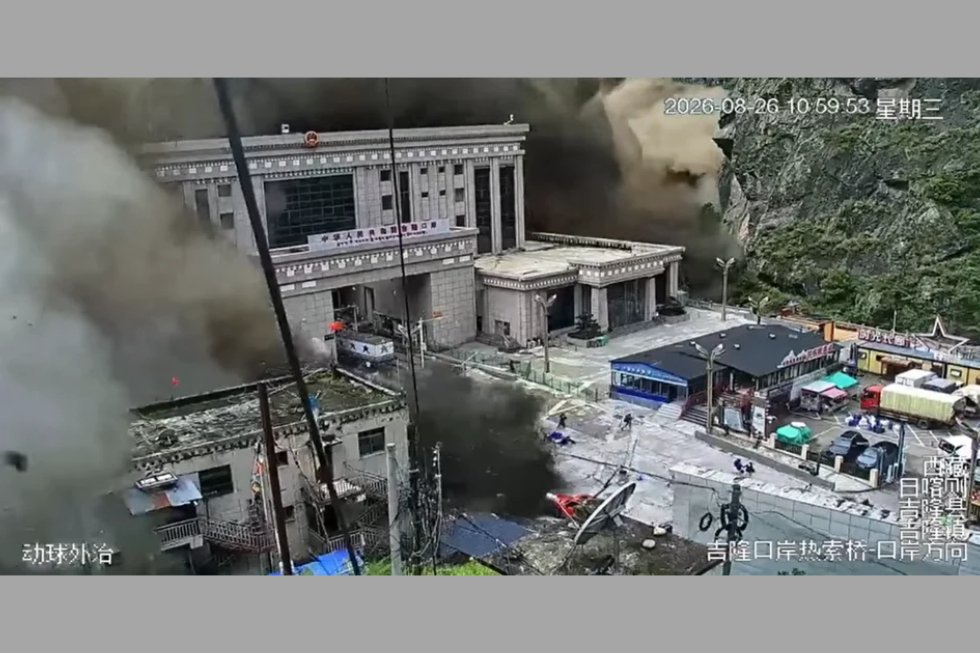
Greetings from North America. This week, we bring our attention to Nepal and the mounting effects of the climate crisis. This summer, on August 26, a massive glacier in the Himalayan Mountains broke off at the Nepal–China border. Part of it crashed onto the valley floor in Langtang National Park, Nepal, causing a landslide with devastating effects. Water, mud, rock and ice swept through the valley and rivers like a solid wall. Moving at 44 miles per hour (71 km/h) and about as tall as the Arc de Triomphe, the flash flood left almost nothing intact at the Gyirong border post. The mudslide reached the border crossing in just seven minutes. A second landslide swept through the valley hours after the first, and the stability of the mountain slopes worried residents and authorities. Damage to infrastructure further down the Trishuli River continued. Estimates say at least 1,454 people were killed and 5,285 are still missing as of October 5.  Via Wikimedia Commons Via Wikimedia Commons
Since then, Nepal has experienced another flood, this time in central Nepal along the Budhi Gandaki River. It destroyed dozens of homes, some bridges and hydropower plants. No fatalities have been reported, but 5 people are missing. Tourists and residents were warned in advance, luckily allowing people to reach higher ground. As flooding incidents increase, advanced warning is not guaranteed. The high human and economic cost will not just stop in Nepal as damage in populated regions drives migration, food insecurity and escalating risks in other environments. Sources: How the deadly Nepal and Tibet flash flood unfolded – a visual guide | The Guardian The final minutes before floodwater crashed through Nepal-China border | BBC What caused Nepal flood? Scientist says it was enormous landslide, glacier fall | ABC News How tattoos helped identify bodies that drifted to India in the Bhotekoshi and Trishuli rivers | BBC Nepal Rescue helicopters race to flood-hit Nepal villages as 5 reported missing | CBC News Past floods in the region Flooding in Nepal is a persistent issue with substantial consequences. Between 1900 and 2005, floods accounted for around 20% of all natural disasters in Nepal, yet were responsible for 44% of total disaster-related deaths. The severity of these disasters also intensified over this time period. Additionally, historical data shows that revenue collection and regulating farming issues characterized government intervention pre-1950s, with no mention of relief measures for lives lost. During monsoon season — falling between June to September — flooding periodically swept through the country for centuries. Records of major floods and landslides highlight high death tolls, mass displacement and infrastructure damage as major effects of disasters, which primarily occurred during these months. In total, 4,160 flood events occurred between 1971 and 2016 across Nepal, making up almost half of the world’s weather disasters recorded from 1970 to 2012. Not only are these events large in magnitude, flood incidents cause extreme effects. Madhesh Province (formerly Province 2) faced the greatest harm by the floods, with the highest number of destroyed houses and the largest economic losses, according to data from 2020. Many researchers attribute flood vulnerabilities to urbanization, population growth, insufficient agricultural practices and increasing deforestation, among other things. Climate change is a serious issue. A UN Development Program (UNDP) study identifies 47 potentially dangerous glacial lakes posing threat to Nepal, India and China because of melting. However, climate change is not seen as the sole catalyst. Rather, these issues together create a compounding loop. The UK government’s 2026 national security assessment points to the Himalayan region as an ecosystem critical to global biodiversity. Due to a number of reasons, they assert the region has a realistic chance of collapsing starting from 2030. Regardless of the catalyst, the region’s pattern of disasters illustrates how these shifts are worsening, and many believe the floods are guaranteed to continue. Sources: A short history of floods in Nepal | The Kathmandu Post Nepal’s 10 worst floods from 1993 fatal deluge to the 2026 Himalayan catastrophe | The Telegraph India (PDF) Review of Flood Hazards Studies in Nepal | Nepal Journals Online Comprehensive analysis of disaster events and their impacts with emphasis on water-induced disasters in Nepal | International Journal of Disaster Studies and Climate Resilience Floods in Nepal: Genesis, Magnitude, Frequency and Consequences | Hydrology and Climate Change in Mountainous Areas Conference Paper Report by ICIMOD and UNDP identifies potentially dangerous glacial lakes in river basins of Nepal, the Tibet Autonomous Region of China, and India | UNDP Inside Nepal’s unending cycle of avalanches, floods and landslides | South China Morning Post Global biodiversity loss, ecosystem collapse and national security | GOV.UK Nepal’s Glaciers Will Flood Again. Can Scientists Predict the Next One? | National Geographic The human and environmental cost On October 5, Nepal officially called off search and rescue operations. The death toll is still rising, but currently there are roughly 1,400 dead, with over 5,000 still missing. This has put the government bureaucracy under immense strain, as Nepalese authorities have little experience with such overwhelming numbers. Further complicating matters is the fact that in Nepalese law, citizens can receive payments for deaths, but only after a death certificate is submitted. And with the country so devastated, many people need the compensation to make up for lost wages, and to simply provide funerals for their lost family members. Not to mention the fact that the 1,400 recovered bodies are not easily identified, requiring DNA tests, further delaying everything. For infrastructure, Nepal estimates 7,750 buildings are damaged or destroyed, which has unhoused roughly 33,000 people. This has also destroyed hundreds of businesses and livelihoods. A number of roads, bridges, farms and even hydroelectric infrastructure have been destroyed. Sources: Many Nepalis swept away in the floods aren’t officially dead, leaving families in limbo | BBC Nepal ends search and rescue after flood, focuses on rehabilitation | Reuters After Nepal Floods, a Long Road to Recovery | UNICEF USA The political context The floods were deadly on their own, but a lack of government coordination and community awareness also increased fatalities. While predicting rock-ice avalanches is currently considered impossible, and discussions about improving river and weather monitoring technology are ongoing, there was a serious lack of drills, public awareness and disaster communication protocols that contributed to the damage. Nepal, as a mountainous country, has had a long history of deadly floods, but in recent years the natural disasters have been noticeably more frequent. Deadly floods have occurred annually since 2020, with only a brief respite in 2023. This is a consequence of increased temperatures and extreme weather conditions brought on by climate change. In response, the Nepali government has not called for aid, instead demanding compensation for the damages. Foreign Minister Shisir Khanal explained that “This is not a matter of charity; it is a matter of legal and moral liability. The major industrial emitters…have a historical responsibility to compensate vulnerable nations like Nepal.” However, the rest of the world has been slow to act. Nepal’s government estimated it needed $4.7 billion for repairs and reconstruction, a third of the government’s annual budget. As of September 16, the US, EU and UK have all pledged money to help aid Nepal, with none rising over $6 million. Prime Minister Balendra Shah has also asked China and India, two countries that Nepal shares a border with, for greater cooperation for the good of the region. So far, neither has responded. The reasons for this rather muted response are numerous, from the US’s increasing isolationism under President Donald Trump, to Europe’s continued struggles with the war in Ukraine, and China and India’s longstanding rivalry centred on their Himalayan border. Of important note is the role that the 2016 Paris Climate Accords are playing, whose framework said that while the signees could acknowledge damage caused by climate change, they could not demand compensation, though the International Court of Justice in 2025 ruled that countries have a legal responsibility to protect the environment. While we are still in the early stages of recovery, it seems that many countries have decided which ruling they prefer. Sources: In the wake of the flood, could Nepal avert the next disaster? | Science News Timeline: Nepal’s fatal history of major floods | Nepal News After the flood: supporting recovery, reconstruction and resilience in Nepal | ODI Global Why has the response to Nepal’s floods been so muted? | Climate Crisis | Al Jazeera Nepal floods: Why Balendra Shah wants India and China to work together in the Himalayan region | BBC Will there be more floods in the future? In a word, yes. Global temperatures are continuing to climb, and glaciers, even in the high Himalayas, are continuing to melt. The past few years seem to imply this may be the new normal for the mountain nation. Will Nepal be able to adapt? One hopes so, and it will definitely be the challenge for this generation. But more importantly, this is one of thousands of stories reflecting the dire need to deal with climate change before it is projected to become an unsolvable crisis. The world is already set to reach the 2030 tipping point of 1.5°C. Action must be taken all over the world if we hope to contain the damage immediately. It is not a question of whether we can prevent the next flood, but of stopping the next ones from becoming even worse. Or so we do not have to grapple with what it means when there are no more floods to prepare for. Source: UNEP: World set to cross 1.5°C global warming, but can still limit, adapt to and return from higher temperatures | UN Environment Programme Casey Herrmann, Aliyah A. Omar Assistant Editors | 














Comment