


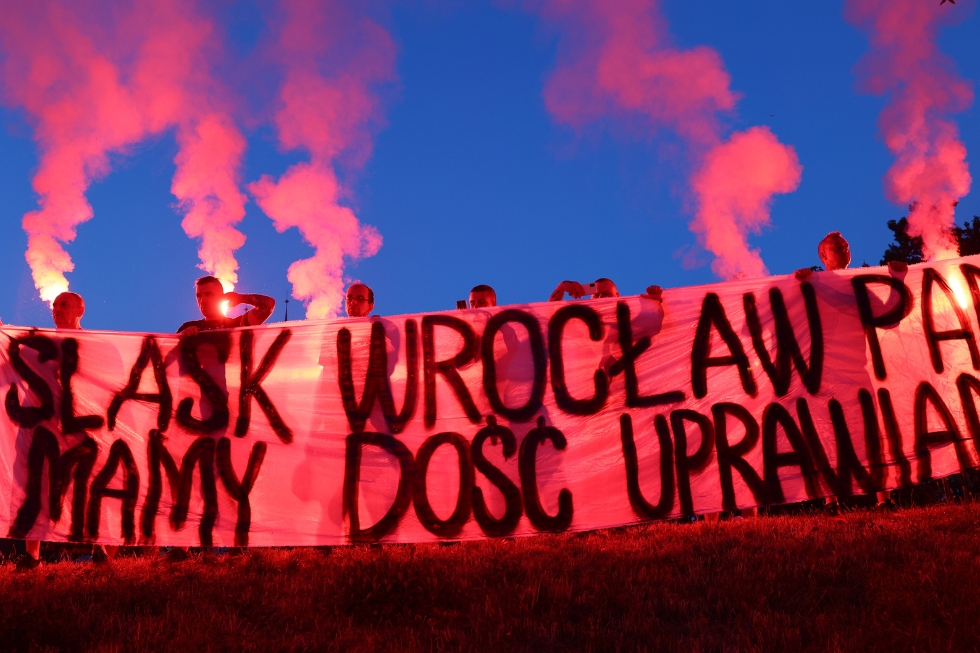



On May 26, Ukrainian President Volodymyr Zelenskyy gave a special operations unit in the Ukrainian military the honorary title “Heroes of the Ukrainian Insurgent Army [UPA],” a reference to the organization of the same name from the 1940s. Many members of this partisan band are considered heroes by part of Ukrainian society, but are despised in Poland due to atrocities its men committed in the Second World War.
The reaction from Poles was overwhelming: President Karol Nawrocki stripped Zelensky of the Order of the White Eagle that Poland had awarded him at the start of Russia’s invasion of Ukraine in 2022. The famed Polish union leader and former president Lech Wałęsa removed the Ukrainian flag he had been wearing on his lapel in public. Hostility from Poles towards Ukrainians soared, and officials in Warsaw have now said that they will reconsider their support for Ukrainian membership in NATO and the EU.
For their part, Ukrainian officials and former presidents have returned fire, claiming that the unit renaming was not meant to offend Poles and insisting that Poland has overreacted. Additionally, some Ukrainians have argued that Poland has not been willing to acknowledge its own past, overlooking past atrocities committed by the Polish-Lithuanian Commonwealth and the 2nd Republic.
Several Ukrainian diplomats and former presidents returned awards that they had received from Poland in response to Nawrocki’s decision. So far, neither side is willing to back down from the impasse, causing a significant crisis in the middle of Ukraine’s most perilous moment since regaining independence in 1991.
Most Westerners, apart from those with an interest in Eastern European history or people with ancestral ties to the region, do not understand the historical rivalry between Poles and Ukrainians. To most people without a stake in these disputes, it seems like just another undying ethnic rivalry.
However, there is something deeper at play here: an inability to reconcile historical narratives that is exacerbating a serious geopolitical crisis. It is extremely unlikely that Ukrainians and Poles will be able to create national narratives completely acceptable to both countries. Therefore, both countries will ultimately need to acknowledge this reality to move forward.
The atrocities in Volhynia and Galicia
Before the Second World War, Poland had control over a large swath of territory in Eastern Europe containing large non-Polish communities, including an estimated five million Ukrainians. Its control over Eastern Galicia and Volhynia embittered Ukrainian nationalists, who saw those territories as part of the Ukrainian nation. As part of an effort to rehabilitate Ukrainian statehood, the hardline Organization of Ukrainian Nationalists (OUN), formed in 1929, began to launch a series of attacks on Polish and Soviet government targets.
This led to a systemic crackdown on Ukrainians in Poland and the USSR, including the 1930 “Pacification” of Ukrainians in eastern Poland and the Soviet deportations of Ukrainian intelligentsia to Siberia. OUN began to turn to Germany (both the Weimar and Nazi governments) for help, intending to establish a Ukrainian state that included most of Galicia and Volhynia.
By the time WWII broke out, OUN offered to help Germany with its dismemberment of Poland and its subsequent invasion of the Soviet Union. It formed several battalions of men that acted as police in Axis-controlled territories. Its leaders, including men such as Stepan Bandera, Andriy Melnyk, Roman Shukhevych and Yaroslav Stetsko, explicitly aimed to create a Ukrainian state dominated by one party with as few minority groups in it as possible. This ran contrary to Axis war aims in Ukraine, which aimed to colonize and partition the territory. Thus, the Germans began arresting many of OUN’s leaders and loyalists and imprisoning or executing them.
In 1942, OUN formed the Ukrainian Insurgent Army, whose combatants sought to fight several different enemies at once: the Germans, the Soviets, the Hungarians, the Romanians and the Polish resistance. In the process, they began targeting Polish villages in Galicia and Volhynia, aiming to kill and expel as many of the Poles as possible. This became UPA’s most infamous action of the war, involving the mass slaughter of civilians.
Often, the killings were done by peasants using farm tools, reminiscent of the Interahamwe’s killings in Rwanda in 1994. From the spring of 1943 to mid-1945, UPA killed anywhere between 60,000 and 90,000 ethnic Poles. When the war ended, the Soviets cracked down ruthlessly against the UPA, but also seized Eastern Galicia and Volhynia from Poland and gave them to the Ukrainian SSR.
The Polish resistance and postwar government also exacted a brutal revenge against the Ukrainians. Elements of the Polish Home Army, Poland’s main resistance organization, massacred several Ukrainian villages, killing around 15,000 to 30,000 people. After the war, the Polish state expelled over 150,000 Ukrainians from its territory in Operation Vistula. Only the start of the Cold War and Soviet dominance in Eastern Europe led to an end to the hostilities.
The unburied dead and the competition of stories
When Ukraine gained independence from the USSR in 1991, Poland was the first country to recognize the new state. Both countries were eager to establish close ties with their neighbors and grow their economies and governing institutions. However, the wounds from the atrocities in Volhynia and Galicia remained unhealed thanks to the refusal by both the Soviet and Polish governments to acknowledge what happened there during the Cold War.
The perception of the UPA as martyrs for the cause of independence grew within Ukraine, fueled by the search for national heroes and the enduring influence of the OUN over the Ukrainian diaspora. Statues of Bandera, Melnyk, Shukhevych and other UPA members went up all over Ukraine, and UPA’s veterans became eligible for state pensions in 2019.
For Poles, this was seen as a deeply offensive act that betrayed the trust between both countries. The UPA is considered a terrorist organization by Poles due to its massacres of Poles during the war. In 2016, the Sejm (Poland’s lower house of parliament) passed a resolution claiming that the Volhynia and Galicia massacres constituted a genocide. The Poles also insisted that Ukraine allow forensic teams onto its territory to conduct exhumations. There had been sporadic searches, but they had been halted by the Ukrainian government in 2017 due to the Polish destruction of a UPA memorial on Polish soil.
When Russia invaded Ukraine in 2022, Polish support for Ukraine was so overwhelming that the tensions between the two countries almost evaporated. It seemed as if the Galicia-Volhynia atrocities had all been forgotten. However, Polish demands for the renewal of exhumations resurfaced, leading to an agreement in 2025. In exchange for Polish forensic teams being allowed back into Ukraine, Ukrainian teams could identify unmarked graves with their countrymen’s bodies on Polish territory.
However, many Poles became convinced that Ukraine was slow-walking the process and the election of Karol Nawrocki in 2025 highlighted how the massacres remain a major part of Polish national memory.
For Ukrainians, the Polish demand for Ukraine to recognize the atrocities as genocide, more exhumations and an end to the glorification of the UPA is seen as a bar to normalized, close relations. Officials in Kyiv have often referred to the massacres as the “Volyn tragedy,” a term that Poles reject. Additionally, many Ukrainian officials (such as former foreign minister Dymytro Kuleba) believe that the Polish reaction is based solely on partisan politics. Thus, the outrage over Ukraine’s decision to commemorate the UPA elicited many eyeroles from Ukrainians.
No reconciliation on the horizon
National remembrance in both Poland and Ukraine is a controversial topic. In 2018, Poland came under intense criticism for a law regulating how the Holocaust could be discussed. While the election of Donald Tusk’s liberal coalition government eased some of the external anger, many Poles still believe that there is a desire on the part of foreigners to judge how Poland tells its national story.
This has become a major problem in Polish elections and is playing into debates about future aid to Ukraine. There is less willingness to acknowledge the historical grievances that Ukrainians had with the Polish government’s policy towards them.
Poland retains considerable leverage over Ukraine. Its decision to provide substantial backing to the Ukrainian military and its acceptance of well over two million refugees at the start of the war means that Ukraine owes Poland a considerable debt. Additionally, Poland has a say over Ukraine’s possible membership in the EU and NATO. Therefore, much of the Polish electorate has been demanding increased pressure on Kyiv to force Ukraine to stop glorifying the UPA.
This is not just a right-wing phenomenon: even left-wing politicians in Poland like former Prime Minister Leszek Miller and current Member of Parliament Anna Maria Żukowska publicly denounced Zelensky’s decision, though they opposed stripping Zelensky of the Order of the White Eagle. Polish demands remain the same: Ukraine needs to stop honoring OUN and agree to acknowledge that the Volhynia/Galicia killings were an act of genocide.
Whereas in prior years, Ukraine was more willing to talk about joint commemorations for the victims of the violence perpetrated by both Poles and Ukrainians, Kyiv has now decided to defy Polish demands, irritated by Warsaw’s perceived haughtiness. On June 28, President Zelensky sent a bill to the Verkhovna Rada that authorized the creation of a national pantheon of heroes.
Both he and his chief of staff, Kyrylo Budanov, stated that Ukraine would not listen to outside demands regarding who Ukraine honors as national heroes. While Ukraine is likely to allow the exhumations to continue, it will almost certainly not meet most of Poland’s demands over this issue. As far as Kyiv is concerned, its people’s sacrifices during the current war in the name of defending Europe from Russia’s aggression have more than made up for any atrocities committed by Ukrainians against Poles in the past.
The way forward
So where do both countries go now? Some minor forms of reconciliation are possible: In 2023, Zelensky and the former Polish President Andrzej Duda visited a Catholic church in the city of Lutsk, Ukraine, where they lit candles in honor of the memory of the dead. Previously, Polish and Ukrainian leaders jointly commemorated the victims of Operation Vistula. Since then, however, the distance in both nations’ perspectives has grown further apart.
Small-scale events honoring the memory of Poles and Ukrainians killed fighting each other can offer some measure of healing. Additionally, Brussels can step in to force both countries to refocus their efforts on forcing Russia to stop its invasion and deterring it in the future. By granting Polish firms a significant stake in its reconstruction efforts, Ukraine could help shift Poland’s perspective, reframing the relationship around economic partnership and commercial opportunity rather than a bitter historical feud.
Ukraine should at least understand the hostility towards its decision to honor OUN/UPA. This organization proved to be remarkably brutal during its existence; not only did its supporters kill Poles, but they also killed Jews, Roma and other Ukrainians who didn’t support their ideology. Ironically, its founders likely would not have cared much for Zelensky, a Jew who spent much of his formative years speaking Russian and who had relatives in the Red Army during the war.
Ukraine may be willing to honor its national heroes without external pressure, but its people should be cognizant of why OUN was such a controversial organization. This is not a new phenomenon; the United States honors many Civil War-era generals even though they committed atrocities against Native American tribes after the war ended.
However, Polish demands that Ukraine completely disavow OUN and condemn the Volhynia/Galicia atrocities as genocide are unrealistic. If anything, they have contributed to a rally-around-the-flag effect. Ukrainian politicians, who previously argued in favor of making concessions to the Poles, are in little mood to answer Warsaw’s demands, lest that lead to a backlash from ordinary Ukrainians.
As the Polish far-right is becoming more politically salient and attacks on Ukrainian refugees increase, many Ukrainians are willing to tell their Polish counterparts to “clean up their own house.” Thus, both Poland and Ukraine desperately need to change their approaches to this issue. If they don’t, the only victor in this diplomatic exchange will be Moscow.
[Casey Herrmann edited this piece]
The views expressed in this article are the author’s own and do not necessarily reflect Fair Observer’s editorial policy.
FO° Exclusive: Poland: Nationalist Nawrocki Sworn-in as Russia–Ukraine War Rages On
To begin the June 2025 episode of FO° Exclusive, Atul and Glenn cover a month marked by heightened geopolitical tension,...
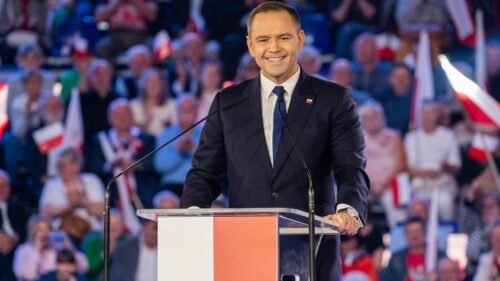
Karol Nawrocki Becomes President in a Divided Poland
Karol Nawrocki narrowly won Poland’s 2025 presidential election after voters turned against Prime Minister Donald Tusk’s government for failing to...
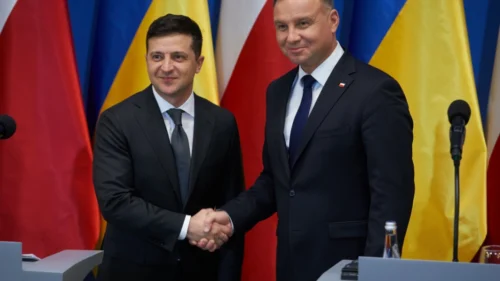
Poland and Ukraine: A Partnership Forged in Resilience
As the Russian invasion of Ukraine continues, Poland remains one of Ukraine’s staunchest allies in terms of both defense and...
Support Fair Observer
We rely on your support for our independence, diversity and quality.
For more than 10 years, Fair Observer has been free, fair and independent. No billionaire owns us, no advertisers control us. We are a reader-supported nonprofit. Unlike many other publications, we keep our content free for readers regardless of where they live or whether they can afford to pay. We have no paywalls and no ads.
In the post-truth era of fake news, echo chambers and filter bubbles, we publish a plurality of perspectives from around the world. Anyone can publish with us, but everyone goes through a rigorous editorial process. So, you get fact-checked, well-reasoned content instead of noise.
We publish 3,000+ voices from 90+ countries. We also conduct education and training programs
on subjects ranging from digital media and journalism to writing and critical thinking. This
doesn’t come cheap. Servers, editors, trainers and web developers cost
money.
Please consider supporting us on a regular basis as a recurring donor or a
sustaining member.
Will you support FO’s journalism?
We rely on your support for our independence, diversity and quality.





Comment