


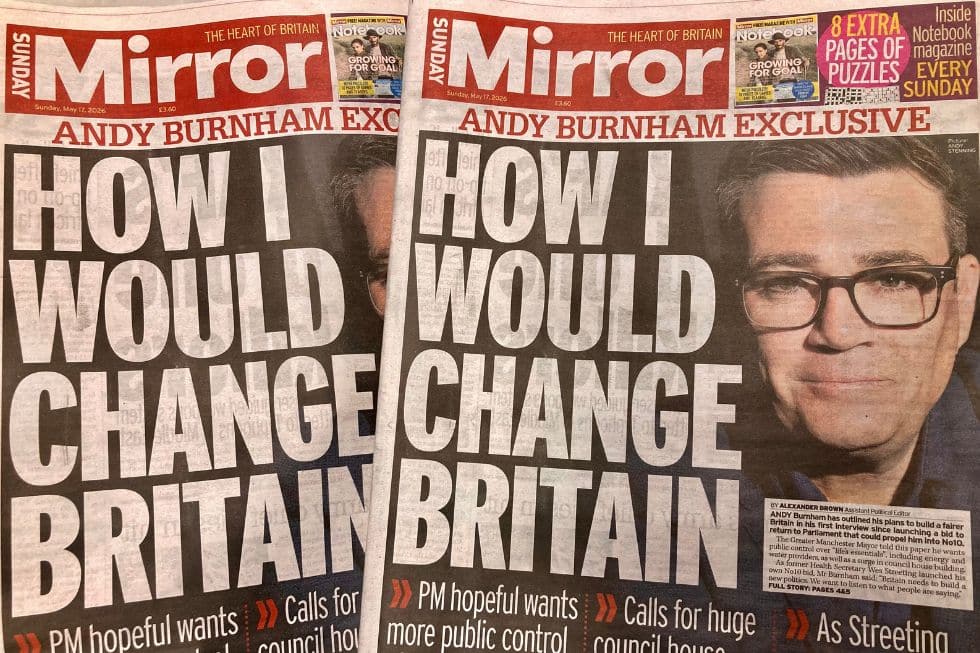



From the moment he opens his mouth, it’s clear there’s something different about Andy Burnham, the UK’s unlikely political phenomenon and Prime Minister (PM) in waiting: Burnham doesn’t sound the way prime ministers are supposed to.
Great Britain has churned through six heads of government in the past decade, installing and quickly discarding leaders of differing parties, philosophies, ethnicities and genders. But one thing has stayed constant throughout: the PM’s tone of voice. Listeners — even American listeners like me — can’t mistake the posh, Oxbridge elocution of England’s upper class, which instantly conveys that the speaker was bred to rule Britannia in spare moments between squash matches and cocktails.
So, when Andy — everyone calls him that, just “Andy” — picks up a microphone, it shocks the ear that he talks a bit like the former Beatle Ringo Starr. And Burnham’s accent — the voice of a middle-class boy from England’s hard-pressed, postindustrial North, around Manchester and Liverpool — is merely the tip of a political and cultural iceberg.
After a runaway victory in his June parliamentary election, Burnham took only hours to force the resignation of incumbent Prime Minister and fellow Labour Party member Keir Starmer. He has also waged open, if civilized, warfare with former Prime Minister and Labour elder statesman Tony Blair over their party’s foundational principles and standing with the British public. And he’s announced unprecedented plans to restructure the national government by implementing a political ethos that has been dubbed “Manchesterism.”
But Burnham’s ambition reaches even farther. When he formally ascends to the leadership of Labour, England’s historically dominant center-left party, Burnham will confront a wave of hard-right, conservative populism that over the past decade has swept not just Great Britain but Western Europe, the US, South America and points beyond. After ten years of global futility, Burnham is proposing Manchesterism as a new brand of left-leaning counterpopulism, a formula for reconnecting traditional liberal parties throughout the West with those working- and middle-class voters who have defected in droves.
Like his recent predecessors in 10 Downing Street, Burnham confronts huge obstacles, and it’s anyone’s guess whether he can make Manchesterism work. But his success or failure will determine more than just the direction of England. It’s likely to influence the 2028 US presidential election and the shape of politics in beleaguered capitals around the West.
A different kind of populist emerges
Viewed from a certain angle — the vantage often occupied by his partisan and ideological detractors — Andy makes for an unconvincing populist. He has spent more than 30 years in politics — nearly all his working life — and for the first 20 of those he built an utterly traditional, establishment-ordained resume: Cambridge University graduate, parliamentary staffer, Member of Parliament, Cabinet posts under multiple prime ministers and two unsuccessful campaigns to occupy the top job himself.
Then came the moment that exploded European politics and Burnham’s career: June 23, 2016, the day that British voters voted to pull their country out of the European Union. The Brexit referendum was driven by a fiery brand of anti-globalist, anti-immigrant, socially conservative populism that, until that moment, had been held to the margins of English politics. Britain’s then-Prime Minister, David Cameron, and most of his Conservative Party’s hierarchy joined hands with prominent Labourites to vehemently oppose Brexit. They were stunned when a ragtag coalition anchored in the countryside and led by a splinter-party politician named Nigel Farage eked out an angry victory.
Elsewhere in the world, Brexit seemed to open the floodgates. A similar right-wing uprising ripped through American politics just a few months later, when Donald Trump was elected US President. The fever would eventually spread to France, Italy, Germany, Hungary, Brazil, Argentina and other Western democracies. For the next ten years, establishment politicians and liberal parties throughout the West would flail aimlessly and fail to contain — or even clearly comprehend — this outsiders’ uprising.
For Burnham, Brexit was the last straw — or so he thought. Deeply disillusioned by the Labour Party’s failure to mount an effective anti-Brexit campaign, and increasingly uncomfortable in London’s halls of power, Burnham shocked his colleagues by abandoning Parliament and standing for election to become mayor of Greater Manchester. This was widely interpreted as some form of surrender or self-deportation.
In Britain, political decision-making over many aspects of the nation’s daily life is tightly centralized and placed in the hands of Parliament, known colloquially as Westminster, and the country’s professional civil service, or Whitehall. Local governments historically have been granted limited power and even less money. And, while London and Manchester are separated by a 200-mile drive, the cultural distance between them is far greater. To say that London’s governing class views gritty, blue-collar Manchester as unfashionable is an exercise in classic English understatement. Burnham seemed like a Premier League football star who suddenly quit to join a third-tier squad in Wales.
But then something odd happened. Parliament spent the next decade trying to sort the wreckage of Brexit and managed only to enrage the British public even further. Burnham spent the next decade trying to revive the fortunes of downtrodden Manchester and managed to become the most popular politician in England.
Manchester as Burnham’s political proving ground
After Brexit, as myriad prime ministers shuffled ineffectually through 10 Downing Street, the public’s attitude toward them never wavered: They detested every one. Five consecutive Conservative PMs were evicted in failure, including Boris Johnson, the former mayor of London noted for his theatrically ridiculous haircut and countless scandals, and Liz Truss, whose first and only proposed budget so terrorized financial markets that she was ousted in about six weeks.
When parliamentary elections were held in 2024, public revulsion propelled Labour to a historic majority — about two out of every three seats in the House of Commons. Yet their mandate evaporated in months. Prime Minister Starmer avoided scandal but committed a series of punishing political missteps and his party was routed in elections for local offices this spring. Starmer’s tenure amounted to a screaming, rollercoaster plunge from the heights at which it began.
The chief beneficiary of this unbroken chaos has been Farage, the Brexit leader, who has steadily built his Reform Party into a national political force. Some polls predict that, if parliamentary elections were held today, Farage would become prime minister. So, in June, panicked Labourites threw Starmer overboard and frantically grasped for someone, or something, that a chronically disaffected electorate might actually like.
The someone that they came up with was Andy Burnham. And the something that they found was buses. Specifically, yellow buses.
If there is a single image that launched Burnham on the road from Manchester back to Westminster and captures the essence of Manchesterism, it is one of Manchester’s bright yellow Bee Line buses, the most visible hallmarks of Burnham’s time as mayor. By now, Burnham has retold his version of the Bee Line story countless times.
In the 1980s, under Conservative Prime Minister Margaret Thatcher, the “Iron Lady,” bus services in Manchester and other major cities were divested from local government ownership and sold off to private companies. Over the years, service deteriorated dramatically while prices soared. After taking office, Burnham established a franchise system that enabled his government to force improvements in bus operations. He set a maximum ticket price of £2 ($2.67) to travel anywhere in the Manchester area. And he slapped a coat of yellow paint on the entire fleet to ensure his changes would not go unnoticed.
They didn’t. The fact that anyone, anywhere in government might be able to accomplish anything, to bring about even a small tangible improvement in daily life, caught the Manchester public’s fancy. Burnham spent his days tightening the nuts and bolts of municipal machinery, bringing a pragmatic, nonideological approach to his job that he called “putting place ahead of party.” His approval ratings shot skyward and an approving buzz spread south. Soon enough, Burnham acquired a new nickname back in Westminster: “King of the North.”
Nowadays, detractors are quick to sneer that fixing a bus line does not qualify Burnham to manage Britain’s economy or conduct foreign affairs. And if you’re looking for clues regarding how he would undertake either of those imposing tasks, you’ll find few. Throughout his parliamentary campaign — and in the 2024 book he coauthored with his friend, Liverpool Mayor Steve Rotherham, Head North — macroeconomics and diplomacy earned barely a mention.
But this is precisely the point where the political contours of Manchesterism clearly emerge. While the establishment ponders the fate of the globe — and patronizingly insinuates that a provincial mayor is too small to wear the mantle of prime minister — Burnham and his supporters are preoccupied with the sorry state of affairs at home. A decade after Brexit, many Britons, particularly those in the hinterlands, feel no less fleeced and abandoned by the forces of globalism and remain no less pissed off about it.
But unlike Farage and his fellow Brexiteers, who directed public anger at EU edicts emanating from Brussels and a stream of multiethnic immigrants changing the face of British society, Burnham has identified a new villain: Westminster and the anonymous bureaucrats of Whitehall. And unlike the racially charged, scapegoating rhetoric of Brexit, Burnham calmly maintains that he not only feels the public’s frustration but can actually make things better.
Burnham sums up the foundations of Manchesterism in a single word: inequality. (In the US, the Democratic Party has landed on a somewhat analogous title for its ongoing campaign against President Trump’s economic policies: affordability.) Manchesterism includes a detailed policy agenda to shrink the economic gulf separating struggling towns like Manchester and Liverpool from the burgeoning prosperity of London. But more broadly, Manchesterism is a frontal assault on the cultural slights and ancient insults of Britain’s class system. As Burnham tells it, that is a campaign he has waged for much of his life.
The personal roots of Manchesterism
Populist movements and their leaders often are defined less by what they are than by what and who they are not. Burnham has gone to some lengths to describe who he is not. Take, for example, his Cambridge degree. Burnham turns this unassailable credential of England’s ruling class on its head, explaining that while he may have graduated from Cambridge, he never fully belonged there.
The son of a telephone company employee and a receptionist, and the first in his family to attend university, Burnham wrote in Head North that “my first interview at Cambridge makes me cringe even now.” Burnham aspired to St. Catharine’s College, one of Cambridge’s 30 or so semi-autonomous constituent colleges, founded in the 15th Century. He describes ascending a stone staircase, entering a wood-paneled room and encountering a professor who proffered him a glass of sherry. “The professor asked me whether I saw any parallels between The Canterbury Tales and a modern package holiday,” Burnham recalled. “I was still pondering what the question meant when the rejection letter dropped on the doormat a few days later.” He was granted a second interview by Fitzwilliam College, which was founded 400 years after St. Catharine’s specifically to enroll less-privileged students for whom Cambridge had theretofore been off-limits. Burnham was dogged by “impostor syndrome” as a student at Fitzwilliam, he wrote, and needed years to feel even remotely comfortable.
Twenty-five years ago, in his maiden speech to Commons after he was elected to represent a Manchester-area constituency, he set out some of the same themes he sounds today. He had barely entered office when a major industrial concern announced plans to close a local plant and move 250 jobs to Eastern Europe. “I am worried that an air of inevitability is growing around the loss of manufacturing jobs in Great Britain, with the use of vague terms such as market forces and globalization,” he said. “This is dangerous.”
But the defining moment of his parliamentary career came in 2009, on the 20th anniversary of the infamous Hillsborough disaster. On April 15, 1989, two traditional pillars of English football (or soccer, as we Americans would have it), Liverpool and Nottingham Forest, met for a high-stakes match at Hillsborough Stadium in Sheffield. More than 50,000 people were crammed into quarters far too small to accommodate them safely, and a catastrophic human crush occurred in a standing-room section filled with Liverpool fans. Ninety-seven people were killed.
In the following days, local police claimed that the deaths were caused by drunken Liverpool supporters who forced their way into the stadium and assaulted officers. But the people of Liverpool, including fans who attended the game and witnessed everything, vehemently disputed this version of events and never accepted it. Two decades later, emotions still ran so raw that a commemoration ceremony drew more than 30,000 people who greeted a representative of British Prime Minister Gordon Brown with catcalls and jeers. That representative was an ashen-faced Andy Burnham.
The next day, Burnham prevailed on his boss to open a new investigation into Hillsborough. The official findings concluded that police not only committed gross negligence and mismanaged the crowd in ways that directly caused the disaster but subsequently lied and doctored witness statements to conceal their culpability. The actions of Liverpool fans were not a contributing factor.
For Burnham, the realization that Liverpool had been denied the truth about Hillsborough for more than a generation was a turning point. “I always say that I took my first steps out of Westminster on 15 April 2009,” he wrote in Head North. “Things would never be the same after that day. I had experienced the way our political system fails people in a very personal way … The spell was broken and I had fallen out of love with Westminster.”
Even now, as he returns in triumph, Burnham is keeping one foot outside Westminster, both symbolically and literally. In late June, he made his first speech after Starmer’s resignation, appearing in Manchester and attired in the uniform he adopted while mayor: blazer and collarless t-shirt, sans necktie. As he tugged his jacket, he cracked, “It’s been such a wrench to leave that I’ve had to get special permission for what people in Westminster call my Manchester clothes.” And he announced that, as prime minister, he would split his workweek between London and Manchester, establishing a satellite office he dubbed “Number 10 North.”
Just as he painted Manchester’s refurbished buses bright yellow, Burnham is creating an image of himself as an outsider rather than an insider, maintaining personal distance from the power structure he is about to take over. It is a dance on a political highwire, a sophisticated exercise in having things both ways. If Farage and his Brexiteers were content to cast themselves as pitchfork-wielding villagers storming a decadent castle, Burnham is suggesting that he is an ordinary bloke who can make government do extraordinary things. Should he succeed in moving Manchesterism from rhetoric to reality, the result might indeed be extraordinary.
From local success to a national governing vision
The most detailed roadmap of Manchesterism is Head North, Burnham’s hybrid book that combines personal biography and political manifesto. (In populist movements, the two are virtually always intertwined.) Head North is constructed as a series of conversations between Burnham and his close pal and political doppelganger, Rotherham. It reads a bit like the script of an old-fashioned, Hollywood buddy movie — think Bob Hope and Bing Crosby, or Paul Newman and Robert Redford — that follows the high jinks of two slightly mismatched besties as they trade quips, bond and somehow carry the day.
Burnham and Rotheram never met as boys but grew up close by each other around Liverpool, both in working- or middle-class families. They shared similar passions: Rotheram is a maniacal Liverpool fan who survived the Hillsborough disaster, and Burnham is equally devoted to Liverpool’s underdog, cross-town rival, Everton. But while Burnham chose academics and Cambridge, Rotherham entered the trades and emerged with the rough hands of a brick mason. He eventually followed his father into Liverpool local politics, earned a degree and landed on the Liberal benches of Parliament around the same time as Burnham. They became close personally but continued along different career tracks. Burnham was tapped for leadership; Rotherham deployed his acid, blue-collar wit to get under the skin of his Tory antagonists.
Their professional lives converged in mutual disgust about the time of Brexit. Rotherham was the one to suggest that the two quit Parliament and seek to lead Liverpool and Manchester; after some convincing, Burnham agreed. They had different personalities and temperaments, but possessed a shared vision for their cities and were attacking very similar problems. From the beginning, they relied on each other as sounding boards, allies and mutual cheerleaders. The results suggest that their partnership produced something even greater than the sum of its parts.
As mayors, they gradually forged the policy and political project that others would later name Manchesterism. An equally descriptive title could have been “Way Less Westminster.” Unsurprisingly, it has not gone over well in London. As Burnham was circling shark-like around Starmer in late May, former Prime Minister Tony Blair weighed in with a 5,000-word essay entitled, “The Labour Party Is Playing With Fire Over Its Future and the Future of the Country.”
Blair argued that the real problems facing Labour and Britain are not “the Westminster bubble” (a favorite Burnham catchphrase) or Starmer’s milquetoast personality. “We don’t have a worked-out, coherent plan for the country in a fast-changing world,” Blair opined, referencing “epochal change in the geopolitical order” and “the technology revolution led by developments in artificial intelligence.” So, as former prime ministers will do, Blair offered his own ten-point program, which included “adaptation to an AI world,” “a Reimagined State” and plenty more Great Big Ideas. Not one of his 5,000 words was “inequality.”
Burnham may well have picked this fight a few days earlier when he declared his intent to end “40 years of neoliberalism,” a movement with which his former boss is inextricably linked. And he wasted no time swinging again in The Times, saying Blair had fundamentally missed the point. “The fall in the living standards of millions, and the reality that life has got harder for most year on year since the financial crash in 2008, is, I believe, the gaping omission in his analysis,” Burnham wrote. Theirs was less a philosophical dispute than a clash of world views. Blair was gazing down on the future from 30,000 feet; Burnham was watching it unfold at street level.
Indeed, Manchesterism is designed to produce clear, concrete changes that average citizens, particularly those outside London, can see and feel. The top of Burnham’s agenda is “devolution,” a bland euphemism for snatching some major programs away from Westminster and Whitehall and handing them over to local governments and officials like, well, mayors. During the covid epidemic, then-Prime Minister Johnson imposed quarantine rules and funding levels on Manchester that Burnham blasted as imperious and egregiously unfair but was powerless to change. It was a searing experience, and he appears intent on restructuring a consequential portion of national government to prevent similar episodes in future.
And as wonky as it sounds, devolution could turn out to be clever politics. The unofficial slogan of the Brexit movement was “Take Back Control;” Burnham describes devolution in similar terms. “Let me say this directly,” he has vowed. “The days of Whitehall fighting the devolution of power to the nations and regions are over for good.” If devolution leads to more success stories like Manchester’s Bee Line, a jaded electorate just might perk up. And that, in turn, could help Labour take back control of political territory now occupied by Farage and his Brexiteers.
Can Manchesterism revive the center-left?
Another key element of Manchesterism, education reform, springs directly from the life experiences of Burnham and Rotheram, and the lingering injuries of class. For university-bound students like Burnham, the British educational system offers a clearly delineated path toward their goal. But for Rotheram and others like him, there are few options, and all feel decidedly second-rate. Burnham wants to create a technical and trade education track that is on par with its academic counterpart: organized, rigorous and respected. On this subject, he scarcely contains his anger.
“The different paths that Steve and I took in life, even though we were born only three miles apart, are an illustration of Britain’s two worlds and its great social divide,” Burnham wrote in Head North:
Steve was clearly capable of attending a top university, as were my parents, but his life circumstances, the era in which he grew up, and an education system which was then, and is still now, very responsive to the influence of class, social connections and money meant it was probably a non-starter … In England, there has always been a serious snobbery at play when it comes to education.
There’s more. Noting that over 1 million people are on waiting lists for council houses — what Americans would call public housing — he has vowed that “Number 10 North will oversee the biggest council-house building program since the post-war period.” He wants to pass a Hillsborough law requiring police and public employees to answer questions truthfully the first time they are asked. Oh, and the UK’s historically famous lack of a written constitution? Burnham wants to write one. (That last will stay on the back burner for now.)
There are a few small details that Burnham has yet to suss out. Such as, how does he plan to pay for his programs at the same time the country needs a huge increase in defense spending? And how will he respond when the inevitable foreign crisis rears its head and knocks him off-script? His answer to date: Stay tuned.
But Burnham argues persuasively that the stakes of his bet on Manchesterism are enormous. After a decade of governmental fecklessness, Burnham positions his regime as Labour’s last chance to get right with an exhausted electorate. Farage and his Reform Party are clamoring for new parliamentary elections, which must take place no later than three years from now, and the clock is ticking toward a liberal political nightmare. The parallels between Farage and Trump are obvious, and Burnham speaks of a potential Farage administration as looming dystopia, or worse, something akin to Trump’s America.
There are equally clear parallels between Burnham’s efforts to articulate and operationalize Manchesterism in England and the struggles of progressive political parties throughout the West to find their own winning strategies. The next US presidential election is more than two years away, but America’s Democratic Party is already caught up in an intense struggle to choose its candidate to succeed Trump.
A handful of state governors who reside well away from Washington are positioning themselves as political insurgents and champions of the common folk. These aspirants — who include Pennsylvania’s Josh Shapiro, Illinois’s J.D. Pritzker, California’s Gavin Newsom and Kentucky’s Andy Beshear — find little of merit “inside the Beltway,” a phrase that literally refers to the highway network encircling Washington but is the rhetorical equivalent of Burnham’s “Westminster bubble.” Shapiro proudly and profanely fashions himself as a guy who can “get shit done.” There’s little question that they and their rivals will be monitoring how Burnham gets on at Number 10 North. And taking notes.
The ultimate test for Manchesterism
As Burnham prepares for his first day at the new job, he has faced intense speculation about every aspect of his plans, so it was no surprise when a journalist pressed him on one of his urgent priorities: football. Burnham is on schedule to formally take office the day after the final match of the World Cup. So, if England wins, he was asked, would he declare a bank holiday — that is, give the whole country a day off? “I think we might be getting ahead of ourselves,” a grinning Burnham replied. “We do have to live in hope. But it might be a bit premature to be speculating (about an England victory). We can hope and pray that it happens.” And then, invoking the long-running travails of his beloved Everton, he added, “I am an Evertonian. I don’t bank on anything when it comes to football.”
Burnham could just as easily have been assessing his own prospects, and those of Manchesterism. His improbable journey from Westminster to Manchester and back again has defied convention and been propelled by a singular political vision, a contrarian sensibility and a share of luck. Burnham will need all those and more on the road ahead.
[Kaitlyn Diana edited this piece.]
The views expressed in this article are the author’s own and do not necessarily reflect Fair Observer’s editorial policy.
Why is Britain not Feeling the Anti-Trump Backlash?
The reelection of US President Donald Trump challenged the West but benefited left-wing parties in Canada and Australia, who gained...

Nigel Farage is Ushering in a New Era in British Politics
Nigel Farage, the leader of Reform UK and the political strategist behind Brexit, has gained support by tapping into Britain’s...
FO° Talks: A Reform UK Perspective on British Politics
Martin Lonergan of the Reform UK party wants to “Make Britain Great Again.” He advocates for a center-right, free-market approach...
Support Fair Observer
We rely on your support for our independence, diversity and quality.
For more than 10 years, Fair Observer has been free, fair and independent. No billionaire owns us, no advertisers control us. We are a reader-supported nonprofit. Unlike many other publications, we keep our content free for readers regardless of where they live or whether they can afford to pay. We have no paywalls and no ads.
In the post-truth era of fake news, echo chambers and filter bubbles, we publish a plurality of perspectives from around the world. Anyone can publish with us, but everyone goes through a rigorous editorial process. So, you get fact-checked, well-reasoned content instead of noise.
We publish 3,000+ voices from 90+ countries. We also conduct education and training programs
on subjects ranging from digital media and journalism to writing and critical thinking. This
doesn’t come cheap. Servers, editors, trainers and web developers cost
money.
Please consider supporting us on a regular basis as a recurring donor or a
sustaining member.
Will you support FO’s journalism?
We rely on your support for our independence, diversity and quality.





Comment