


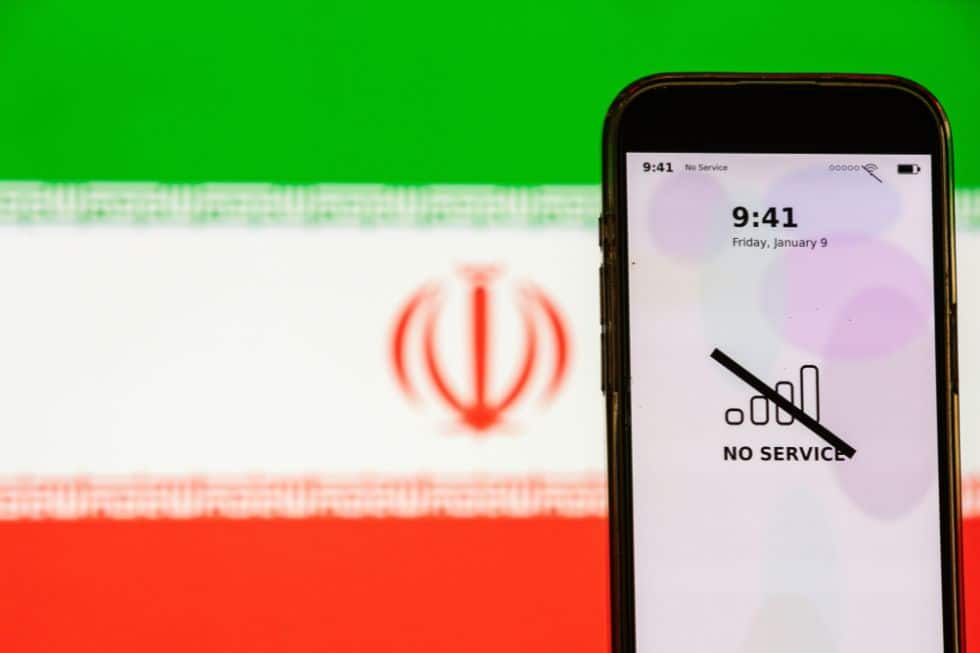



Since Saturday, I have finally been hearing from family and friends inside Iran for the first time in months. The messages arrive unevenly. Some disappear midway through conversations, others come through hours later. Certain apps work briefly before failing again. A relative responds with only a few words before going silent once more. Even reconnection itself feels fragile and conditional.
The regime shut down access to the Internet on January 8, 2026, as it met nationwide protests with a brutal crackdown and massacre that claimed the lives of thousands of unarmed civilians. This was the world’s longest Internet blackout.
Outside Iran, headlines frame this moment as a “restoration” of Internet access amid ongoing military escalation and political turmoil. But for many Iranians, the lived reality feels far more complicated than the language of reconnection suggests.
People emerged from prolonged informational isolation into an atmosphere still shaped by fear, surveillance, instability and emotional exhaustion. Communication remains inconsistent. Trust remains fractured. And beneath the technical discussion of bandwidth, restrictions and access lies a deeper psychological reality that is far more difficult to measure: What happens to individuals, families and entire societies when connection to one another becomes chronically interrupted?
How Iranians have endured
In reality, for many Iranians, the Internet never fully “returned” in the way outside audiences may imagine. Access still depends heavily on virtual private networks (VPNs) used to bypass government filtering systems. They have become increasingly expensive, unstable and temporary. Once authorities identify widely used circumvention tools, they often block them, which forces citizens to purchase new ones repeatedly to maintain ordinary communication with the outside world.
Even sharing which VPN currently works has become difficult, as the landscape changes constantly. A VPN that functions one week may become useless the next. People are constantly trying new ones, sharing names with each other and hoping they work for at least a little while. For many families already under economic strain, the rising cost of reliable circumvention technology now determines who can remain connected and who cannot.
In this sense, the recent “restoration” of Internet access has not marked a return to open connectivity. For many Iranians, it has simply meant a return to the fragile and exhausting conditions that existed before January: slowed Internet, unstable access, constant filtering and the ongoing emotional labor of navigating systems designed to make connection unreliable.
For those outside the country, Internet shutdowns are often understood primarily as political tools or technological events. For Iranians living through them, however, they become relational and psychological events as well. A disappearing checkmark on a messaging app does not merely indicate a lost signal, but uncertainty about safety, survival and reality.
During prolonged shutdowns, families outside Iran refresh applications compulsively, searching for signs of life from loved ones they cannot reach. Conversations become fragmented into moments of panic and temporary relief. Information circulates incompletely and often without verification. Videos emerge in fragments, detached from context, while audiences simultaneously confront another modern problem: the growing suspicion that what they are seeing may not be real.
Psychological damage
What makes this dynamic psychologically affecting is not only the absence of information, but the collapse of continuity itself.
Human beings regulate themselves through predictable relational contact. We orient ourselves to one another through routines of response, communication and presence. Under ordinary circumstances, a delayed text message is an inconvenience. Under conditions of political violence, war and state-imposed disconnection, silence acquires entirely different meanings.
The nervous system begins adapting to uncertainty as a chronic condition rather than a temporary interruption. Many Iranians both inside and outside the country have now lived through repeated cycles of blackout, fear, partial reconnection and renewed instability for years. The body learns to anticipate disruption before it arrives. People begin monitoring multiple channels simultaneously, sleeping irregularly and interpreting even minor communication changes as potential indicators of danger.
Gradually, this produces something deeper than acute stress. It alters perception itself.
Trauma changes not only how people feel, but also what they come to recognize as normal, tolerable or alarming. Humans gradually absorb psychologically unbearable conditions into ordinary functioning because survival requires adaptation. The inability to reach family members for days at a time. Watching war unfold through fragmented footage. Navigating contradictory information streams. Living with the constant possibility that communication may disappear again without warning.
This adaptation creates a dangerous illusion for outside observers. The continuation of daily life is often mistaken for resilience without cost. But there is indeed an invisible cost.
Adapting to trauma
The restoration of Internet access does not automatically restore trust in information itself. Iran’s recent crisis has unfolded during a historical moment in which digital reality itself has become increasingly unstable. Images, videos and testimony now face immediate skepticism online, and many often dismiss them as manipulated, exaggerated or AI-generated before fully examining them. Citizens attempting to document lived reality during periods of repression therefore carry a double burden: first, surviving events themselves, then struggling to convince others that those events actually occurred.
For many Iranians, this creates a painful contradiction. The world appears flooded with information, images and commentary about Iran, yet many still feel profoundly unseen. There remains a widening gap between the Iran discussed geopolitically and the Iran experienced intimately by ordinary civilians.
The disruptions gradually reshape how people experience reality itself. Communication and attention fragment, uncertainty intensifies and emotional stability becomes harder to sustain under conditions of chronic interruption. Even reality itself begins to feel fragmented. This is part of what makes Internet shutdowns so psychologically powerful within authoritarian environments. They reshape the emotional architecture through which people experience the world around them.
When reality is repeatedly interrupted or questioned, maintaining psychological coherence requires increasing emotional labor. Keeping our internal world from fracturing when everything around us is breaking isn’t a passive state; it takes a massive, invisible toll on our daily emotional energy just to force a sense of meaning onto the chaos taking place.
Part of what makes this so exhausting is that nothing stays stable long enough for people to emotionally settle. Uncertainty becomes regulatory. Access, safety, visibility and communication can disappear at any moment. Under these conditions, even reconnection can carry anxiety alongside relief. A message arriving from a loved one no longer feels ordinary. It feels precious, temporary and vulnerable to interruption.
For diasporic families, these disruptions create an especially painful form of suspended attachment. Many people outside Iran live in a constant oscillation between connection and helplessness. They witness events unfolding in fragments while remaining physically unable to intervene. The result is a chronic state of emotional partiality: never fully informed, never fully disconnected, never fully reassured.
Yet despite repeated rupture, people continue reaching toward one another. Parents cannot reach their children. Siblings disappear from communication unexpectedly. Friends rely on brief moments of unstable access to reassure one another they are still alive.
Over time, many people begin adapting to these ruptures as though they are ordinary conditions of life. When a threat lasts long enough, the human mind is forced to treat the abnormal as ordinary just to keep functioning day to day. This is one of trauma’s most profound effects: the gradual normalization of instability. Such prolonged exposure slowly narrows collective expectations about what people deserve from life, governance and human connection.
When unpredictability becomes chronic, emotional survival often depends on reducing expectations themselves. Lowering our expectations isn’t a sign of giving up; it is an active defense mechanism the mind uses to protect itself from breaking under conditions it cannot control. Safety becomes temporary. Reliable communication becomes a luxury. Consistent access to reality becomes uncertain.
Preserving Iran’s shared humanity
When Iranians receive a message from a loved one after weeks or months of silence, they do not experience it simply as information. It becomes confirmation that someone still exists within reach of your relational world. In this sense, Internet shutdowns do not only interrupt communication, but witnessing. They sever the ordinary rhythms through which human beings reassure one another that they are still here.
This is partly why moments of reconnection can feel emotionally overwhelming even when conversations themselves remain brief or incomplete. Beneath the relief lies accumulated exhaustion. Many Iranians have spent years living within recursive cycles of fear, rupture, uncertainty and partial restoration. The nervous system does not instantly return to baseline simply because a connection briefly reappears.
Selective restoration of Internet access raises difficult questions about visibility and inequality within the crisis itself. Who is able to reconnect? Who remains unreachable? Which voices become visible internationally and which disappear again into silence? Even access to reality becomes unevenly distributed.
And yet, despite all of this, many Iranians continue documenting, communicating and maintaining connection however they can. Families improvise around restrictions. Friends develop coded ways of checking on one another. People continue sending fragments of ordinary life alongside moments of crisis such as sharing photos of daily life, brief jokes and messages asking whether others are safe.
These small exchanges preserve something authoritarian disruption often erodes over time: relational continuity and shared humanity.
Global harm
Unfortunately, the world gradually becomes accustomed to these disruptions as well. Repeated shutdowns, partial glimpses of events and cycles of ordeal can produce a kind of global desensitization in which instability begins to appear permanent and therefore less shocking. But we must never mistake normalization for acceptability. Constant digital exposure to unyielding crises leads to global empathy fatigue — a state where the human mind emotionally detaches from ongoing tragedy not out of a lack of moral care, but as a structural defense against relentless, unresolvable distress.
Perhaps all these stated reasons are why so many Iranians both inside and outside the country experience moments of reconnection with such emotional intensity. A simple notification sound, a familiar voice message or a delayed reply can suddenly release weeks or months of accumulated fear a person has silently held. What appears technologically minor from the outside often carries enormous psychological weight for those living within these conditions.
This is crucial in an era where public attention moves rapidly between crises. For many outside observers, Internet shutdowns become temporary headlines attached to geopolitical events. But for those living through them, uncertainty, hypervigilance and fractured trust linger long after the signal returns.
Technological disruption under authoritarian conditions is never solely technological. It becomes embedded within the emotional fabric of everyday life. It shapes how children watch adults respond to fear, how families organize connections across continents and how individuals learn to interpret silence, interruption and unpredictability.
The world often measures Internet shutdowns through statistics: percentages restored, regions affected, hours disconnected. But the more difficult reality to quantify is the emotional cost of repeatedly losing access to one another. Millions of homes, conversations and nervous systems carry that burden long after the signal briefly returns. The Internet may reconnect devices, but rebuilding psychological trust in continuity, safety and reliable connection takes far longer.
These are not merely individual psychological reactions. They become collective relational patterns that ripple across families, communities and diasporic networks over time. When a whole community is subjected to chronic instability, the fear changes the very atmosphere of how people connect and reshapes how loved ones interact with one another. Children absorb the emotional atmosphere surrounding interrupted communication. Adults internalize hypervigilance as ordinary functioning. Communities learn to navigate reality through fragments rather than continuity.
Human beings do not seek connection during crises only to exchange information. They seek reassurance that they still exist within one another’s emotional worlds.
Iran’s Internet shutdown wasn’t so devastating because of censorship, but because it ruptured people’s human connections, leaving lasting psychological and relational wounds that will continue to shape daily life, family relationships and people’s sense of safety for years to come.
[Lee Thompson-Kolar edited this piece.]
The views expressed in this article are the author’s own and do not necessarily reflect Fair Observer’s editorial policy.
US Intervention Could Spark Chaos in Iran
US threats of military intervention in Iran amid protests risk unintended consequences, including regime destabilization and regional fragmentation. While some...
Why Iran’s Collapse Requires Decisive American and Israeli Intervention
Iran has entered a terminal phase of systemic failure following the 12-Day War and the economic collapse of early 2026....
FO° Talks: Iran Vows Stronger Response If Attacked Again By America, Israel
In this episode of FO° Talks, Rohan Khattar Singh and Stephen Zunes examine the US–Israel–Iran relationship. The latter argues that...
Iran’s Revolutionary Ideology Is the Architect of a Destabilizing Order
The Iranian revolution established a unique ideological archetype: the Supreme Leader wields absolute power, the nation views itself as a...

Support Fair Observer
We rely on your support for our independence, diversity and quality.
For more than 10 years, Fair Observer has been free, fair and independent. No billionaire owns us, no advertisers control us. We are a reader-supported nonprofit. Unlike many other publications, we keep our content free for readers regardless of where they live or whether they can afford to pay. We have no paywalls and no ads.
In the post-truth era of fake news, echo chambers and filter bubbles, we publish a plurality of perspectives from around the world. Anyone can publish with us, but everyone goes through a rigorous editorial process. So, you get fact-checked, well-reasoned content instead of noise.
We publish 3,000+ voices from 90+ countries. We also conduct education and training programs
on subjects ranging from digital media and journalism to writing and critical thinking. This
doesn’t come cheap. Servers, editors, trainers and web developers cost
money.
Please consider supporting us on a regular basis as a recurring donor or a
sustaining member.
Will you support FO’s journalism?
We rely on your support for our independence, diversity and quality.





Comment