

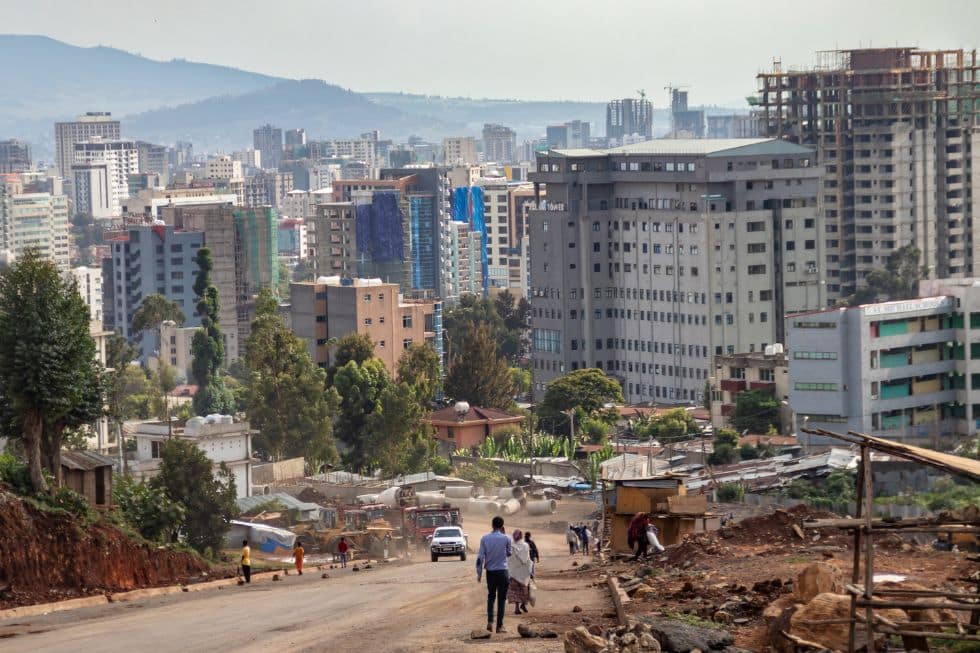




Addis Ababa is rising fast and defiantly. Steel and glass now puncture the highland sky, signaling Ethiopia’s ambition to be seen as a modern African power. East Africa’s tallest building, the 209-meter headquarters of the Commercial Bank of Ethiopia, was completed in 2022. Even taller plans follow: a 327-meter tower for Ethiopian Electric Power, poised to dominate the skyline and claim continental superlatives. Alongside them sit a $30 billion slate of mega-projects — airports, dams, industrial parks, even a proposed nuclear facility — aimed at catapulting the country into a new development league.
From a distance, the message is unmistakable: Ethiopia is ascending.
Yet beneath the skyline, another story unfolds. One that is less visible, less photogenic, but far more consequential. It is a story not of towers, but of people. One of children who struggle to read by age ten. Of hospitals without medicines. Of doctors earning less than $100 a month. Of a state that builds monuments faster than it builds human capability.
This contrast is not accidental; it reflects a strategic choice about what development is meant to look like — and whom it is meant to serve.
The human cost of Ethiopia’s development model
Despite its urban renaissance, Ethiopia invests strikingly little in the foundations of human development. Public health spending stands at roughly 0.7% of GDP, far below the already modest low-income country average of 1.2% and less than half the 15% target pledged under the African Union’s Abuja Declaration. Per capita health spending has collapsed in real terms, falling to around $11 per person in 2024 as inflation and currency depreciation erode nominal budget increases. The result is a health system stretched to the edge of viability.
The workforce numbers tell the story starkly. Ethiopia has approximately 1.2 health professionals per 1,000 people — barely a quarter of the World Health Organization’s minimum threshold for universal coverage. Hospital beds, diagnostic equipment, essential drugs and trained staff remain scarce across much of the country. Even in Addis Ababa, a city of nearly five million, public health infrastructure remains thin. Outside the capital, access deteriorates rapidly.
Education fares little better. Learning poverty — defined as the inability of a ten-year-old to read a simple text — hovers around 90%. Primary school completion is roughly 70% and adult literacy remains close to 50%, with stark gender and regional disparities. According to the World Bank’s Human Capital Index, a child born in Ethiopia today is expected to reach only 38% of their productive potential under current health and education conditions.
These are not abstract statistics; they translate directly into lost growth, weakened resilience and heightened instability. A young, undereducated and unhealthy population cannot anchor a durable middle-income transition, no matter how tall the buildings that surround it.
Infrastructure, debt and global comparisons
What makes this trajectory especially striking is how sharply it diverges from successful development experiences elsewhere. South Korea, Singapore, Vietnam and more recently, Rwanda all began from positions of deep poverty and institutional fragility. None started with skyscrapers. Each began instead with mass literacy, primary healthcare and social inclusion. In South Korea, universal education preceded industrial take-off. In Vietnam, near-universal health insurance underpinned productivity gains. In Rwanda, community-based healthcare achieved coverage rates above 90% long before Kigali’s convention centre reshaped the skyline.
In these cases, infrastructure followed human capital, not the reverse.
Ethiopia’s approach inverts that sequence. Billions of dollars — much of it borrowed — flow into high-visibility projects with limited immediate social returns. Chinese financing dominates, accounting for roughly 60% of new investment projects, particularly in transport, real estate and energy. Debt restructuring agreements with Beijing since 2020 underscore the strain this model imposes. Meanwhile, clinics go under-resourced, schools are overcrowded and frontline workers are demoralized.
Yes, Beijing’s checkbook builds skylines, not social contracts. If Horn states trade welfare for prestige projects, they hand strategic leverage to outsiders while hollowing out domestic resilience.
Future prospects and the importance of human capital
This imbalance has foreign policy implications that extend well beyond development metrics. Ethiopia sits at the heart of the African Union, projecting diplomatic weight across the Horn of Africa. Its choices shape regional norms. A development model that privileges spectacle over welfare risks, normalizing a version of “success” that is politically brittle and socially exclusionary. It also complicates Ethiopia’s relationships with Western partners, multilateral lenders and humanitarian agencies increasingly focused on governance, equity and human security.
The contradiction becomes sharper when conflict is factored in. The war in Tigray and ongoing instability in Amhara and Oromia have displaced millions and devastated already fragile social systems. Conflict destroyed health facilities, closed schools and interrupted vaccination programs. Yet even as reconstruction needs mount, capital continues to be channeled into prestige projects rather than systemic recovery.
There is a deeper irony here. Ethiopia’s ambition to be a regional power rests ultimately on people, not structures. Diplomatic influence, economic resilience and national cohesion all depend on human capability: Skyscrapers do not vaccinate children; smart corridors do not train midwives; airports do not repair trust between the state and its citizens.
None of this is to deny Ethiopia’s right to aspire, nor to dismiss the value of infrastructure. Roads, energy and urban renewal matter. But development is not an architectural competition. It is a social contract. When public resources are finite — as they always are — choices reveal priorities.
The current pattern risks entrenching inequality and eroding legitimacy. Urban elites benefit disproportionately, while rural and conflict-affected communities fall further behind. Health workers strike, teachers leave and young people emigrate. The social return on investment narrows even as the physical footprint expands.
There remains, however, a window for recalibration. Ethiopia possesses a large, youthful population, a strategic geographic position and deep historical legitimacy. Redirecting even a fraction of mega-project spending toward universal health coverage, quality schooling and social protection would yield dividends far exceeding those of any single tower. International partners stand ready to support such a shift, not as charity, but as a shared interest in a stable and capable regional anchor.
Development, at its core, is not about height. It is about depth. Ethiopia’s future standing — at home and abroad — will be determined less by how high its skyline climbs than by how firmly its people are supported beneath it.
[Luna Rovira edited this piece.]
The views expressed in this article are the author’s own and do not necessarily reflect Fair Observer’s editorial policy.





Join the conversation
Share your perspective
Log in to share your thoughts and take part in the discussion.