


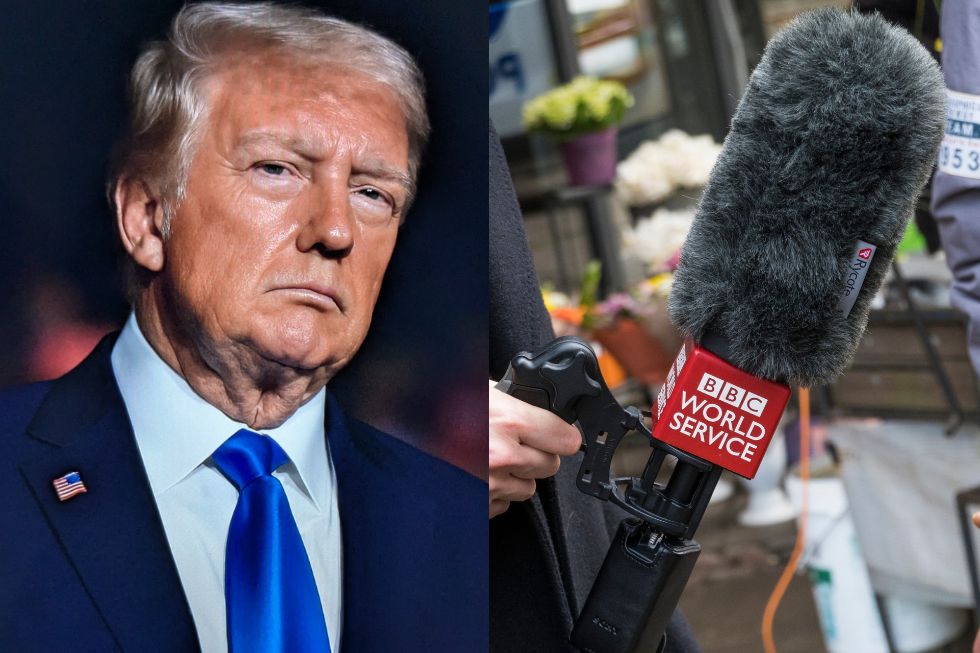


When a sitting or former US president sues a media organization, it’s big news. When they sue the British Broadcasting Corporation for $10 billion, it’s something else, closer to a geopolitical spectacle than a legal action.
Florida judge Roy K. Altman has set a February 2027 trial date for US President Donald Trump’s lawsuit against the British public service broadcaster, BBC for defamation. The claim centers on an episode of the BBC current affairs program Panorama, titled “Trump: A Second Chance?” The episode edited together two passages of Trump’s speech on January 6, 2021, in a way that appeared to suggest he had directly urged his supporters to march on the US Capitol and “fight like hell.”
Trump has sued American outlets before and his record is mixed. In 2024, ABC News settled a defamation action after anchor George Stephanopoulos inaccurately described the E. Jean Carroll verdict as a finding of “rape” rather than sexual abuse under New York civil law. The settlement reportedly included a multimillion-dollar payment toward Trump’s future presidential library and legal fees. In 2025, CBS News and its parent company, Paramount Global, also reached a financial settlement over a 60 Minutes segment Trump claimed was misleading.
But other suits have failed. In 2023, a federal judge in Florida dismissed a $475 million defamation claim against CNN over its use of the phrase, “the Big Lie.” A separate multibillion-dollar action against The New York Times met a similar fate. American courts have repeatedly emphasized the high constitutional threshold for public figures alleging defamation. Two settlements, two dismissals. A 2–2 record, if we want to keep score.
But this is different. The BBC is not a partisan cable network in the crowded US market. It is a century-old British institution, funded primarily by a license fee, chartered to inform and educate as well as entertain. It does not allow advertising. The BBC is woven into the cultural fabric of the United Kingdom and regarded internationally as the Rolls-Royce of broadcasting.
That is what makes this case extraordinary. It’s not simply Trump versus another newsroom. It is Trump versus a totem of British civic life. And the near-theatrical $10 billion figure signals that this is about much more than compensation. It’s about what or who has authority, power and legitimacy on a global stage.
Error of judgment
The BBC has already conceded that the program spliced together two segments of Trump’s speech, delivered nearly an hour apart, without making that clear to viewers. The effect was to compress his rhetoric into a single, more incendiary sequence. Critics argue that the edit omitted a crucial line in which Trump urged supporters to protest “peacefully.”
After an internal uproar and the leak of a critical document by Michael Prescott, a former advisor on editorial standards, the BBC apologized. Its chair, Samir Shah, described the edit as an “error of judgment.” Director General TimDavie accepted responsibility before stepping down amid the wider turbulence. Deborah Turness, chief executive of BBC News, also departed.
Crucially, though, the corporation stopped short of admitting defamation. It offered no damages. And it strenuously denied malicious intent. So, when Trump’s lawyers escalated the matter into a multibillion-dollar suit filed in Florida, the BBC challenged the court’s jurisdiction, arguing that the program was neither produced nor broadcast in Florida and was not available there via its streamer BritBox as alleged. Judge Altman rejected attempts to delay discovery; the case will now proceed.
Could the broadcast genuinely have damaged Trump’s checkered reputation? That is the legal nub of the matter. Defamation law in the United States, especially for public figures, sets a prohibitively high bar. A claimant must show not only falsity but “actual malice:” knowledge of falsity or reckless disregard for the truth. Trump’s legal team claims the edit was “intentionally and maliciously” misleading. Note: Intentionally. The BBC says it was a mistake, now acknowledged.
There are precedents for media organizations paying dearly for editorial lapses. But there are few, if any, precedents for a British public broadcaster facing a $10 billion claim in an American court over a documentary edit. And, in this instance, timing matters because the BBC doesn’t enter the fray in good financial health.
Under pressure
Even without Trump, the BBC is under pressure. The broadcaster is pursuing savings of up to £600 million (over $860 million) over three years. License fee revenues are falling as households move toward streaming platforms and social media. Around 300,000 fewer British households paid their license fee in the last reported year. Departments are bracing for cuts. Outsourcing is inevitable.
Public service broadcasters were never designed to absorb shocks of this magnitude. Unlike commercial rivals, the BBC doesn’t rely on advertising or subscription revenue. It’s funded by a compulsory license fee whose legitimacy is periodically contested in Parliament and in public debate. It is right now.
In that context, a $10 billion liability — even a fraction of it — would not be an ordinary line item. It would be an existential catastrophe. (While the BBC isn’t in literal “debt” like a business with a balance-sheet liability that must be paid off, it is running deficits and facing revenue shortfalls and operating pressures that are forcing cost cuts and license fee increases.)
Which brings us to the first conjecture.
What if Trump wins?
Bookmakers, were they to set odds, would likely price a full $10 billion victory as 25/1, maybe 33/1 at most. The legal hurdles are formidable. Yet imagine, for argument’s sake, that Trump prevails and secures a judgment on that scale.
The immediate consequence would be seismic. The BBC’s annual budget is roughly £5 billion ($6.8 billion) sterling. A damages award of $10 billion (about £7.5 billion) would eclipse its annual income. Even a significantly reduced award could destabilize the corporation’s finances, potentially forcing emergency government intervention or radical restructuring.
The reputational damage would be devastating, too. For a broadcaster that trades on credibility, reliability and impartiality, a court finding of malicious defamation would undermine its moral authority at home and abroad. Critics who already question its impartiality, neutrality and objectivity — and there are plenty in the UK and elsewhere — would feel vindicated. Politicians skeptical of the license fee would gain leverage. Calls to privatize, allow advertising or dismantle the corporation completely would intensify.
For Trump, by contrast, victory would be nectar. He has long depicted mainstream media as hostile and dishonest. A courtroom triumph over, of all broadcasters, the BBC would validate his narrative to a global audience. It would bolster his standing among supporters who see him as a victim of elite institutions. It would inflate his already considerable self-belief.
And there is a longer-term implication: A Trump win would signal to media organizations worldwide that editorial misjudgments, even acknowledged and corrected, can carry calamitous financial risk. The effect could be sobering. Investigative journalism, already expensive and fraught, might grow more cautious. Legal departments would gain power. Editors would hesitate. The media would be domesticated.
That might please those who see the media as already too powerful and untouchable. It would trouble those who value the media’s autonomy and ability to criticize without fear.
What if the BBC wins?
The alternative is less obvious but still significant. Suppose the court finds no defamation — perhaps that the edit, while erred, did not meet the criterion of actual malice. The BBC would emerge legally vindicated. Bookies might price this as evens, perhaps 5/6 (meaning you stake $6 to win $5 if the case is thrown out).
A “victory” for the Beeb would not, however, bring a reward of $10 billion from Trump. Nor would it remove the BBC’s structural financial problems. License fee decline would continue. Savings targets would still loom. Pride and honor might be restored, but balance sheets would not be any healthier.
For Trump, defeat would sting. By February 2027, he will be 80 years old and approaching the end of a second term in office. Attention will be shifting to the next presidential contest, which is scheduled for November 7, 2028. The Republican Party will be thinking about succession and electability.
In July 2024, gunman Thomas Matthew Crooks attempted to assassinate Trump, grazing his ear with a bullet — an event that underscored how deeply the now-president divides American society. A courtroom loss would not change his polarizing potential nor end his overall influence. His capacity to command loyalty and shape narratives as well as antagonize detractors and engender hatred would remain formidable. But failure would pierce the aura of inevitability that has often surrounded him. For a leader who reduces complex events, especially conflicts, to deals or no-deals, a public defeat against a foreign broadcaster would be an unequivocal disaster. Not just defeat, but humiliation.
Would it be transformative? No. The BBC would continue to struggle financially. Trump would continue to dominate attention for at least the remainder of his tenure. Yet the symbolism would matter. It would reaffirm the resilience of established media institutions against political assault. It would remind would-be litigants that courts are not just campaign platforms.
Beyond damages
Strip away the legal briefs and this case is about something larger: the collision between a populist politician who thrives on confrontation and a public broadcaster that embodies an older model of civic rectitude.
Trump has built a career on challenging institutions, including courts, universities, newsrooms and intelligence agencies. The BBC represents a particularly attractive target: foreign, publicly funded, proud of its editorial standards, perhaps even haughty about the global prestige it still enjoys after over a hundred years of broadcasting.
The corporation, for its part, is navigating a media environment transformed by YouTube, Netflix, TikTok and myriad streaming services. It’s pruning costs while trying to maintain global reach. It can ill afford complacency at the moment. The Panorama edit was, by its own admission, a lapse. In an era of forensic scrutiny, lapses can be expensive.
What happens in that Florida courtroom in 2027 will reverberate far beyond the litigants. A Trump victory could reshape the risk calculus for journalism worldwide. A BBC victory would help stabilize an institution under strain and reinforce the legal protections that enable robust reporting.
Either way, this is emphatically not routine litigation. It’s a clash of reputations: one personal and political, the other institutional and national. When the gavel falls, the consequences will extend well beyond damages.
[Ellis Cashmore is the author of Celebrity Culture, now in its third edition.]
[Lee Thompson-Kolar edited this piece.]
The views expressed in this article are the author’s own and do not necessarily reflect Fair Observer’s editorial policy.
What’s Amiss in the Abyss? Trump Gets an Earful!
The 2024 US presidential campaign has had its second traumatic moment in less than a month. The assassination attempt on...
The Ruthless Political Agenda Behind 91 Indictments of Donald Trump
The lack of substance to the criminal charges against Donald Trump makes it obvious that they are politically motivated. Career-conscious...
The Worrying Consequences of the January 6 Insurrection
The January 6 insurrection on the US Capital can only be compared in severity with the 1814 British burning of...

Support Fair Observer
We rely on your support for our independence, diversity and quality.
For more than 10 years, Fair Observer has been free, fair and independent. No billionaire owns us, no advertisers control us. We are a reader-supported nonprofit. Unlike many other publications, we keep our content free for readers regardless of where they live or whether they can afford to pay. We have no paywalls and no ads.
In the post-truth era of fake news, echo chambers and filter bubbles, we publish a plurality of perspectives from around the world. Anyone can publish with us, but everyone goes through a rigorous editorial process. So, you get fact-checked, well-reasoned content instead of noise.
We publish 3,000+ voices from 90+ countries. We also conduct education and training programs
on subjects ranging from digital media and journalism to writing and critical thinking. This
doesn’t come cheap. Servers, editors, trainers and web developers cost
money.
Please consider supporting us on a regular basis as a recurring donor or a
sustaining member.
Will you support FO’s journalism?
We rely on your support for our independence, diversity and quality.





Comment