


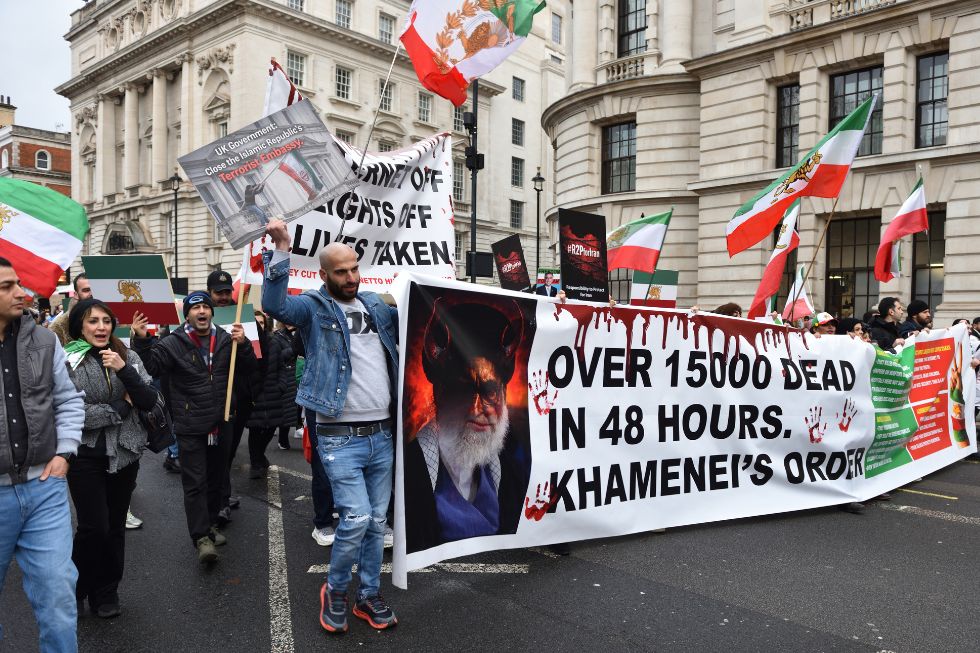



The latest round of protests by the Iranian people against fascism and the dictatorship ruling this land began on December 28, 2025, when the Tehran bazaar took to the streets in response to rampant inflation and the unprecedented fall in the value of the national currency. However, these protests lasted only three days, and following a compromise between the owners of capital and the government, the Tehran bazaars resumed their normal activities.
Simultaneously with this compromise, the provinces of Kurdistan — which are considered among the poorest, most deprived and most underdeveloped regions of Iran — disregarded the agreement between the bazaar and the government and took to the streets, not only against inflation and poverty, but also against the foundation and foundation of the Islamic Republic of Iran.
By making overtly political demands, the protesters called for the overthrow of the dictatorship of the Islamic Republic and the end of Iranian fascism. They announced that they did not want the Islamic Republic or the imperial dictatorship. Rather, they demand democracy, freedom and the right to self-determination for Kurdistan.
The beginning of a new round of protests in Kurdistan
The initial spark of these protests was set in the cities of Kohdasht and Malekshahi in the provinces of Ilam and Lorestan — located in the southern part of Iranian Kurdistan. Iranian Kurdistan comprises seven provinces, and the Kurdish population is estimated at around 15 million. The provinces of Urmia, Sanandaj, Kermanshah, Ilam, Lorestan, Chaharmahal and Bakhtiari, and Kohgiluyeh and Boyer Ahmad are located in the foothills of the Zagros Mountains and are considered part of the geography of Iranian Kurdistan.
On the fourth day, the protests spread to other cities such as Abdanan, Ilam, Kermanshah, Harsin, Islamabad West and surrounding areas. These protests continued in the following days, and the military forces of the Islamic Republic directly targeted the protesters with weapons of war from the very first hours of the uprising. According to eyewitness accounts and independent journalists, in the city of Malekshahi alone, on January 3, 2026, known as “Bloody Saturday,” at least five Kurdish citizens were killed, about 40 were injured and many were arrested.
According to videos released from Kurdistan, the Revolutionary Guards stormed the hospital where the wounded were being treated that night, abducted a number of them and transferred them to detention; an act that has left families unaware of the fate of their loved ones to this day.
The US State Department’s social media account, reposting images of the attack, described it as “a brutal attack and a clear crime against humanity” and wrote: “Hospitals are not battlefields. These actions by the Islamic Republic regime are a flagrant violation of international law and demonstrate this regime’s complete disregard for human life.”
The news of the attack on hospitals sparked an unprecedented wave of anger throughout Kurdistan. Therefore, on January 4, almost all cities in Iranian Kurdistan — especially the southern regions — took to the streets and demanded the overthrow of the government and the establishment of a federal system in Iran or the independence of Kurdistan.
According to a report by Human Rights Activists in Iran (HRANA), by January 7, during the 11 days of the uprising, at least 34 people were killed by direct fire from military forces, 28 of whom were Kurds.
General strike and massacre
Amid the protests in Kurdistan and Iran, on January 4, Supreme Leader Ali Khamenei addressed military commanders, saying, “There is no point in negotiating with the rioter; the rioter must be put in his place.” These words were in effect an order to suppress the protesters in full force; an order that led to widespread massacres on January 8 and 9.
As the killing of Kurdish citizens intensified, the main parties in Iranian Kurdistan — based in the Iraqi Kurdistan region and with a decades-long history of fighting the Islamic Republic — issued a call for a general strike in Kurdistan to condemn these crimes.
On Thursday, January 8, the strike was implemented across seven provinces of Kurdistan; about 15 million people remained in their homes, and markets were completely closed. Political experts described this as the largest strike in the history of Kurdistan’s struggle against Iranian fascism and the dictatorship of the Islamic Republic. However, participation in Persian-speaking cities was limited, and major cities such as Tehran, Isfahan and Shiraz did not join the call.
That evening, the Kurdish people took to the streets after their successful strike. This time, tens of thousands of people took to the streets to celebrate the victory in the general strike and chanted slogans against the Islamic dictatorship and Iranian fascism. They said, “You Iranian occupier, you are the murderer of our children.” At the same time as Kurdistan, other nations of Iran had taken to the streets throughout the country. But the protesters, unaware of anything, did not know that the Islamic government had prepared itself for an unprecedented massacre and that the order for the massacre had already been issued by Khamenei.
On January 27, HRANA published its latest report on the number of victims. This figure, based on verified data with complete details of the victims, showed that 6,007 protesters have been killed by Iranian terrorist-military forces since the protests began. HRANA reported that the actual number of deaths is likely much higher and that it is receiving additional information and will update the figures.
Also, on Sunday, January 25, Time magazine reported, citing two senior officials in the Iranian Ministry of Health, that “up to 30,000 people” were killed on the streets of various cities in the two days of January 8 and 9, when the bloody repression by the government reached its peak.
In this regard, I had a conversation with a medical staff member working in a hospital in Ilam — who did not want to be named — who reported that more than 2,500 citizens were killed in various cities in Ilam province during these two days. He said many of the victims were killed by direct shots to the head, and a number of the wounded were either shot in the streets or killed in ambulances on the way to the hospital. He added that the military forces had set fire to shops, houses, offices, mosques and schools, then blamed the protesters for the attacks.
The “Total Digital Isolation” project
After the massacre, the government completely cut off all internet and even telephone communications. According to reliable reports, it was not even possible to make phone calls or send text messages between January 9 and 11. The NetBlocks report also details a complete internet shutdown across Iran from the time of the massacre until the time of the writing of this report.
According to the Filterwatch report, the Iranian government has put on the agenda a secret project called “Total Digital Isolation,” a plan that aims to transform the country’s internet infrastructure into a closed and secure network — known as the “barracks internet” — so that communication with the outside world is only possible through controlled routes and with security permits.
Human rights activists have warned that the Islamic Republic is, on the one hand, seeking to conceal the extent of the massacre and, on the other hand, trying to continue to torture and kill detainees in silence. Reports indicate that hundreds of protesters have died in detention centers due to torture in recent days.
What do the Kurds want?
Since the uprising of Kurdish leader Semku Shakak in the 1920s, known as the father of the national-democratic struggle in Kurdistan, the Kurds of Iran have begun the path of struggle to achieve their national and political rights, oscillating between two approaches to independence and autonomy to this day.
The independence of Kurdistan is the historical aspiration of a large part of Kurdish society; however, if it remains within the framework of Iran, the central demand of Kurdish political forces is the establishment of a democratic, federal and secular system; a system in which national rights are legally guaranteed, gender equality is achieved, religion is separated from the state and the role of the central government in governing the regions is reduced to the minimum possible. This view is close to models of consensual and decentralized democracy, such as the Swiss political system.
In a brief interview, Kaveh Ahangari, director of the Zagros Voice media organization in Belgium, emphasizes:
The Kurds have been fighting for equal rights, recognition of their historical and territorial identity, peace, and sustainable development for over a hundred years. It may seem paradoxical, but the Kurds are fighting for peace. Repression, genocide, assimilation, and imposed underdevelopment have not extinguished the fire of this struggle.
Explaining why the repression in Kurdistan is so intense, he adds:
This reality is rooted in the fundamental contradiction between the worldview of the centrists and the demands of the Kurds. They cannot tolerate participatory democracy and consider federalism to be contrary to their interests; therefore, they consider repression to be the easiest and least costly solution. However, Kurdistan is not simply a geography, but a historical, living, and deeply rooted identity in the context of human society.
The crossroads of Kurdistan’s struggle: independence or federalism?
The future remains uncertain: Will the Kurds achieve independence? Will Iran move towards a federal, democratic and secular system? Or will a centralized dictatorship once again rule, which, by granting privileges to the “ruling nation”, will continue the project of Persianization, colonization and exploitation of non-Persian nations? The answers to these questions are largely tied to the role and will of the international community — and especially Western countries — in providing practical support to oppressed nations.
Undoubtedly, lasting peace and stability in the Middle East will only be achievable when the rights of nations are truly recognized, whether in the form of a federal and democratic Iran or in the form of independent countries such as Kurdistan. As long as dictatorial and fascist structures rule Iran and the exploitation of nations by the centralized system continues, the expectation of lasting peace and reconciliation will be far from reality.
[Kaitlyn Diana edited this piece.]
The views expressed in this article are the author’s own and do not necessarily reflect Fair Observer’s editorial policy.
Why the Iranian Opposition Has Failed to Unite Against the Regime in Iran
Widespread protests across Iran, especially in Kurdish regions, have been met with violent crackdowns, highlighting deep-rooted demands for autonomy and...
Iran’s Protest Moment: Four Stakeholders, One Coherent Vision
Iran’s protests stem from deep economic hardship and a clash between societal change and an entrenched regime. Four groups —...
Support Fair Observer
We rely on your support for our independence, diversity and quality.
For more than 10 years, Fair Observer has been free, fair and independent. No billionaire owns us, no advertisers control us. We are a reader-supported nonprofit. Unlike many other publications, we keep our content free for readers regardless of where they live or whether they can afford to pay. We have no paywalls and no ads.
In the post-truth era of fake news, echo chambers and filter bubbles, we publish a plurality of perspectives from around the world. Anyone can publish with us, but everyone goes through a rigorous editorial process. So, you get fact-checked, well-reasoned content instead of noise.
We publish 3,000+ voices from 90+ countries. We also conduct education and training programs
on subjects ranging from digital media and journalism to writing and critical thinking. This
doesn’t come cheap. Servers, editors, trainers and web developers cost
money.
Please consider supporting us on a regular basis as a recurring donor or a
sustaining member.
Will you support FO’s journalism?
We rely on your support for our independence, diversity and quality.





Comment