


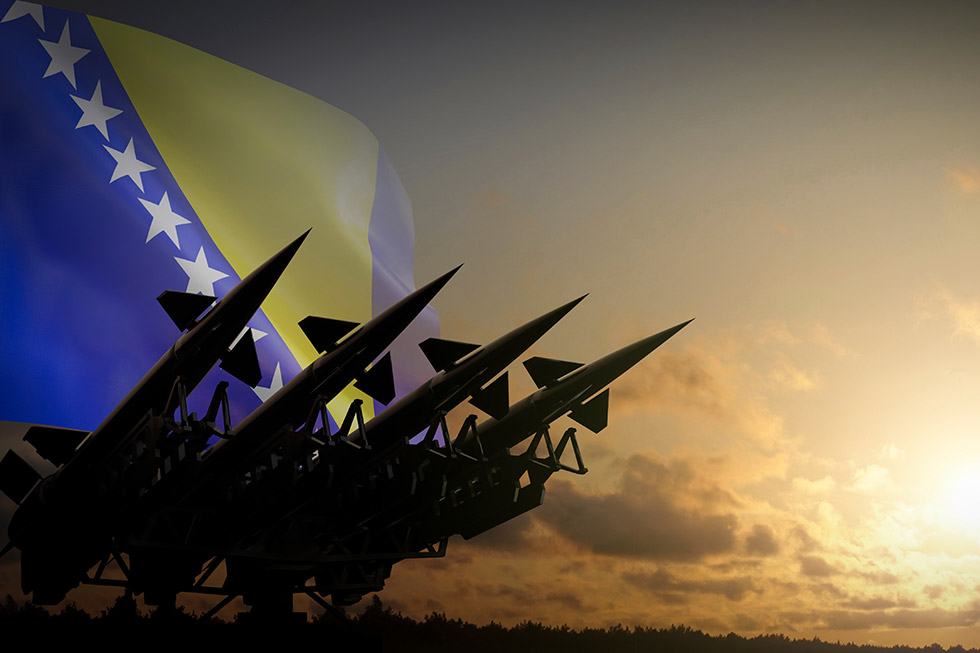



Bosnia and Herzegovina is rarely associated with industrial resilience, let alone strategic defense manufacturing. Yet beneath the country’s familiar image as a post-conflict state beset by political dysfunction lies a defense industry that has not only survived war and transition, but is now quietly reasserting itself as a consequential — if underappreciated — component of Europe’s security ecosystem.
This is not a new story. The foundations of Bosnia’s military industry were laid during socialist Yugoslavia, when more than half of the Yugoslav People’s Army’s arms and ammunition were produced in what is today Bosnia and Herzegovina. Facilities established between 1948 and 1951 were deliberately concentrated in the republic, reflecting both geography and the federation’s emphasis on industrial depth and redundancy. Although the wars of the 1990s severely damaged this infrastructure, they did not erase the skilled workforce, institutional knowledge or manufacturing culture on which the sector was built.
Revitalization of Bosnia’s defense industry
Over the past decade,Bosnia’s defense industry has undergone a steady, largely overlooked revival. The sector today employs several thousand workers across more than 20 companies, spanning state-owned incumbents, mixed-ownership firms and a growing private segment. Producers such as Pretis Vogošća, BNT Novi Travnik and Binas Bugojno have scaled up the output of high-demand munitions, particularly 155 millimeter artillery shells. BNT alone has cited potential annual production capacity in the hundreds of thousands of rounds — figures that, if sustained, place Bosnia among the more consequential secondary producers on Europe’s periphery.
The industry is almost entirely export-oriented. More than 80% of Bosnia’s arms and ammunition output is sold abroad, reaching over 40 countries. In the first two months of 2025, Bosnia and Herzegovina exported military equipment worth €46.6 million — double the value for the same period in 2024. Likewise, total military exports in 2025 reached around 400 million Bosnia-Herzegovina Convertible Mark (€200 million), up 100 million Bosnia-Herzegovina Convertible Mark from 2023.
Early 2026 trends suggest export values could significantly exceed previous years. While the country does not produce complex, high-end systems, its specialty in bombs, grenades, mines, rockets, ammunition and related components has made it increasingly relevant in conflicts where consumables are in high demand.
Bosnia’s dual role in defense and geopolitics
Bosnia’s renewed relevance is also geopolitical. The country sits at a strategic crossroads between its Euro-Atlantic aspirations and persistent Russian influence in parts of its political system. While not a NATO member, Bosnia is a partner country and an indirect contributor to Ukraine’s war effort. Its defense industry occupies a distinctive niche: few European producers retain the technical capacity to manufacture both NATO-standard and Soviet-caliber arms and ammunition at scale. This dual compatibility has allowed Bosnian firms to serve a diverse customer base spanning NATO states, the Middle East, Africa and other markets — while remaining adaptable to shifting battlefield requirements.
This strategic utility has not gone unnoticed by the US. US firms have emerged as some of the largest buyers of Bosnian ammunition, quietly but firmly embedding the country in Western supply chains. While Bosnia does not officially export arms to Ukraine, deliveries are routed through intermediaries, allowing its factories to contribute materially while navigating domestic political sensitivities. US investment has been central to this process:Regulus Global is one example.
The US-based defense company purchased majority stakes in two Bosnian armaments companies, Pretis and Binas. With a $100 million capital injection into Sarajevo’s Pretis factory, the company has already brought forward upgrades it couldn’t have afforded on its own. Joe Wallis, the company’s CEO,said:
To be honest, we didn’t come to BiH because it was the easiest place to operate. We came because it made sense; strategically and personally. What we found here was a depth of expertise, real industrial capability, and a work ethic that frankly impressed us. These are qualities you can’t fake, especially in sectors where precision and trust are non-negotiable. This wasn’t a fly-in, sign-a-deal kind of situation. We spent time here. We met the people, walked the floors, and looked at the long-term. And what we saw was a country that deserves investment, not just interest. That’s what brought Regulus here—and what’s keeping us here.
Emerging defense industries in the Western Balkans: a strategic asset for Europe
The broader Western Balkans also stand poised to contribute to Europe’s defense-industrial resurgence. According to a major study by Friedrich Ebert Stiftung, Albania is reviving production of explosives, small arms, ammunition and drones, while entering a joint venture with the UK for armored vehicles. Kosovo and North Macedonia are partnering with Turkish firms to develop ammunition and propellant capabilities and to seed domestic drone ecosystems. Cost competitiveness and proximity to European markets are clear advantages: output can be priced below Western equivalents and delivered rapidly. With predictable demand signals and modest investment, these facilities could help plug bottlenecks in EU and NATO supply chains.
This industrial and regional relevance aligns closely with Europe’s own strategic ambitions. The European Commission’s 2025 White Paper on European Defence, Readiness 2030, identifies concrete industrial priorities, four of which map directly onto Western Balkan strengths.
First, Europe aims to produce at least two million large-caliber artillery rounds annually, creating immediate demand for existing production lines in Bosnia and neighboring states. Second, investment in artillery systems themselves opens space for licensing, modernization and scaling production from proven regional manufacturers. Third, drones and counterdrone systems — while high-end unmanned aerial vehicles remain the domain of larger original equipment manufacturers — offer opportunities for cost-effective intelligence, surveillance and reconnaissance, as well as for loitering platforms. Fourth, expanding capacities for propellants, explosives and munitions aligns with both EU supply needs and Bosnia’s demonstrated export strengths.
Here is where Ukraine comes into the picture. Politically, the Western Balkans have largely condemned Russia’s 2022 invasion of Ukraine. Several countries in the region have also providedtangible military support: Albania donated Mine-resistant ambush protected vehicles along with small-arms and mortar ammunition, Montenegro contributed naval and artillery munitions, Kosovo supplied vehicles, ammunition packages and hosted training activities, while Serbia — though publicly avoiding direct military aid — has been widely reported to have supplied substantial ammunition via third parties, with open-source estimates reaching up to €800 million by the end of 2024. Bosnia itself has channeled significant volumes of ammunition to Ukraine through intermediaries. Taken together, these contributions represent niche but nontrivial support streams, particularly valuable during the early phases of the conflict when Soviet-standard systems were at a premium.
Bosnian American political analyst Jasmin Mujanovic sees a lot of potential in Bosnia supplying Ukraine’s military:
But for the purposes of the question of Ukraine’s needs at this time, all of the relevant firms are located in the Federation entity. And these are firms that produce munitions and specifically large caliber artillery munitions, in particular 155mm shells, the NATO standard artillery caliber. You have at least two firms that are producing the shells sort of tutto completo, and then another two firms that are producing various components for these shells. You also have another company there, Igman, which does not produce artillery shells, but is producing large quantities of small arms munitions.
Overall, the Bosnian defense industry is valued at several hundred million dollars — potentially even a billion, depending on valuation — an impressive scale for a country of its size.
Bosnia is not about to become Europe’s arsenal. But in an era defined by attrition warfare, logistical pressure and the need for resilient industrial throughput, secondary producers matter more than ever. Bosnia’s defense industry has demonstrated the ability to meet NATO standards, scale output and absorb targeted investment. What it has lacked until now is sustained strategic attention. If the trajectory of US engagement, EU interest and regional industrial expansion continues, Bosnia’s quiet rearmament may emerge as one of Europe’s most consequential, if least noticed, security stories.
[Kaitlyn Diana edited this piece.]
The views expressed in this article are the author’s own and do not necessarily reflect Fair Observer’s editorial policy.
Foreign Off-the-Shelf Products Miss the Mark for European Defense
Despite prominent European leaders arguing that European nations need to buy European defense technology, several EU nations have continued to...
NATO and European Defense in the Face of Russian Resurgence and America First
The Russo-Ukrainian War and the trend for US disengagement from Europe, particularly under the Trump administration, have brought the inadequacy...
Balkan Tinderbox: How Russia’s Moves Could Reignite Bosnia
Russia is trying to stop the Balkan nations from joining the Euro-Atlantic community. This is causing instability in Bosnia and...

Support Fair Observer
We rely on your support for our independence, diversity and quality.
For more than 10 years, Fair Observer has been free, fair and independent. No billionaire owns us, no advertisers control us. We are a reader-supported nonprofit. Unlike many other publications, we keep our content free for readers regardless of where they live or whether they can afford to pay. We have no paywalls and no ads.
In the post-truth era of fake news, echo chambers and filter bubbles, we publish a plurality of perspectives from around the world. Anyone can publish with us, but everyone goes through a rigorous editorial process. So, you get fact-checked, well-reasoned content instead of noise.
We publish 3,000+ voices from 90+ countries. We also conduct education and training programs
on subjects ranging from digital media and journalism to writing and critical thinking. This
doesn’t come cheap. Servers, editors, trainers and web developers cost
money.
Please consider supporting us on a regular basis as a recurring donor or a
sustaining member.
Will you support FO’s journalism?
We rely on your support for our independence, diversity and quality.





Comment