


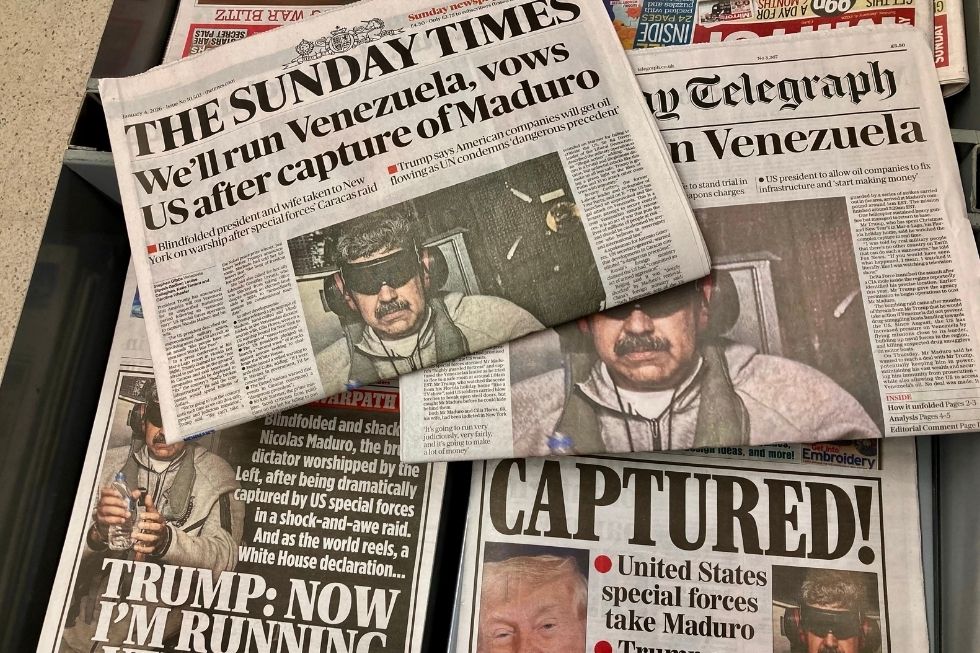



US President Donald Trump’s surprise military operation to seize Venezuelan President Nicolás Maduro and announce that the US will “run” Venezuela for an unspecified transition period has been widely described as the rebirth of the Monroe Doctrine. At Mar-a-Lago, he even tried out a new label — the “Donroe Doctrine” — and promised that “American dominance in the Western Hemisphere will never be questioned again.”
For three decades, many in Washington saw the post-1945 order in very different terms. The American political thinker Robert Kagan famously described it as a “liberal garden” — an artificial space of relative peace and prosperity, fenced off from the global “jungle” of historical great-power rivalry and tended by US power and alliances. The job of American statecraft, in this view, was to keep the garden alive: expand its borders cautiously, prune its institutions and keep predators at bay.
Trump’s Venezuela operation marks a break with that metaphor. This is not Iraq 2003. There is no talk of a broad “coalition of the willing,” of democratization or of weapons of mass destruction. There is an indictment in a US court, a helicopter raid and an open pledge to restore Venezuelan oil production under US guidance — “we’re going to be taking out a tremendous amount of wealth out of the ground,” as Trump put it. The logic is not Wilsonian gardening; it is frankly transactional destroyer-boat diplomacy.
For Trump and his advisers, Venezuela is a test case of a new Monroe Doctrine updated for the twenty-first century: shut out China and Russia, discipline unruly left-wing governments in the hemisphere and secure cheap resources and leverage over migration and narcotics flows. The National Security Strategy’s “Trump Corollary” spells this out: Latin America is to be kept “free of hostile foreign incursion or ownership of key assets,” and governed by regimes that “cooperate with us against narco-terrorists, cartels, and other transnational criminal organizations.”
Trump’s Venezuela move vindicates neither the liberal center nor its most strident critics. It reveals, instead, how much of our politics — on the populist right and, in a different way, on parts of the left — has slipped back into a geopolitical language of spheres of influence and transactional deals. And it sends a powerful signal to other autocrats, especially in Moscow and Beijing, that the old rule-book of territorial carve-ups may be back in business.
The new Monroe Doctrine as transactional geopolitics
From the White House’s standpoint, the case for attacking Venezuela has shifted over time. Maduro was first framed as a narcoterrorist heading the so-called Cartel de los Soles; the Justice Department indicted him in 2020, and Trump placed a $50 million bounty on his head. But specialists in counternarcotics have long questioned whether that organization exists in the form described, and the administration has not presented a clear threat to US national security that would meet UN Charter standards for the use of force.
In practice, the more compelling explanation is strategic and commercial. The new National Security Strategy asserts the right — indeed the necessity — for the US to dominate the Western Hemisphere, keep out extra-regional powers, and secure access to energy and critical minerals. Trump has been unusually blunt about wanting control of Venezuelan oil, which he insists rightly belongs to US companies and, by extension, to American consumers and “the people of Venezuela” once they align with Washington.
This is an old pattern in new clothes. President James Monroe’s 1823 doctrine warned European powers not to meddle in the Americas; President Theodore Roosevelt turned it into a charter for gunboat diplomacy and “international police power” in the Caribbean and Central America. Trump’s version adds 21st-century targets: Chinese loans, ports and telecoms; Russian military advisers, bases and energy stakes.
What’s missing is any sustained concern with Venezuelan democracy. Washington is sidelining opposition figures like María Corina Machado and Edmundo González — widely seen as the rightful winners of the 2024 Venezuelan election — in favor of a “transition” negotiated with elements of the Maduro regime and US energy firms, with Trump announcing that the US will “run” Venezuela for now. Even sympathetic analysts warn that there is no coherent “day after” plan and that a dash to restart oil production could trigger a scramble for assets and a new cycle of corruption and conflict.
This is regime change, but not in the Iraq mold. It is closer to what The New Statesman calls “a new era of rogue superpowers,” in which great powers overtly claim regional spheres as their own and use pretexts — drug trafficking, terrorism, separatism — to justify “snatch-and-grab” operations against unfriendly leaders.
From Lebensraumto the “Donroe Doctrine”
Seen in this light, Trump’s Venezuela operation is not an aberration but an extension of a much older tradition of thinking about space and power. In late-19th-century Germany, figures like German geographer and ethnographer Friedrich Ratzel and Swedish political scientist Rudolf Kjellén drew on German biologist and philosopher Ernst Haeckel’s popularized Darwinism to describe states as organisms competing for space. Ratzel coined the term Lebensraum to capture the territorial conditions a people needed to flourish; Kjellén spoke of the state as a living being whose borders were never permanently fixed. This intellectual climate helped normalize the idea that great powers were entitled to expand at the expense of weaker neighbors.
German political geographer Karl Haushofer and his interwar school of Geopolitik popularized a language of heartlands, buffer zones and pan-regions — “continental blocks” and civilizational spheres that should be organized under a dominant power. The legal and conceptual term Großraum — a large space ordered around a hegemon — was developed most systematically by the conservative jurist Carl Schmitt, whose writings on international law in the late 1930s justified regional spheres under German leadership and attacked universalist notions of sovereignty. Haushofer provided the maps and rhetoric; Schmitt provided the juridical theory.
Together, they portrayed Germany as a cramped “middle state” unjustly constrained by Versailles, surrounded by hostile powers and lacking the living space that Britain, France and the US had achieved through empire. This story resonated far beyond the far right.
German Dictator Adolf Hitler radicalized it into a necropolitical program: Eastern Europe, especially Ukraine and Russia, was to be cleared and resettled to secure German existence for a “thousand years.” Political activist and Marxist Franz Neumann, in his powerful 1942 analysis of the Nazi state, Behemoth, saw clearly that geopolitics in this guise was not a neutral science but “nothing but the ideology of imperialist expansion” — a language that made war over territory seem natural, even inevitable.
After 1945, this vocabulary became disreputable in Europe, but the underlying logic persisted elsewhere. The Soviet Union asserted a sphere of influence in Eastern Europe; the US asserted one in the Americas. Monroe’s hemispheric exclusion and Schmitt’s Großraum ideas found an echo across ideological lines. Trump’s “Donroe Doctrine” speaks directly to that heritage. He is explicit that the Western Hemisphere is America’s unquestioned domain, where “nonhemispheric competitors” such as China and Russia are to be denied serious footholds. He is equally open about wanting a sphere that matches, symbolically, those of Chinese leader Xi Jinping and Russian President Vladimir Putin. The goal is not a rules-based order but a negotiated cartel of empires.
What the right misunderstands — and what the left forgets
A powerful strain of the populist right — including Trump himself — embraces this shift. In Trump’s practice, “America First” has meant not pure isolationism, but mercantilist hard-power politics within a self-defined sphere: threaten Mexico over drugs and migration; pressure Colombia and Brazil with tariffs and sanctions; flirt with the idea of annexing Greenland or making Canada the “51st state”; and now, physically remove an unfriendly leader in Caracas.
Alongside this, there is indeed a genuinely isolationist current in the Make America Great Again (MAGA) coalition — voices who want to cut aid to Ukraine, avoid confrontation with Iran or China, and focus exclusively on domestic culture wars. The Tucker Carlson/“no more foreign wars” wing is real. But when push has come to shove, Trump’s own version has dominated: rhetorical Fortress America at home, selective coercion and deal-making abroad, especially in what he considers “our” hemisphere.
The right’s critique of the post-1990 order is not entirely wrong. It is true that globalization eroded the industrial base of many communities, that liberal interventionism produced disasters in Iraq and Libya, and that US elites have too often cloaked raw power in lofty rhetoric. What is wrong is the conclusion: that the cure is to abandon alliances, normalize spheres of influence and treat neighboring states as bargaining chips. That is how Europe sleepwalked into catastrophe a century ago.
The contemporary left, for its part, is divided. The strand that matters most for this argument is not authoritarian “campism” that reflexively sides with any regime opposed to Washington, but a more mainstream current that sees international law, multilateral institutions and transnational activism as sufficient to contain aggression, and that views almost any use of US power abroad as suspect.
Here, too, there is a long pedigree: the disillusionment of 1918, German novelist Erich Maria Remarque’s Im Westen nichts Neues (All Quiet on the Western Front), the interwar peace movements’ faith in Kellogg-Briand, the “One World” internationalism of US Republican presidential candidate Wendell Willkie, the mid-century cult of the UN. That tradition continues today in climate accords, human-rights campaigns and pandemic-era defenses of “the international scientific community.”
The left is right to stress interdependence and to highlight Western hypocrisy. But it often underestimates how far regimes like Putin’s or Xi’s have moved beyond the rules-based order, and how little they care for the constraints of law when core interests — as they define them — are at stake. In practice, a world in which the US renounces any hard-power role while others pursue spheres of influence would not be more peaceful; it would be more dangerous, especially for smaller democracies like Ukraine, Taiwan, or now perhaps Colombia and Mexico.
A dangerous precedent for Moscow and Beijing
Perhaps the most troubling aspect of the Maduro coup is not what it says about Trump’s worldview — that is no secret — but what it signals to other major powers. The administration has justified the operation by pointing to Maduro’s US indictment on drug-trafficking charges; officials present the raid as an arrest operation, not a war.
Critics have been quick to note how easily this logic can be repurposed. Commentators have pointed out that one could easily imagine Beijing indicting a Taiwanese president on spurious grounds and citing Trump’s precedent to “execute an arrest warrant” across the strait — or Moscow doing the same with President Volodymyr Zelensky in Ukraine. Senator Mark Warner, the Democratic vice-chair of the Senate Intelligence Committee, has warned that if the US asserts a right to use force to capture foreign leaders it accuses of criminal conduct, “what prevents China from claiming the same authority over Taiwan’s leadership? What stops Vladimir Putin from asserting a similar justification to abduct Ukraine’s president?”
This plays directly into the hands of Moscow and Beijing, both of which already treat neighboring democracies as wayward provinces within their historical spheres. Putin speaks of “denazifying” Ukraine; Xi speaks of “reunifying” Taiwan. If Washington now abandons any pretense of respecting the UN Charter, its objections to those projects will ring even more hollow.
In the longer term, Trump’s move may also accelerate the very multipolarity he claims to resist. Latin American governments that fear US volatility will quietly hedge with China, diversify trade and seek diplomatic cover in BRICS-style forums. A hemisphere that experiences the US primarily as a capricious sheriff, not a partner, will be less receptive the next time Washington asks for solidarity over Taiwan or Ukraine. Trump appears to believe that the world can be stabilized if the great powers simply agree on who owns which sphere. In reality, he is endorsing a crude version of the Athenian historian Thucydides: the strong do what they will, and the weak suffer what they must.
Old maps, new dangers
From Ratzel’s Lebensraum to Roosevelt’s corollary, from Schmitt’s Großraum to Putin’s “Russian world,” the temptation to divide the globe into tidy zones of influence has always been strongest when empires feel threatened, and elites lose faith in universal rules. It is understandable that, after the fiascos of Iraq and Afghanistan, many on both right and left have turned away from the rhetoric of liberal order.
But Trump’s Venezuela gambit is not a corrective to those failures; it is a relapse into an older, more brutal way of thinking about the world — one that will be eagerly imitated by other strongmen if it goes unchallenged. It shows that the US is not withdrawing from world politics, as isolationists claim, but reentering it on explicitly neoimperial terms in its own backyard. That should worry not only Venezuelans, but also Ukrainians, Taiwanese and anyone else whose security depends on the idea that borders cannot be redrawn at will.
The left is right to insist that we cannot bomb our way to a just world order. The right is correct to insist that power and geography still matter. Both are wrong if they think the answer is to abandon the attempt to build and enforce common rules — whether by retreating into small utopias of cooperation or by cutting deals over other peoples’ sovereignty.
We are unlikely to return to the liberal triumphalism of the 1990s. But we do not have to accept a future in which rogue superpowers arrest each other’s enemies across borders, parcel out regions and call it stability. Kagan’s liberal garden was always more fragile and partial than its defenders admitted. The alternative, however, need not be a jungle of competing empires. The first step is recognizing when our own governments have started to talk like the geopoliticians of the past — and refusing to pretend that this is anything other than a return to a past we thought we had left behind.
[Kaitlyn Diana edited this piece.]
The views expressed in this article are the author’s own and do not necessarily reflect Fair Observer’s editorial policy.
How the US Capture of Nicolás Maduro Impacts China’s Engagement with Indonesia
The US capture of Venezuelan President Nicolás Maduro has sparked global debate over sovereignty and international law, impacting China’s diplomatic...
Beyond the Fog of War: Venezuela’s Democracy is at Stake
Venezuela faces a turning point after the capture of Nicolás Maduro by US forces, which shattered the balance of the...
The US Invades a Latin American Country — Again
On January 3, US President Trump announced the capture of Venezuelan president Nicolás Maduro by the US military during an...
The Trump Corollary: US Imperialism in Latin America From the Monroe Doctrine to Maduro
Washington is reviving its long-standing history of control in the Western Hemisphere by citing threats from Venezuela to justify military...

Support Fair Observer
We rely on your support for our independence, diversity and quality.
For more than 10 years, Fair Observer has been free, fair and independent. No billionaire owns us, no advertisers control us. We are a reader-supported nonprofit. Unlike many other publications, we keep our content free for readers regardless of where they live or whether they can afford to pay. We have no paywalls and no ads.
In the post-truth era of fake news, echo chambers and filter bubbles, we publish a plurality of perspectives from around the world. Anyone can publish with us, but everyone goes through a rigorous editorial process. So, you get fact-checked, well-reasoned content instead of noise.
We publish 3,000+ voices from 90+ countries. We also conduct education and training programs
on subjects ranging from digital media and journalism to writing and critical thinking. This
doesn’t come cheap. Servers, editors, trainers and web developers cost
money.
Please consider supporting us on a regular basis as a recurring donor or a
sustaining member.
Will you support FO’s journalism?
We rely on your support for our independence, diversity and quality.





Comment