


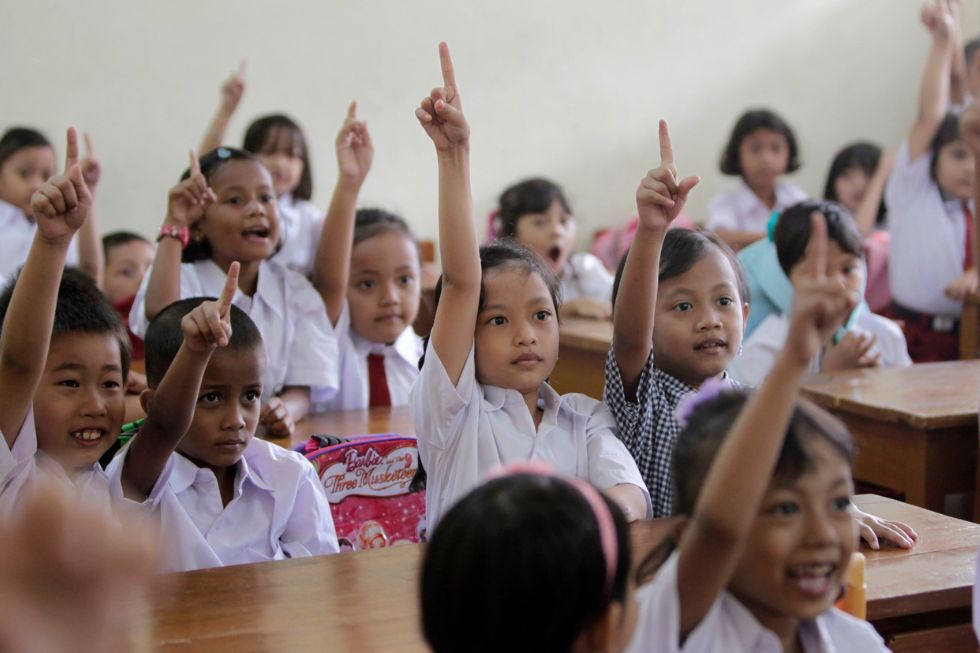



Indonesia’s schools tell a story of two nations. Across Jakarta and Java, classrooms buzz with potential; in parts of Papua and eastern Indonesia, children struggle to finish elementary education. Decades of rapid growth have significantly expanded access — Indonesia now reports formal literacy rates nearing 96% and average years of schooling that have roughly doubled since the 1980s.
Yet, the stark paradox remains: years spent in school do not reliably lead to learning. A generation whose formal schooling has increased greatly still performs close to the bottom of international benchmarks.
In the 2022 Programme for International Student Assessment (PISA) assessments, no more than 25% of 15-year-olds met basic expectations in mathematics and reading, and functional illiteracy among school graduates remains alarmingly high, estimated at 55% in one study. That gap — between enrollment and competence — is not just an academic issue. It is an economic deficit, a democratic risk and a moral failure of policy.
The origins of this failure are not mysterious. Indonesia’s post-independence commitment to education as a constitutional right spawned an extraordinary school-building drive under the New Order and an equally important decentralization wave after Reformasi. By the early 2010s, the country counted over 200,000 schools and roughly three million teachers. But quantity outpaced quality. The policymaking architecture placed teachers, procurement and program design under shifting institutional umbrellas and decentralization — while democratically legitimate — produced uneven capacity across more than 500 districts.
One country, two education systems
The result is predictable: pockets of excellence in urban centers, vast deserts of resources in remote districts and learning outcomes that are strongly correlated with where a child is born. In practical terms, a child in Jakarta will typically complete nearly 11 years of schooling; a child in Papua will average as low as six. That geographical divide is also a social one: Indonesia risks entrenching inequality if the promise of education does not deliver skills across the archipelago.
Economic pressures magnify the stakes. Indonesia lost an estimated 42,000 manufacturing jobs in the first half of 2025 as industries reconfigured, and youth unemployment hovered near 17% in 2024. When tens of millions of young people face such a labor market squeeze, poor learning outcomes cease to be a technocratic problem; they become a material threat to social cohesion and economic resilience.
The country’s tertiary attainment remains low by regional standards — only a minority of young adults complete higher education — and nation-building ambitions for technological upgrade and productivity depend on a far more capable workforce than current schooling produces.
Policy responses to these realities have been bold but uneven, and the latest initiatives show both promise and peril. The Merdeka Belajar (Freedom to Learn) reforms rightly emphasize school autonomy and practical skills, while Australian-backed programs such as Innovation for Indonesia’s School Children (INOVASI) target foundational literacy and numeracy.
Yet the headline policy of 2024–25 — the Makan Bergizi Gratis (MBG) universal school-feeding program — has produced a national debate about priorities and trade-offs. Feeding up to 83 million students is a humane and politically powerful idea; the first phase to feed roughly 17.5 million children carries an estimated price tag of about 71 trillion rupiah ($4.3 billion), and universal coverage could cost in the order of $28 billion.
With education spending already concentrated on teacher salaries and operational grants, diverting funds to universal feeding without a tight governance plan risks cannibalizing core learning investments. The evidence from global programs is clear: school feeding improves attendance and can boost nutrition, but it is not a substitute for foundational teaching, teacher training and curricular clarity.
Steps to a solution
What Indonesia now needs is not fresh slogans but an integrated, evidence-driven compact that joins equity, pedagogy, data and fiscal realism.
First, resource allocation must be rebalanced so that every rupiah emphasizes learning yield. The constitutional mandate to dedicate around 20% of public budgets to education must translate into smarter, not merely larger, spending. That means shifting the marginal rupiah from undifferentiated wage bills and one-size-fits-all grants into targeted investments: hardship allowances and housing incentives to place qualified teachers in remote districts, ring-fenced funds for instructional materials and early-grade reading programs and outcome-linked grants for districts that close learning gaps.
Greater funding transparency is essential: a publicly accessible dashboard that disaggregates BOS and local education budgets by district and links them to learning metrics would allow parents, researchers and donors to hold local officials to account.
Second, teacher quality must be the fulcrum of reform. Current assessments indicate a troubling competence gap, with substantial shares of the teaching force underperforming national standards. A coherent, long-term professional development system — backed by fast-track certification, school-based mentoring, digital continuous professional learning and community monitoring — will lift classroom practice.
Evidence from Indonesia’s Research on Improving Systems of Education (RISE) program and international comparisons shows that community engagement, coupled with incentives for instructional time and accountability, yields measurable gains. Pedagogy must shift away from rote learning toward active, competency-based instruction. Mother-tongue literacy approaches in early grades, particularly in regions with strong local languages, will improve comprehension and retention.
Third, assessments and data systems require urgent modernization. National examination cheating scandals and inconsistent district reporting have eroded trust in metrics. The government should implement secure, computer-based assessments for periodic diagnostic surveys, complemented by low-cost, high-frequency learning checks in classrooms.
Publishing district-level learning outcomes will not punish poorer districts if accompanied by conditional grants, technical assistance and public dashboards that make progress visible and verifiable. Donor partners — from the World Bank and the Asian Development Bank (ADB) to the UN Educational, Scientific and Cultural Organization (UNESCO) and bilateral aid partners including Australia — should fund this data modernization, with a compact that ties technical support to local capacity building rather than top-down templates.
Fourth, nutrition and early childhood interventions should be redesigned into a targeted, fiscally sustainable package. Rather than an immediate universal rollout financed from existing education levies, MBG should be phased and prioritized for districts with the highest stunting and low enrollment. Complementary measures — subsidized preschool, deworming, school health checks and nutrition education — magnify the learning impact of meals.
International evidence suggests such integrated packages produce far stronger cognitive gains than feeding alone. Importantly, financing should exploit blended models: central transfers for the poorest districts, conditional local matching for logistics and private sector partnerships for local sourcing, creating both fiscal sustainability and local economic spin-offs.
Fifth, pathways from schooling to decent jobs require rapid expansion of vocational and tertiary access in underserved regions. Indonesia must scale modular vocational certification, dual-track apprenticeships tied to local industry and scholarship schemes targeted at disadvantaged provinces. The Institute of Education Fund Management (LPDP) and provincial scholarship schemes can be retooled to support regional innovation hubs, while universities should be incentivized to open branch campuses and partnerships that align with local labor demand.
Finally, the international dimension matters. Australia and Indonesia already collaborate on education; this partnership should deepen into a strategic education compact that supports teacher training, digital infrastructure and evidence systems, while respecting Indonesia’s reform agenda.
Multilateral institutions — World Bank, ADB, UNESCO, the UN Development Programme (UNDP) and the World Food Programme (WFP) — should coordinate a shared support envelope that links finance to a clear results framework: measurable improvements in foundational literacy and numeracy, increased teacher competency rates, reduced regional attainment gaps and robust monitoring of fiscal flows.
Education: a right worth defending
The moral argument is simple and urgent. Education is not merely an economic investment; it is the foundation of civic life. Indonesia’s democratic resilience depends on whether children across islands can read, reason and participate as informed citizens.
If the state can translate lofty constitutional commitments into practical, accountable reforms — by refocusing funding, professionalizing teaching, modernizing assessments, targeting nutrition and expanding vocational pipelines — then the archipelago’s demographic dividend can become a generational triumph rather than a social liability.
The choices are technical, yes, but they are also profoundly ethical: to leave millions of children behind is to narrow the nation’s future. To invest wisely in learning is to protect the promise of the republic itself.
[Casey Herrmann edited this piece]
The views expressed in this article are the author’s own and do not necessarily reflect Fair Observer’s editorial policy.
China’s Involvement Could Undermine Prabowo’s Free Meal Program in Indonesia
Indonesia plans to give free meals to millions of schoolchildren. China agreed to help fund the program, but the details...
Should Students Rely on AI Grammar Tech to Write Better?
The AI platform Grammarly claims to be the perfect grammar machine which benefits both students and educators. I recently put...

Prabowo Easily Wins the Indonesian Presidency: What Next?
Official results from Indonesia’s presidential election are expected later this month. However, Defense Minister Prabowo Subianto is widely expected to...
Support Fair Observer
We rely on your support for our independence, diversity and quality.
For more than 10 years, Fair Observer has been free, fair and independent. No billionaire owns us, no advertisers control us. We are a reader-supported nonprofit. Unlike many other publications, we keep our content free for readers regardless of where they live or whether they can afford to pay. We have no paywalls and no ads.
In the post-truth era of fake news, echo chambers and filter bubbles, we publish a plurality of perspectives from around the world. Anyone can publish with us, but everyone goes through a rigorous editorial process. So, you get fact-checked, well-reasoned content instead of noise.
We publish 3,000+ voices from 90+ countries. We also conduct education and training programs
on subjects ranging from digital media and journalism to writing and critical thinking. This
doesn’t come cheap. Servers, editors, trainers and web developers cost
money.
Please consider supporting us on a regular basis as a recurring donor or a
sustaining member.
Will you support FO’s journalism?
We rely on your support for our independence, diversity and quality.





Comment