


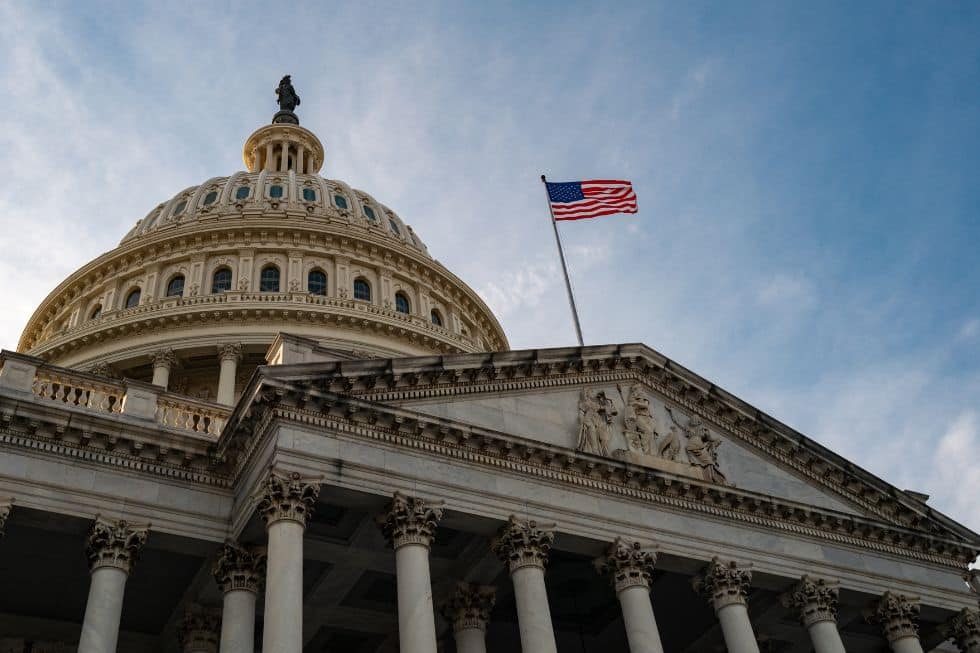



The defining feature of Washington’s Iran policy right now is not a single strike package or a single speech. It is the sequence. The US entered a large, high-tempo campaign against Iran, and only afterward did the Senate move toward a vote designed to force the president to seek congressional authorization for continuing hostilities. That vote is real, and it matters, but it is happening on the executive branch’s timeline, not Congress’s. The Senate’s initial vote on a War Powers resolution aimed at restricting President Donald Trump’s ability to continue strikes without approval underscores how far the constitutional order has drifted toward “war first, permission later.”
The House has shown the same pattern. A bipartisan War Powers push led by Representatives Ro Khanna and Thomas Massie became a test not only of Republican loyalty to Trump but also of whether Democratic leadership would risk a recorded vote that could split the caucus. Even when members publicly invoke the Constitution, many behave as if the vote itself is the threat.
That is the “theater” problem. Congress keeps rehearsing oversight while letting the executive branch set facts on the ground. A War Powers process that begins after thousands of sorties and hundreds of deaths is not a guardrail. It is a postscript.
A strategy built on speed and ambiguity invites civilian catastrophe
The administration’s public case has leaned heavily on urgency and prevention, but urgency is not evidence, and prevention is not a legal blank check. A UN panel was “deeply disturbed” by the strike on the Shajareh Tayyebeh girls’ school in Minab, southern Iran, which Iran’s UN mission said killed more than 160 children, with calls for transparency and an investigation. Washington and Tel Aviv can say they did not intend to hit a school, yet intention is not the only standard. International humanitarian law requires feasible precautions, distinction and proportionality. When children die at that scale, the burden shifts to the attackers to explain what happened, what intelligence supported the target, what safeguards were used and what changes will prevent repetition.
Hospitals have also been pulled into the blast radius. Reuters imagery and reporting showed the aftermath at the Gandhi Hotel Hospital in Tehran, including residents carrying belongings and visible damage. Al Jazeera’s photo gallery likewise documented damage at Gandhi Hospital amid the US-Israeli strikes. These are the kinds of incidents that turn policy failure into moral failure. Once hospitals and schools become recurring features of the war’s footprint, claims of surgical precision stop sounding like reassurance and start sounding like evasion.
This is where Trump’s approach is uniquely dangerous. His political style favors maximal threats and minimal disclosure. In war, that combination is not strength. It is volatility. The less the public knows about objectives, target selection and constraints, the easier it becomes for the campaign to expand while accountability shrinks.
Costs are not just dollars; they are capabilities
War Powers debates often get framed as constitutional symbolism. The numbers make the argument concrete. Estimates indicated that the first day of the US offensive burned through roughly $779 million, about 0.1% of the 2026 defense budget, a staggering sum to spend before Congress authorizes anything. Even if precise accounting varies, the direction of travel is unmistakable: The US is consuming high-end munitions at a high speed.
The more strategically relevant story is what those expenditures do to readiness. The US is facing shortages of key missiles and interceptors such as Tomahawks and SM-3s amid the ongoing offensive. Shortages do not simply raise the bill. They narrow the menu of choices. As stockpiles tighten, leaders become more likely to “double down” to avoid an ugly pause, more likely to widen the battlefield to chase decisive outcomes and more likely to treat restraint as weakness. A campaign that begins as air strikes can drift into a larger commitment because the political cost of stopping rises as the sunk cost grows.
This is the core indictment of Congress’s passivity. When lawmakers refuse to force an upfront authorization debate, they do not prevent war. They prevent strategy. They hand the executive a blank check, then act surprised when the ink runs out.
Trump’s war-making model is escalation plus impunity
A serious war policy requires three things the administration has not credibly supplied: a clear legal rationale, a defined objective and an off-ramp. The legal debate is not academic. Experts have questioned whether the scale of the operation fits within presidential authority absent congressional approval and noted the limits imposed by international law on the use of force. If the White House believes the operation is lawful and necessary, it should be able to state the rationale plainly, publish supporting evidence where possible and accept independent scrutiny where evidence cannot be made public.
Instead, the administration has relied on assertion. A striking example is the reported gap between the rhetoric of imminent threat and what officials privately told lawmakers. Reports indicated the Pentagon told Congress there was no sign Iran was going to attack the US first, undercutting claims of urgent self-defense. When a war is framed as necessary to stop an imminent attack, but briefings acknowledge no clear sign of one, the policy begins to look less like defense and more like a choice.
This is where Trump is politically exposed. A president who normalizes war without authorization is not merely bypassing Congress. He is hollowing out the accountability mechanisms that protect Americans from executive overreach and protect civilians from unchecked military force. The civilian toll inside Iran and the strain on US capabilities are not separate issues. They are the predictable products of the same model: act fast, disclose little, dare Congress to stop it.
What an actual War Powers response would look like
If Congress wants to prove the War Powers Resolution still has meaning, it has to treat authorization as a threshold, not as commentary. That means a binding requirement for specific authorization for continued hostilities, with defined objectives, geographic limits, time limits and mandatory public reporting on civilian harm. It means independent investigations into incidents like the Minab school strike and the damage to medical facilities, with findings released in a form the public can evaluate. It means funding tied to compliance, not compliance tied to vague promises.
A War Powers vote that comes after the bombs is still better than silence. But if Congress lets this war proceed without authorization, it will be sending a message that the Constitution is optional in wartime, civilian protection is negotiable and presidential discretion is the only policy America needs. That is not oversight. That is surrender.
[Kaitlyn Diana edited this piece.]
The views expressed in this article are the author’s own and do not necessarily reflect Fair Observer’s editorial policy.
A War to End All (Middle East) Wars?
The US and Israel’s strike on February 28 eliminated Iran’s Supreme Leader Ali Khamenei and other top leaders, revealing deep...
Trump Backs Down From Iran Threats, for Now
Mounting economic collapse initially drove Iran’s largest protests since 1979, but they were quickly fueled by open demands for regime...
Make America Scary Again: The Challenging Path to Reviving US Deterrence
America’s strike on Iran’s nuclear facilities marked a rare reinforcement of deterrence after years of erosion due to the “preparedness...
Support Fair Observer
We rely on your support for our independence, diversity and quality.
For more than 10 years, Fair Observer has been free, fair and independent. No billionaire owns us, no advertisers control us. We are a reader-supported nonprofit. Unlike many other publications, we keep our content free for readers regardless of where they live or whether they can afford to pay. We have no paywalls and no ads.
In the post-truth era of fake news, echo chambers and filter bubbles, we publish a plurality of perspectives from around the world. Anyone can publish with us, but everyone goes through a rigorous editorial process. So, you get fact-checked, well-reasoned content instead of noise.
We publish 3,000+ voices from 90+ countries. We also conduct education and training programs
on subjects ranging from digital media and journalism to writing and critical thinking. This
doesn’t come cheap. Servers, editors, trainers and web developers cost
money.
Please consider supporting us on a regular basis as a recurring donor or a
sustaining member.
Will you support FO’s journalism?
We rely on your support for our independence, diversity and quality.
Freedom Talk, War Risk: America’s Iran Playbook
Washington frames Iran policy as a choice between “freedom” and “appeasement,” even as it expands its military posture alongside indirect...





Comment
Great piece! And this is only the latest of a long line of examples that Congress has evaded accountability by handing off broad “emergency” powers to the president. It’s cowardly, damaging, and undemocratic.