


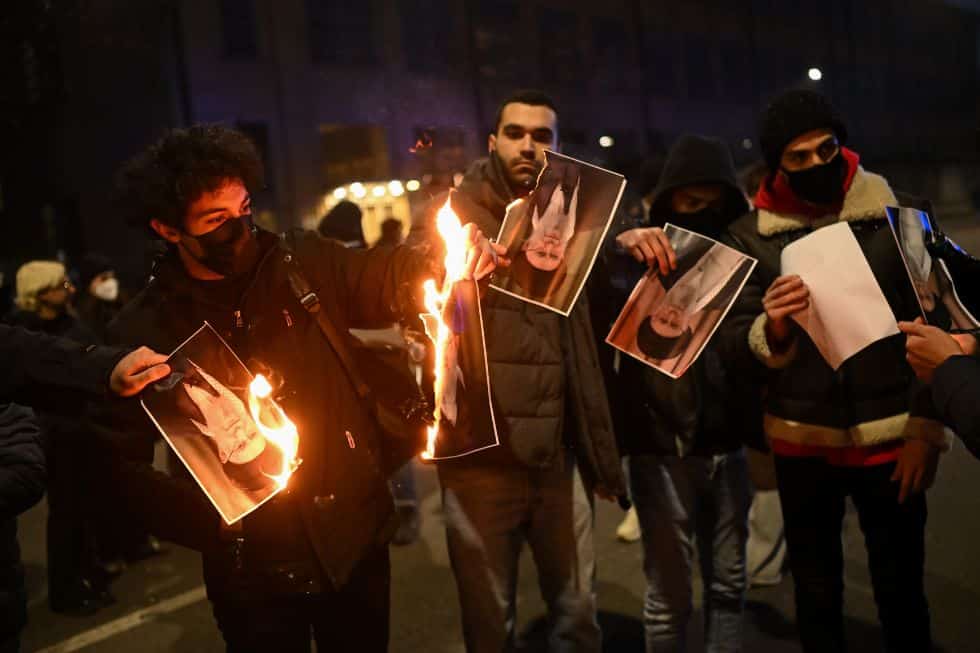



In the past couple of weeks, the Islamic Republic of Iran has carried out what is likely the most extensive episode of organized state violence in the country’s modern history. In response to a mass uprising rooted in economic collapse and social exhaustion, the regime has killed an estimated 12,000–20,000 unarmed civilians. The precise number is unknowable by design: hospitals are sealed, morgues are restricted, journalists are silenced and communication networks are dismantled. Uncertainty here is not a failure of governance but one of its techniques. The production of opacity is central to how contemporary authoritarian states manage legitimacy in moments of crisis.
The uprising itself did not emerge from ideological agitation but from the breakdown of everyday reproduction. Inflation on essential goods has crossed catastrophic thresholds, the rial has effectively collapsed after losing over 90% of its value since 2018, wages lag months behind prices and water scarcity — produced by extractive development, dam projects favoring elite agribusiness and systematic elite capture — has devastated entire regions. What is unfolding is a crisis of social order, where the existing arrangement can no longer secure consent and must increasingly rely on coercion to survive.
Economic collapse beyond sanctions
Much external commentary explains this collapse primarily through sanctions. This is analytically inadequate. Sanctions have undeniably intensified pressure, but they operate on an economy already hollowed out by decades of kleptocratic accumulation and militarized corruption.
The Islamic Revolutionary Guard Corps (IRGC) and affiliated foundations are estimated to control between 30 and 40% of Iran’s economy, spanning construction, energy, telecommunications, ports and black-market trade. These entities extract rents while crowding out productive investment and remain largely outside taxation and oversight.
Scarcity is not evenly distributed; while food inflation exceeds 40–50% and wage arrears are widespread, resources continue to flow to proxy wars, missile programs and elite consumption in the absence of a military-Keynesian circuit capable of stabilizing wages, employment or household reproduction.
A comparison with other sanctioned economies clarifies this point. Russia, now the most heavily sanctioned major economy in the world, has avoided outright economic collapse despite financial isolation, export controls and asset seizures. Growth has remained modest and uneven, but inflation has largely stayed in the single digits to low double digits, unemployment remains contained and the state has retained fiscal capacity through centralized control of energy rents and redistribution.
Russia’s experience demonstrates that sanctions alone do not mechanically produce economic disintegration. Iran’s disproportionate failure reflects the absence of state capacity oriented toward social reproduction. Where Russia’s authoritarian capitalism stabilizes key macroeconomic functions, Iran’s clerical-military elite has converted the state into an instrument of extraction, leaving the wider population exposed to shock.
From bazaar strikes to national uprising
The protests began in Tehran’s bazaar following a currency shock, but their rapid spread revealed deeper contradictions. Bazaar strikes were soon joined by students, contract workers, industrial laborers, informal workers and the urban poor. The uprising then moved decisively into smaller western and southwestern towns — Lordegan, Malekshahi, Abdanan — where, in some cases, a majority of residents reportedly took to the streets.
These areas, long treated as expendable by a centralized state that extracts without reinvesting, have been especially hit hard by water shortages and ecological collapse. These were not peripheral disturbances but expressions of uneven development and internal colonization converging into a national rupture.
Initially, the regime allowed the protests to unfold, relying primarily on regular police forces. This restraint was tactical. By early January, the posture shifted decisively. Supreme Leader Ali Khamenei publicly ordered that “rioters” be “put in their place,” while IRGC-linked channels declared that “tolerance” was over and that the state would not “yield to the enemy.” On January 8, the authorities imposed a near-total internet and telecommunications blackout. Under the cover of this informational darkness, the killing escalated sharply.
The IRGC shot thousands of unarmed protesters not only in Tehran, Isfahan and Mashhad, but across countless smaller towns and villages. There are credible reports of Russian-made heavy machine guns being used against demonstrators. Witnesses described scenes resembling war zones. Several noted a stark contrast with the suppression of the 2009 Green Movement, when even armed units exercised relative restraint; this time, IRGC-linked forces fired sustained automatic bursts at full capacity. This marked the moment when the state abandoned even the pretence of mediation and revealed itself primarily as an apparatus of organised violence.
Repression as a security strategy
To legitimize this escalation, the regime has recoded popular revolt as a foreign conspiracy. Protesters are branded “terrorists” and agents of Mossad, a move that converts class antagonism into an existential security threat and radically expands the state’s claimed right to kill. Iran’s justice minister has declared the protests an “internal war,” while the head of the judiciary has promised “no leniency” for anyone accused of aiding the enemy. This discursive architecture closely parallels the logic through which the Israeli state has sought to normalize genocide in Gaza since October 08, 2023: the systematic erasure of civilian status through the universalization of “terrorism.”
Though sworn enemies, the Iranian regime and the Israeli state participate in a co-constitutive security imaginary, each feeding off the other’s violence to legitimate its own repression. Partisans on both sides amplify this dynamic, reducing human suffering to a geopolitical scoreboard in which atrocities are minimized, denied or excused depending on who commits them — turning human rights into a zero-sum contest rather than a universal claim.
Repression has extended beyond killing into the social fabric itself. Families are denied access to the bodies of their dead and forbidden from holding funerals. Mourning is treated as subversion. This is not incidental cruelty but a deliberate strategy: grief is weaponized to prevent loss from becoming collective and political. By isolating trauma and privatizing fear, the regime seeks to fracture solidarity at its most human level. When the state can punish the living through the dead, resistance becomes unbearably personal.
Regime stability and opposition challenges
Despite the depth of popular rage, the regime may yet survive this phase. Power does not rest on ideology alone but on institutions, armed force and material interests. The ruling bloc remains largely cohesive under Khamenei, though there are persistent rumours of dissent, particularly over his obstruction of nuclear concessions that could ease the regime’s existential crisis.
The state can still mobilize hundreds of thousands of armed supporters, and significant sections of the propertied classes — senior bazaaris, oligarchs, rent-seekers embedded in state capitalism — continue to prefer authoritarian stability to revolutionary uncertainty. The uprising could even degenerate into armed civil war, especially given the scale of bloodshed already inflicted.
The opposition’s failure is structural rather than moral. It lacks durable organization, internal discipline and mechanisms capable of converting mass spontaneity into sustained power. Prince Reza Pahlavi has emerged as a prominent media figure, but not as an effective political organizer. His claim last year that he had secured the defection of 50,000 regime personnel through a televised QR-code campaign has not been substantiated. No such defections materialized when protesters were being massacred.
During a CBS News interview, when asked whether it was responsible to urge people into the streets as the death toll rose, Pahlavi replied, “This is a war, and war has casualties.” The remark reflects a familiar class politics in which leadership is exercised through rhetoric while risk is socialized downward. In the absence of organization, protection or material capacity, civilian death is moralized as historical necessity rather than recognized as strategic failure. In the absence of an alternative rallying figure, this form of symbolic leadership does not merely fall short — it reproduces the very logic of disposability on which authoritarian power depends.
This vacuum is especially stark given Iran’s social diversity. Ethnic minorities — particularly Kurds, who make up roughly 10% of the population and possess some of the most organized and militarily experienced opposition forces — remain deeply distrustful of exile-led, Persian nationalist projects. Without a unifying framework capable of integrating these forces, fragmentation persists, allowing a centralized state to defeat resistance piecemeal.
The need for alternative power structures
What regime opponents lack is not bravery. They lack rooted organizations, parallel institutions and a shared political horizon capable of replacing the existing order rather than merely denouncing it. In 1979, the old regime fell not simply because it was hated, but because an alternative machinery of power had already begun to crystallize — however catastrophically that project later betrayed and destroyed its allies.
If the Islamic Republic collapses, it will do so violently. The people of Iran need urgent material support, including efforts to disrupt the regime’s ability to impose information blackouts and conduct mass murder in silence — we can do so through sustained pressure on governments and technology firms, support for secure communication infrastructure and refusing to allow repression in Iran to disappear behind manufactured opacity. Above all, they need organizational coherence and a politics grounded in everyday survival.
Without that, the uprising risks remaining what so many have been before it: historically justified, morally clear and brutally unfinished.
[Kaitlyn Diana edited this piece.]
The views expressed in this article are the author’s own and do not necessarily reflect Fair Observer’s editorial policy.
Trump Backs Down From Iran Threats, for Now
Mounting economic collapse initially drove Iran’s largest protests since 1979, but they were quickly fueled by open demands for regime...
Iran’s Protest Moment: Four Stakeholders, One Coherent Vision
Iran’s protests stem from deep economic hardship and a clash between societal change and an entrenched regime. Four groups —...
Why Iran’s Collapse Requires Decisive American and Israeli Intervention
Iran has entered a terminal phase of systemic failure following the 12-Day War and the economic collapse of early 2026....
Support Fair Observer
We rely on your support for our independence, diversity and quality.
For more than 10 years, Fair Observer has been free, fair and independent. No billionaire owns us, no advertisers control us. We are a reader-supported nonprofit. Unlike many other publications, we keep our content free for readers regardless of where they live or whether they can afford to pay. We have no paywalls and no ads.
In the post-truth era of fake news, echo chambers and filter bubbles, we publish a plurality of perspectives from around the world. Anyone can publish with us, but everyone goes through a rigorous editorial process. So, you get fact-checked, well-reasoned content instead of noise.
We publish 3,000+ voices from 90+ countries. We also conduct education and training programs
on subjects ranging from digital media and journalism to writing and critical thinking. This
doesn’t come cheap. Servers, editors, trainers and web developers cost
money.
Please consider supporting us on a regular basis as a recurring donor or a
sustaining member.
Will you support FO’s journalism?
We rely on your support for our independence, diversity and quality.





Comment