




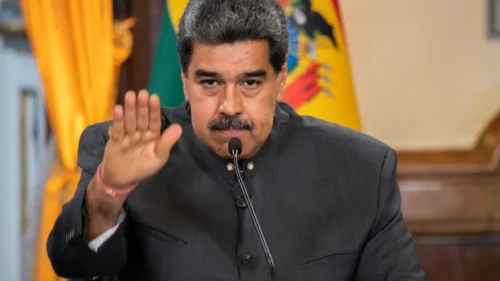
Fair Observer’s Video Producer Rohan Khattar Singh speaks with Kyle Moran, a political commentator and Young Voices contributor, about rising hostilities between the US and Venezuelan President Nicolás Maduro. The discussion explores US military strikes, oil and drug politics, regional instability and the risk that tensions could turn into open conflict.
US–Venezuela tensions
Singh notes “quite a bit of escalation” in recent weeks. US forces have carried out multiple strikes on Venezuelan boats allegedly carrying narcotics bound for the US, the latest (at time of recording) on September 15, 2025. The Pentagon has also moved aircraft and naval assets into the Caribbean, prompting speculation about preparations for war.
Moran characterizes the American strategy as one of “maximum pressure and minimum coherence.” While Washington tightens sanctions, it still allows Chevron Corporation to operate oil wells in Venezuela. The policy makes little sense because Petróleos de Venezuela, S.A., the state-owned giant, controls all exports and has even blocked shipments over unpaid fees. Since Chevron cannot pay in dollars, it compensates the regime in crude oil — effectively free oil for Maduro. Pursuing this policy while increasing military pressure, Moran argues, demonstrates the inconsistency at the heart of US strategy.
Trump wants war?
The US buildup includes Lockheed Martin F-35 Lightning II fighter jets in Puerto Rico and Navy destroyers near Venezuelan waters. Washington calls the attacks anti-narcotics operations, while Maduro claims they hit civilians. Moran believes a full invasion is unlikely, but intermediate military actions remain possible.
He argues that Maduro “has had a terrible track record” and accuses him of aiding drug networks like Cartellis de Solas and Tren Aragua. Moran agrees with US Secretary of State Marco Rubio’s condemnations, viewing the regime’s narco-terrorism links as a financial lifeline amid cash shortages. He predicts growing military escalation in the region.
Can Maduro respond?
Maduro claims to have mobilized eight million militia volunteers, but Moran says intelligence suggests the move is largely symbolic. He doubts Venezuela’s ability to counter modern US operations, arguing that its forces would struggle severely.
Moran sees the regime’s show of unity as political theater: Maduro must project national cohesion, yet the ground reality is very different. Once richer than many European countries, Venezuela now faces extreme poverty, food shortages and hyperinflation. Moran expresses sympathy for ordinary citizens and says the regime’s loss of legitimacy is “hard to overstate.”
Drugs or oil?
Venezuela holds the world’s largest oil reserves, but sanctions restrict sales mostly to China, India and Iran. The US has recently resumed small-scale purchases, a move Moran criticizes. When Singh asks whether this conflict is about oil or drugs, Moran replies that “the simple answer to that is it’s about the drugs.”
Moran labels the renewed oil purchases a “very bad misstep” akin to the era of US President Joe Biden, forced by high energy prices. The administration of US President Donald Trump both revoked and later restored oil licenses, undercutting its own maximum pressure campaign. Such policy swings, he says, expose Washington’s strategic incoherence.
China and Russia
Over ten million Venezuelans have fled abroad, destabilizing neighbors like Colombia. Moran highlights the territorial dispute over the Essequibo region with Guyana, calling Venezuela’s annexation threat an “existential threat to [...] Guyana.” Guyana is firmly aligned with the US, while Brazilian President Lula da Silva performs a “delicate balancing act” — opposing war but sympathetic to Maduro.
Among global patrons, Moran believes China wields far greater influence than Russia. He rejects the claim that US drilling deters Chinese dominance, calling it “a fever dream” designed to justify Chevron’s presence. The oil output gains from this policy, he adds, are extremely unfortunate.
Will tensions spike?
Moran predicts further action against the Venezuelan capital of Caracas. He foresees strikes stronger than recent boat attacks but short of invasion. Moran insists Trump is “not a war hawk” yet “not an isolationist.” He will use force if he deems it in the national interest.
Given deployments, Moran does not see this conflict simply disappearing, though he stops short of predicting regime change. If US forces down Venezuelan aircraft, Maduro will face a dilemma: retaliate and risk collapse, or stand down and appear weak. “If he starts bombing or really messing around with US military personnel,” Moran warns, “this is going to end badly for him.”
Moran concludes that a decisive attack would end Maduro’s regime, but limited conflict now seems more likely than peace.
[Lee Thompson-Kolar edited this piece.]
The views expressed in this article/video are the author’s own and do not necessarily reflect Fair Observer’s editorial policy.






















Comment