


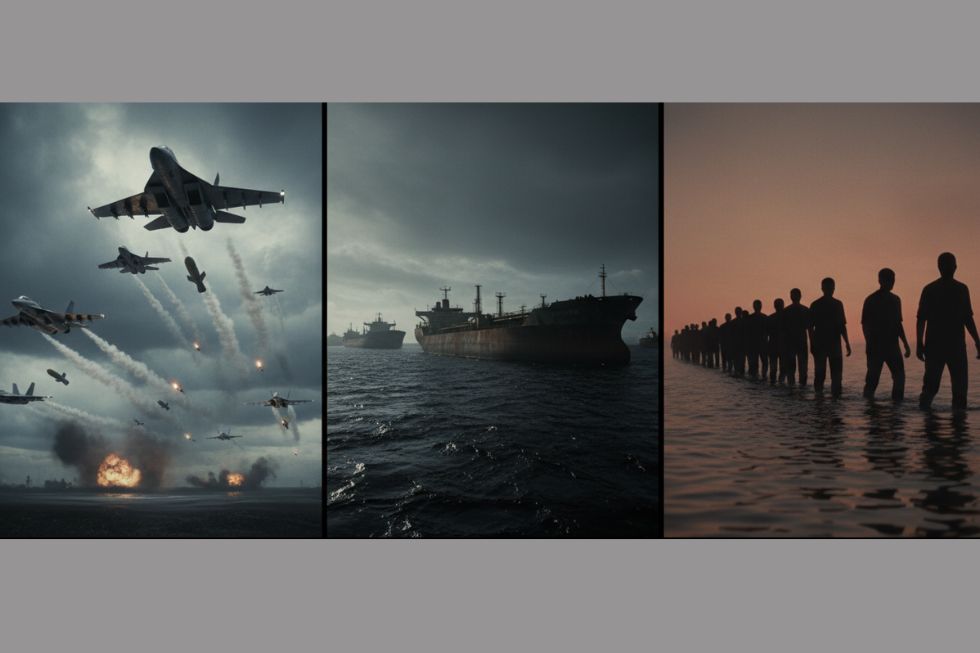



There is a stretch of water between Myanmar, Bangladesh and Thailand where the Rohingya humanitarian crisis and the interests of Iran’s “Shadow Fleet” converge. The Andaman Sea is no longer just a migratory route; it has evolved into a lethal criminal ecosystem. Here, invisibility is a deliberate strategy used to move both human lives and sanctioned fuel, ensuring supplies for the Burmese military junta’s fighter jets. In this maritime no-man’s-land, a brutal, vicious cycle unfolds: The freedom of movement enjoyed by these “ghost ships” translates into terror from the skies for those left behind in the hinterland.
The Rohingya: an endless exodus
The Rohingya, a Muslim minority from Myanmar’s Rakhine State, were stripped of citizenship and rights by a 1982 law. Victims of what the UN described in 2017 as a “textbook example of ethnic cleansing,” over 740,000 people fled to Bangladesh. Today, approximately one million of them live in the Cox’s Bazar district, home to Kutupalong, the world’s largest refugee camp. The 2021 military coup shattered any hope of repatriation, fueling a desperate, multi-stage journey toward Southeast Asia.
This hell begins in Teknaf, on the coast of Bangladesh. There, refugees brave the deadly currents of the Naf River on small, overcrowded boats that frequently capsize. Those who survive fall into the hands of traffickers, who manage clandestine departures toward the Andaman Sea from hidden mangrove inlets, packing hundreds of people onto fishing vessels to evade the Coast Guard.
Welcome aboard the “ghost” ships
Once at sea, the operational phase known as the “Ghost Protocol” begins. This involves deactivating the Automatic Identification System (AIS) — a tactic technically referred to as “going dark.” By switching off these electronic transponders, traffickers eliminate all traceability of the vessel’s route and position. By becoming invisible to radar, the vessels transform into floating prisons. Deprived of Wi-Fi, traceability and legal protection, refugees are ammassed in fish holds. This lack of connectivity is not a technical limitation, but a deliberate strategy by smugglers to prevent the reporting of abuse and torture used to extort money from families.
In this technological limbo, the crews themselves become invisible slaves, recruited through deception and forced into months of sailing without pay. The practice of going dark eliminates any chance of assistance: In the event of a breakdown, no signal exists to guide rescuers. Data from 2025–2026 confirms the lethality of the Andaman Sea route: One in five people is reported missing or dead. With over 600 confirmed victims in the past year, the true toll remains tragically uncalculable.
The Junta link: the ship-to-ship operations fueling the airstrikes
Myanmar’s instability has transformed the Andaman Sea into a military corridor disguised as a migration route. The networks transporting Rohingya south toward Malaysia and Indonesia are often the same ones that, through ship-to-ship (STS) operations in international waters, supply the military junta with sanctioned fuel (Jet A-1). Without these maneuvers, the regime would be unable to power the Chinese-made jets and drones responsible for bombing civilians. Precisely because it is prohibited, the junta must rely on STS operations to bring fuel into the country while concealing its origin.
Large “mother ships” loaded with crude oil from the Russian Federation or Iran — countries officially under international sanctions — transfer their cargo on the high seas to the Burmese shadow fleet, which operates on behalf of the junta. Once there, the fuel is “laundered” by falsifying documents to make it appear to have originated from legitimate Southeast Asian ports: a proven mechanism that finances authoritarian regimes through these invisible fleets.
Justice at sea: the cynical game of bouncing and reflagging
The tragedy is amplified by “informal pushbacks.” In the absence of a coordinated Search and Rescue (SAR) system, such as the one in the Mediterranean, boats are bounced between the Exclusive Economic Zones (EEZs) of Thailand, Malaysia and Indonesia. Extreme abuses have been documented, including refugees forced to jump into the open sea and swim for miles back toward Myanmar under armed threat. Despite the High Seas Treaty (BBNJ) entering into force in January 2026 — adopted by the UN — the protection of human life in Southeast Asia remains a mirage.
While the treaty aims for transparency, Myanmar’s instability and the region’s fragmented sovereignty allow shipowners to bypass all oversight. By changing flags (reflagging) with staggering speed, vessels mask their maritime criminal records. By exploiting “shadow states” like the Comoros, Panama or the Cook Islands, they operate within a bureaucratic gray zone. Small island nations become involuntary accomplices in a system that guarantees impunity. International authorities find themselves chasing not physical ships, but “ghosts” that switch identities every time they approach a new port or a refueling operation, making their capture nearly impossible.
While the International Court of Justice in the Hague proceeds with the genocide case against Myanmar, the Rohingya tragedy in the Andaman Sea remains the result of a criminal architecture that exploits the physical and digital geography of Southeast Asia. As long as the world permits the existence of a ghost fleet beyond any rules, the sea will continue to be a place of silent violations. To save lives, we must first turn on the radars, enforce on-board connectivity and recognize that every deactivated AIS signal is a potential crime against humanity. Breaking the cynicism of the “bouncing game” is the only way to restore dignity to these people that the world has left invisible for too long.
[Kaitlyn Diana edited this piece.]
The views expressed in this article are the author’s own and do not necessarily reflect Fair Observer’s editorial policy.
FO° Podcasts: Myanmar Votes During a Civil War: Why This Election Could Tear the Country Apart
In this episode of FO° Podcasts, Rohan Khattar Singh and Asanga Abeyagoonasekera examine Myanmar’s December 28 elections against the backdrop...

Reconciliation in a Broken State — Myanmar’s Civil War and the Illusion of Elections
Myanmar has been gripped by civil war, leading to widespread suffering, poverty and displacement since the military coup in 2021....

The Rohingyas’ Plight Continues Though the World Has Forgotten
In 2017, Myanmar exiled over a million of its chiefly Muslim Rohingya minority. Bangladesh is struggling to support the exiles,...
Support Fair Observer
We rely on your support for our independence, diversity and quality.
For more than 10 years, Fair Observer has been free, fair and independent. No billionaire owns us, no advertisers control us. We are a reader-supported nonprofit. Unlike many other publications, we keep our content free for readers regardless of where they live or whether they can afford to pay. We have no paywalls and no ads.
In the post-truth era of fake news, echo chambers and filter bubbles, we publish a plurality of perspectives from around the world. Anyone can publish with us, but everyone goes through a rigorous editorial process. So, you get fact-checked, well-reasoned content instead of noise.
We publish 3,000+ voices from 90+ countries. We also conduct education and training programs
on subjects ranging from digital media and journalism to writing and critical thinking. This
doesn’t come cheap. Servers, editors, trainers and web developers cost
money.
Please consider supporting us on a regular basis as a recurring donor or a
sustaining member.
Will you support FO’s journalism?
We rely on your support for our independence, diversity and quality.





Comment