


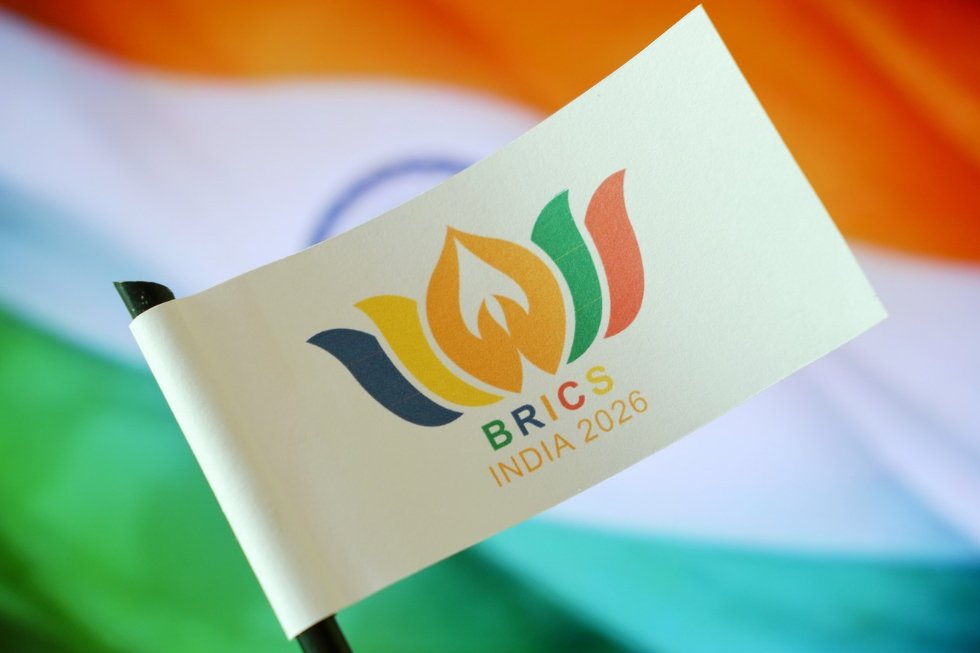



On September 12 and 13, New Delhi hosted the 18th BRICS summit under the solemn theme “Resilience, Innovation, Cooperation and Sustainability.” It was a fine formula, but what reality did it cover? For the first time in their history, the BRICS met with members waging war on one another, members who had just signed military alliances directed against other members and a host country, India, that enforces American sanctions against its own strategic partner, Russia.
The summit ultimately closed with a joint declaration calling on the parties to the Middle East conflict to exercise “maximum restraint” — a diplomatic win for the Indian chairship. But that common text, wrung out at great cost, papered over only the surface of the deep fractures still running through the bloc.
A meeting without a communiqué
On May 14 and 15, the BRICS foreign ministers met in New Delhi. They failed to issue a joint communiqué. India acknowledged divergent views among certain members on the war in the Middle East. Iranian Foreign Minister Abbas Araghchi had called on member states to condemn “violation[s] of international law” by the United States and Israel. The Emirati delegation rejected his statements. This was no matter of detail or diplomatic nuance. It was a profound disagreement laid bare at the Indian chairship. This failure was not the first.
The BRICS had already run into a comparable deadlock in April 2025: Egypt and Ethiopia, which joined the club in 2024, objected to the ministers’ text naming South Africa among the candidates for a permanent seat on a reformed Security Council. Yet, since the Sanya summit in 2011, that mention had been a matter of course. In other words, expansion had begun to paralyze consensus even before war broke out between members.
Members at war
On February 28, 2026, Iran struck the United Arab Emirates and Saudi Arabia. All three countries are BRICS members. What a contrast with the month before, when, in January, Russia, China and Iran were conducting joint naval exercises in South African waters. This rapid swing from shared maneuvers to war between members of the same “club” illustrates a dynamic that may well be inevitable: the wider the alternative BRICS coalition grows, the more its members’ diverging interests come into view.
According to the Washington Post of March 11, US President Donald Trump is said to have launched the US attack on Iran after weeks of intense lobbying by an unusual pair: Israel and Saudi Arabia. Crown Prince Mohammed bin Salman of Saudi Arabia reportedly argued the case for an attack over several telephone calls with Trump.
After the strikes began, Gulf allies led by Saudi Arabia and the Emirates are further said to have pressed Trump to continue the war against Iran, judging that Tehran had not yet been sufficiently weakened. In other words: two countries close to the BRICS (Saudi Arabia has never formally joined) actively encouraged Washington to attack a third BRICS member — and then argued for that war to go on.
Less grave, but no less revealing, is the Indonesian case. On April 1, the Quincy Institute warned that American military operations in the Gulf risked “severely degrading US military readiness in other critical areas of national interest, particularly the Indo-Pacific.” That risk led Indonesia — the tenth BRICS member since January 2025 — to hastily consolidate its military alliance with Washington within an architecture aimed at China’s rise. A BRICS member reinforcing an alliance against another founding member sums up the bloc’s structural incoherence.
India, a chair under sanctions
The least comfortable position is not the host country’s. By letting the authorization allowing New Delhi to buy discounted Russian oil expire on April 11, Washington deprived India of a supply it had fought hard to secure. New Delhi complied. In doing so, India is enforcing American sanctions against Russia — its historic partner, whose president it welcomed back to New Delhi on September 12 and 13.
The cruel irony is that India provides the technical coordination for BRICS Pay, the SWIFT alternative whose rollout the New Delhi summit was meant to accelerate. At the summit, the final declaration confined itself to promoting the interlinking of national payment systems and trade in local currencies, with no formal launch announced. The country enforcing American sanctions against Russia remains in charge of building the financial system meant to circumvent them — and is careful not to hurry. No speech could illustrate India’s strategic schizophrenia better than this paradox.
The real stakes still need measuring. The threat of a BRICS-driven de-dollarization is largely a Washington fantasy: As of August, the dollar still accounts for 57% of global foreign exchange reserves, 54% of export invoicing and 89% of foreign exchange transactions. No other currency, the yuan included, comes close to those levels.
More to the point, the BRICS’ own contribution to the marginal erosion already observed is very small: Russia is the only member genuinely motivated, Chinese enthusiasm remains lukewarm, and India and Brazil alike have explicitly denied any intention of creating a rival currency. India’s schizophrenia is therefore less an exception than a symptom: no one in the club is truly willing to pay the political price of what everyone says they want to build.
The American paradox
If the BRICS are not a revolutionary grouping but a reformist one — attached to state sovereignty, the UN system and economic development — then American hostility is largely a self-fulfilling prophecy. Since returning to office, Donald Trump has regularly threatened members of the bloc with 100% tariffs, and his commerce secretary gave India an explicit ultimatum in September 2025 to stop buying Russian oil and to leave the BRICS or suffer 50% tariffs.
In the short term, the pressure has worked, causing New Delhi to give way on Russian crude oil. In the medium term, it produces the opposite of the intended effect. What the Global South seeks in the BRICS is not an anti-American crusade but a hedge against Washington’s unpredictability. When the United States weaponizes the dollar and secondary sanctions, it hands the club’s members the one thing they lack today: a shared reason to overcome their differences.
A diplomatic challenge for India
If the truth about the BRICS in 2026 is uncomfortable, it is not hopeless: the bloc houses several projects that coexist without merging. The Russo-Chinese BRICS wants to build an alternative to the dollar. The BRICS of the Gulf monarchies seeks to diversify its alliances without breaking with Washington — Saudi Arabia declining, for that matter, to formalize its membership so as not to ruffle the United States. The Indian BRICS aspires to great-power status without the ideological constraints. And the Iranian BRICS seeks international legitimacy at the very moment it is at war with two of its fellow members.
These tensions are real, but they are not without precedent in the history of the great multilateral institutions: the UN survived the Cold War, the G20 the financial crisis of 2008, NATO its own internal contradictions. The question posed by the New Delhi summit is not whether the BRICS can survive their divisions — they can, as all institutions do. It is whether they can turn those divisions into a resource rather than a paralysis.
A bloc that brings together, at one and the same time, belligerents, potential mediators, energy powers and growing economies possesses in theory a capacity for mediation that neither NATO nor the G7 can claim. On September 12 and 13, Indian Prime Minister Narendra Modi chaired a table seating Iran and its targets, Russia and those enforcing the Western sanctions that bear down on it, Washington’s partisans and its rivals.
On the face of it, the outcome proved the optimists right: a joint text calling for restraint in the Middle East, a reaffirmation of support for a “non- discriminatory, open, fair, transparent and just” multilateral trading system in the face of Donald Trump’s tariff war, and the carefully staged images of Russian President Vladimir Putin and Chinese President Xi Jinping symbolically planting trees alongside the Indian prime minister. Xi summed up the bloc’s ambition by warning that “a world without rules is like a crossroads without a traffic lights: chaos and disorder are inevitable.”
However, the unity on display in New Delhi remains above all rhetorical. Not one of the structural fractures described above was resolved by the final declaration: not the Sino-Indian border dispute, unsettled since 1962; not India’s record trade deficit with China; not the American sanctions that continue to weigh on trade with Russia; not the rivalries pitting Iran against two of its Gulf partners. New Delhi showed that the BRICS could still produce a common text. It did not show that they could produce a common policy.
[Charlie Smith edited this piece.]
The views expressed in this article are the author’s own and do not necessarily reflect Fair Observer’s editorial policy.
How Drone Warfare Is Rewiring Geopolitics and Rewriting the Age of Superpowers
The rise of cheap drones is reshaping global warfare, challenging traditional superpower dominance and eroding US hegemony. Conflicts in Ukraine...

Putin–Xi Summit Was an Exercise in Diplomatic Discipline and Strategic Alignment
Russian President Vladimir Putin’s visit to Beijing highlighted the deepening strategic partnership with China, contrasting sharply with the transactional nature...
China Watch: The Rise of a New Global Order Amidst the Persian Gulf War
China’s strategic restraint in the recent war in Iran contrasts with US aggression, positioning it as a stabilizing global force...
How the US–Israel–Iran War Costs the Gulf States
The US-Israeli attacks on Iran have placed the Gulf states, particularly the Gulf Cooperation Council members, in a precarious position....
Support Fair Observer
We rely on your support for our independence, diversity and quality.
For more than 10 years, Fair Observer has been free, fair and independent. No billionaire owns us, no advertisers control us. We are a reader-supported nonprofit. Unlike many other publications, we keep our content free for readers regardless of where they live or whether they can afford to pay. We have no paywalls and no ads.
In the post-truth era of fake news, echo chambers and filter bubbles, we publish a plurality of perspectives from around the world. Anyone can publish with us, but everyone goes through a rigorous editorial process. So, you get fact-checked, well-reasoned content instead of noise.
We publish 3,000+ voices from 90+ countries. We also conduct education and training programs
on subjects ranging from digital media and journalism to writing and critical thinking. This
doesn’t come cheap. Servers, editors, trainers and web developers cost
money.
Please consider supporting us on a regular basis as a recurring donor or a
sustaining member.
Will you support FO’s journalism?
We rely on your support for our independence, diversity and quality.





Comment