


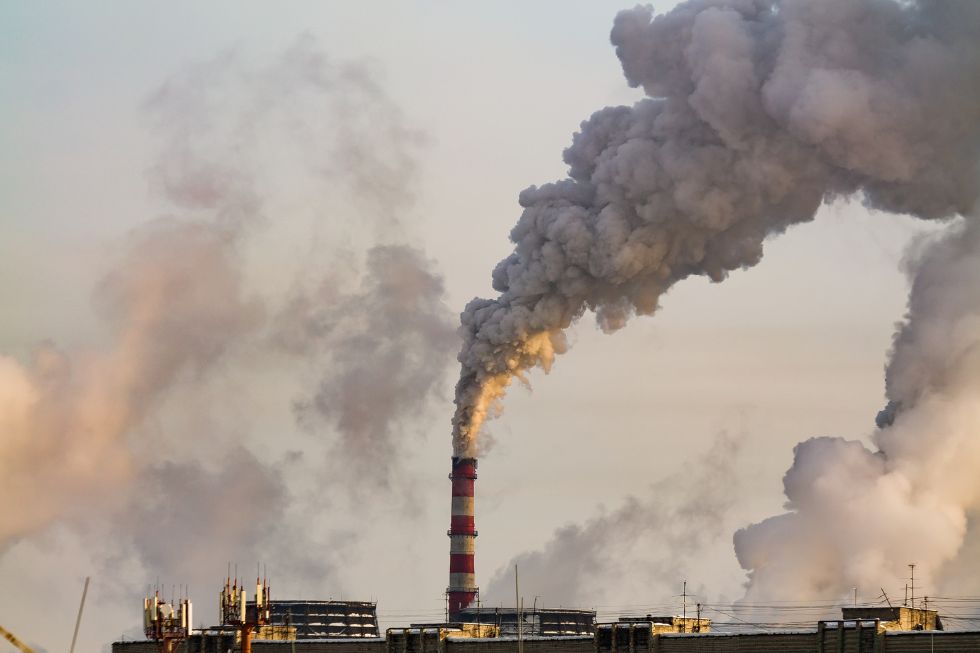



The latest splash in the Trump Administration’s flood-the-zone strategy was the repeal of the Endangerment Finding, an Obama-era policy that monitors greenhouse gas emissions. There are concerns that once the repeal emerges from the US legal system, it will accelerate emissions in the US, contributing to global warming and exposing Americans to harmful pollution. However, a haphazard approach to policymaking in the Federal Government may moderate the extent to which businesses choose a costly path of pollution, and industry might instead look to the next election cycle for long-term stability.
What is the Endangerment Finding?
The Endangerment Finding was signed in late 2009 under President Barack Obama and stated in inauspicious legalese that “the Administrator finds that the current and projected concentrations of the six key well-mixed greenhouse gases … in the atmosphere threaten the public health and welfare of current and future generations.”
The finding determined that the Environmental Protection Agency (EPA), via the Clean Air Act, was legally required to regulate harmful pollutants. A raft of environmental regulation followed, including greenhouse gas (GHG) standards and permits for large emitters, such as car and aircraft manufacturers, as well as Clean Power Plans for the US’ energy mix.
From a national health perspective, the finding was a tremendous success. In 2009, over 128,000 deaths in the US were attributed to air pollution. By 2023, this had dropped to 82,000, according to Our World in Data.
The repeal and immediate reactions
Still, on February 12, 2026, the Trump Administration announced an “elimination” of the Obama-era finding, allowing the EPA to wash its hands of its responsibility to regulate harmful emissions.
A White House article published the next day announced with great fanfare that the repeal would be the “biggest regulatory relief in history.” The press briefing was unequivocal and brief in its summary: “lower prices, more freedom, and a stronger economy for every American,” along with quotes from spokespeople from the Petroleum Alliance, the Heritage Foundation and the American Energy Alliance.
What follows will be a lengthy legal process full of challenges. Within the week, a collection of health and environmental groups filed a lawsuit against the Environmental Protection Agency in the US Court of Appeals for the District of Columbia. Now all eyes are watching to see whether the DC Circuit will issue a stay or an injunction that would block the repeal as the legal challenges play out.
The legal grounds for the repeal will depend on whether the court judges that it was not arbitrary or capricious, inconsistent with the Clean Air Act and in keeping with the latest science. The Federal Government was dealt a blow regarding the latter when a federal court struck down a Department of Energy report in August 2025 that sought to downplay the impacts of climate change. Depending on the outcome, an appeal might bring the challenge to the Supreme Court, which is currently in the Trump Administration’s bad books after rejecting the President’s tariff plan.
A final resolution could take months or even years as it squirms through the due process. The outcome of the midterm elections, despite many polls predicting a Democratic slide, is unlikely to deliver the kind of supermajority needed to reverse the repeal via the Congressional Review Act.
Environmental and market impacts
There are concerns among environmentalists and health experts that the repeal, if and when it is pushed out of the legal system, could have significant impacts on the environment and the wider US economy.
The environmental impacts of the repeal of the Endangerment Finding could see a bounce-back in US emissions of carbon dioxide, which have been on a downward trend since 2007, and other pollutants, such as toxic heavy metals produced in coal combustion, that can be deadly when inhaled.
But there are mitigating factors that might dampen an emissions boom. For one, there is the possibility of a state-level fightback. Twenty-four (mainly blue) States and the District of Columbia all have greenhouse gas reduction targets independent of the Clean Air Act, and some, like California, have their own industrial standards and cap-and-trade emissions schemes.
It is also unclear if market forces will continue to follow the Endangerment Finding after it is repealed. The US automobile industry exported 1.6 million light vehicles in 2023. These same industries might be disadvantaged in export markets as environmental levy policies are put in place for dirtier products. Indeed, there is discussion within the EU that the Carbon Border Adjustment Mechanism, which today applies only to imported materials, might be expanded to finished products like cars in 2028.
The repeal could negatively impact high-value American industries, redirecting capital and innovation in the US away from rapidly growing markets, like those for electric vehicles. In late 2025, Ford canceled its program to develop its fully electric F-150, while in January, General Motors took a $6 billion write-down on its EV investments. The result will be sacrificing ground to China in the ever-expanding global market for electric vehicles, and begs the question: Could industry innovation be endangered by the repeal of the Endangerment Finding and a return to 2009?
Business uncertainty and regulatory volatility
For some businesses, long-term investments in factories and less clean energy infrastructure might prove too costly. Board members will have one eye on the prospect of a switch back to the Democrats in the next election cycle, and might be dizzied by a tightening and loosening of the regulatory environment every half-decade.
In the carefully chosen words of Goldman Sachs CEO David Solomon, addressing Fox Business in the build-up to last year’s tariff Liberation Day: “The more we can have certainty on the policy agenda as we move forward, the better that’s going to support capital investment”.
Business leaders across the country are looking for a new normal, but the issue is that nothing about politics today is normal. The largest confounding factor is the Trump Administration’s flip-flopping, back-tracking and contradictory approach to government oversight and intrusion into citizens’ lives.
On the one hand, the repeal is the latest example of a federal strategy aimed at reducing departmental spending and powers, especially in departments that have not traditionally aligned with Make America Great Again (MAGA) objectives, begun and imperfected with the Department of Government Efficiency’s job cuts of over 200,000 federal workers and contractors.
On the other hand, the incumbent Presidency is only too happy to support branches of government with unprecedented and “absolute immunity” to carry out its goals, with $78 billion put aside as funding for Immigration and Customs Enforcement (ICE), in addition to levying sweeping global tariffs of 10% on all countries.
For example, the drill-baby-drill and “beautiful clean coal” mantras have been one of the more consistent Trump 2.0 policies. Despite that, year-on-year coal consumption in the USA’s electricity mix is projected to decrease in 2026, according to the United States Energy Information Administration.
In the short term, the upheaval of political life in the US today may well have a moderating impact on the industrial response to the repeal of the Endangerment Finding, even if and when it comes out the other side of the courts.
After that, the real battle may well only take place after the next election. Whatever happens, the incoming President will have important and long-lasting decisions to make about the future of American industry and the health and safety of its people. But for now, as an antidote to the string of climate backsliding that began with the US’s withdrawal from the Paris Agreement on the President’s first day back in the White House, the adage of the Trump Administration’s latest attempt to derail climate action may well be: Everything happens, nothing changes.
[Kaitlyn Diana edited this piece.]
The views expressed in this article are the author’s own and do not necessarily reflect Fair Observer’s editorial policy.
We’re Racing Down the Highway to a Mad Max World
Relentless fossil fuel use and economic growth are driving a climate crisis that demands a shift toward degrowth to avoid...

How US States Can Protect the Environment From Federal Rollbacks and Intervention
US President Donald Trump’s environmental rollbacks have sparked a constitutional clash over states’ rights, prompting governmental resistance. Democratic-led states are...

Trump Two Is a Formula for Hell on Earth
Donald Trump is a modern-day Joe McCarthy with exponentially more destructive reach — set to supercharge climate chaos, social disintegration...
Support Fair Observer
We rely on your support for our independence, diversity and quality.
For more than 10 years, Fair Observer has been free, fair and independent. No billionaire owns us, no advertisers control us. We are a reader-supported nonprofit. Unlike many other publications, we keep our content free for readers regardless of where they live or whether they can afford to pay. We have no paywalls and no ads.
In the post-truth era of fake news, echo chambers and filter bubbles, we publish a plurality of perspectives from around the world. Anyone can publish with us, but everyone goes through a rigorous editorial process. So, you get fact-checked, well-reasoned content instead of noise.
We publish 3,000+ voices from 90+ countries. We also conduct education and training programs
on subjects ranging from digital media and journalism to writing and critical thinking. This
doesn’t come cheap. Servers, editors, trainers and web developers cost
money.
Please consider supporting us on a regular basis as a recurring donor or a
sustaining member.
Will you support FO’s journalism?
We rely on your support for our independence, diversity and quality.





Comment