


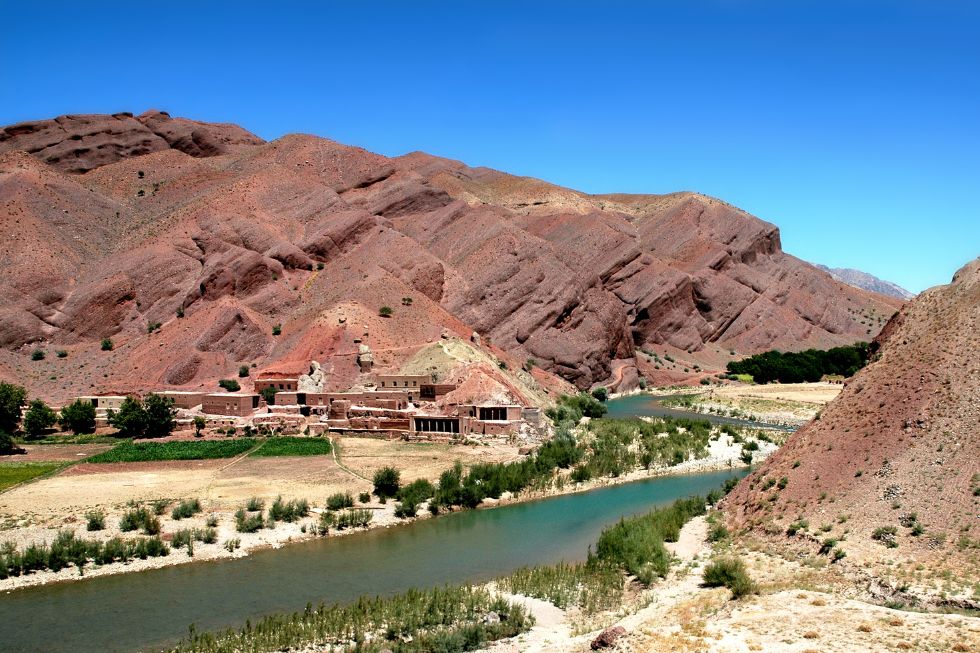


In early 2026, the Harirud River Basin stands at a catastrophic crossroads. This 1,124-kilometer transboundary lifeline is in a state of “water bankruptcy.” Over the last 30 years, average discharge has plummeted by 50%. It is now the fourth most water-stressed basin globally. The river originates at an elevation of 3,000 meters in the Baba Mountains of Afghanistan. It sustains a region where 70–90% of the population depends on subsistence agriculture.
The basin’s survival depends on dismantling unilateral “hydro-hegemony.” We must move beyond regional finger-pointing. Instead, a new trilateral framework must be established. This framework should recognize the residents of Ghor and Herat as the primary custodians and sovereign stakeholders of the river.
Climate shifts and hydrological collapse
Climate change has fundamentally decoupled the Harirud from its historical snow-melt cycles. Average temperatures in the basin have increased by 1.7°C (3.06°F) since 1980. Rainfall has declined by roughly 150 millimeters. The Baba Mountain glaciers serve as the basin’s “water tower.” They have experienced a nearly 40% reduction in surface area over four decades.
The basin is currently enduring its sixth consecutive year of drought. Surface water resources have decreased by 29%. This represents a loss of approximately 1 billion cubic meters of available water. Even during the spring thaw, the riverbed remains dangerously low. It fails to meet the minimum ecological flow requirements for regional biodiversity.
Geopolitical misconceptions and the “single-source” myth
A primary hurdle in regional diplomacy is a false narrative. Many believe the water of the Harirud is solely the responsibility of Afghanistan. In reality, the catchment area is shared. Afghanistan accounts for 39.5%, Iran for 43.7% and Turkmenistan for 20.9%. Although the headwaters are in Afghanistan, critical tributaries, such as the Kashafrud River in Iran, join the system.
This “single-source” myth allows downstream states to evade responsibility. Downstream nations demand “customary rights” from the headwaters in Afghanistan while often obstructing secondary branches within their own borders. This selective focus distorts the diplomatic narrative.
This situation highlights a critical water management disparity. Afghanistan utilizes only about 40% of its potential surface water resources due to conflict-damaged infrastructure. Meanwhile, neighbors Iran and Turkmenistan heavily exploit their resources, even exceeding sustainable limits. This causes aquifer stress and water scarcity, impacting agriculture, drinking water and regional stability.
The infrastructure imbalance: diversion to Mashhad
A technical comparison of reservoir capacities debunks claims that development in Afghanistan is the sole cause of downstream scarcity:
- The Doosti (Friendship) Dam: Built jointly by Iran and Turkmenistan in 2004 without consultation with Afghanistan. It has a massive capacity of 1,250 million cubic meters (m³). Critically, this dam functions as a mechanism for interbasin water transfer. It diverts water out of the Harirud system to supply Mashhad, Iran’s second-largest city.
- The Pashdan Dam: Inaugurated in August 2025, this project in Afghanistan has a capacity of 54 million m³. It irrigates 13,000 hectares of Herati land. This represents only 4.3% of the total volume of the Doosti Dam.
- The Salma Dam (Afghanistan-India Friendship Dam): This project has a capacity of 633 million m³.
The Salma Dam is situated nearly 480 kilometers upstream of the Doosti Dam. This vast distance means the Harirud passes through hundreds of kilometers of arid terrain and irrigation zones before reaching the border. The storage deficit at the Doosti Dam is clearly driven by systemic losses and the 180-kilometer pipeline diversion to Mashhad, which sits outside the natural flow of the Harirud River.
Furthermore, Salma is not a “new” infrastructure. The project was initially conceived in 1957, and construction began in 1976. For four decades, its completion was a known factor in regional hydrology. The current collapse of the Doosti reservoir is a result of the 1.7°C temperature rise, not upstream impoundment.
Ghor and Herat: the epicenter of custodianship
The residents of Ghor and Herat are the frontline victims. Ghor is the “water tower” where the river begins. Herat was the most productive agricultural hub of the basin, but multi-year droughts have displaced thousands of families in western Afghanistan.
Survival depends on local stewardship. The ancient irrigation “blocks” of Herat follow the 16th-century Ab Bakhshi treatise by Qasim Haravi. This manuscript remains a legal reference for water conflicts today. Modernizing this traditional system with lined canals could reduce water losses from seepage by 50%. This would directly benefit the families who have protected this river for generations.
The path toward a basin-wide plan: a strategic framework
Addressing “water bankruptcy” requires a multidimensional approach that balances high-level diplomacy with grassroots custodianship:
1. Establishing trilateral data transparency and a joint monitoring body: The first step toward stability is the creation of a permanent, trilateral technical committee involving Afghanistan, Iran and Turkmenistan. This committee must facilitate the transparent exchange of real-time data on all tributaries. This includes the Kashafrud River and other secondary branches originating in Iran. By establishing a common hydrological baseline, the three nations can move away from political rhetoric and toward evidence-based allocation and joint drought forecasting.
2. Modernizing local custodianship through integrated management: We must bridge the gap between ancient wisdom and modern technology. We must modernize community-led irrigation by integrating pressurized systems and satellite-monitored soil sensors. These upgrades should be managed directly by the local Mir Abs (Water Masters). Empowering local stakeholders ensures “buy-in” and compliance that top-down treaties often lack.
3. Addressing interbasin transfer inequities through benefit-sharing: Negotiations must confront the unsustainable practice of interbasin transfers. The Doosti Dam’s primary function — supplying Mashhad at the expense of the Harirud’s internal ecology — is a major driver of regional scarcity. Treaties must prioritize the basin’s ecology over external urban demand. Downstream nations must invest in internal recycling and desalination rather than further depleting the Harirud. A “basin-first” policy could be supplemented by a benefit-sharing model in which downstream gains contribute to upstream water efficiency.
4. Legal harmonization and accountability: Regional water management must be codified within a robust legal framework of “equitable and reasonable utilization.” This requires harmonizing national water laws with international standards. By moving toward a unified basin-wide plan, the Harirud can transform from a source of conflict into a model for regional cooperation and climate resilience.
[Kaitlyn Diana edited this piece.]
The views expressed in this article are the author’s own and do not necessarily reflect Fair Observer’s editorial policy.
China Builds Mega Dam to Gain Leverage Over South Asia
China is building the world’s biggest dam on the Brahmaputra River to boost its power and sway in South Asia....
Iran-Afghanistan Tensions Now Rising Over Water
In March 2021, Afghanistan opened the gates to the Kamal Khan Dam. According to Iran, its neighbor is clearly violating...
Support Fair Observer
We rely on your support for our independence, diversity and quality.
For more than 10 years, Fair Observer has been free, fair and independent. No billionaire owns us, no advertisers control us. We are a reader-supported nonprofit. Unlike many other publications, we keep our content free for readers regardless of where they live or whether they can afford to pay. We have no paywalls and no ads.
In the post-truth era of fake news, echo chambers and filter bubbles, we publish a plurality of perspectives from around the world. Anyone can publish with us, but everyone goes through a rigorous editorial process. So, you get fact-checked, well-reasoned content instead of noise.
We publish 3,000+ voices from 90+ countries. We also conduct education and training programs
on subjects ranging from digital media and journalism to writing and critical thinking. This
doesn’t come cheap. Servers, editors, trainers and web developers cost
money.
Please consider supporting us on a regular basis as a recurring donor or a
sustaining member.
Will you support FO’s journalism?
We rely on your support for our independence, diversity and quality.





Comment
Thanks,
You say “Addressing “water bankruptcy” requires a multidimensional approach that balances high-level diplomacy with grassroots custodianship:«
Laudable.
But how.?