


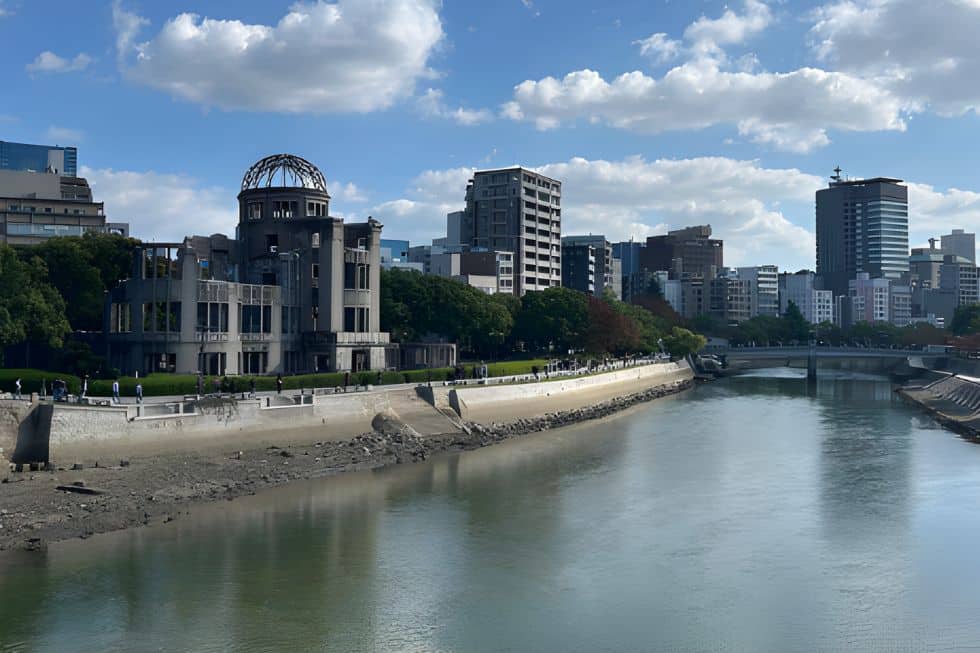



I’ve had the unique opportunity to visit Hiroshima three separate times within the span of nine months. Each visit had a purpose and took place within a personal and professional context distinct from the others. If not for the plaques, memorials and, of course, the Genbaku Dome, it would be hard to believe such a serene city would be the site of “hell on earth” 80 years ago.

Seeing humanity in everyday Hiroshima
When you walk the streets of Hiroshima, you’ll never be able to guess if the grandmother with a poor gait passing you was the sole survivor of her family in the bombings, or if the gray-haired man was in utero during the bombings. The middle schooler in uniform may come from a family that experienced discrimination due to their exposure to A-bombs, and her mother may harbor resentment toward the Japanese government for never acknowledging the pain inflicted on Koreans who were involuntarily brought to serve a nation that denies their dignity.
Experiencing the ordinary in an extremely unordinary city shifts your perspective on the history of human atrocity. What we so often gloss over in history books and mass media, occurring 80 short years ago, appears in the rhythm of daily living with an overwhelming mundanity and a horrifying profundity.
When I see the habits and mannerisms of my own grandparents in these brave, merciful Hibakusha (survivors of the atomic bomb), the unconscious rationalizations that help me justify the bombings as an American citizen are overridden by the power of human connection and compassion. Citizens are treated like pawns in any militaristic society, sacrificed in atrocious ways, often not for their country’s common good, but the corrupted aims of their leaders and generals.
Leaning into the humanitarian within me
What Hiroshima taught me is to lean into the humanitarian within me and implore my friends, family and community to do the same. As an aspiring public servant and diplomat from the United States, I wish to remember the human component in all of my professional endeavors. This task is easier said than done.
Campaigning, political compromises, utilitarian decision-making and diplomatic negotiations can often trivialize the multitude of human stories that even the most minute policy outcomes will impact. In this cynical world we live in, I often ask myself how I can advance each human being as an end in themselves, rather than as a means to an end that benefits me professionally and politically. I refuse to accept that entering the political sphere requires a degradation in moral character.
“The real problem of humanity is the following: We have Paleolithic emotions, medieval institutions and godlike technology. And it is terrifically dangerous, and it is now approaching a point of crisis overall.” — Edward O. Wilson
People in my life ask, “Why diplomacy?”. Our human family has advanced rapidly in the last few centuries; yet, we collectively never seem to realize the limitations (and power) placed upon us by our emotional wiring. Technological innovations will bridge critical gaps in industries such as engineering, nuclear medicine and cloud computing. It will never solve the subjective difficulties of embodied human dialogue, which have consequences in interpersonal, inter-community and international relations.
I consider myself blessed to have not one, but three separate opportunities to engage in meaningful dialogue with students, activists and Hibakusha in the inspiring city of Hiroshima, Japan.

Holding onto hope in global conflict
Many people, including myself, feel despair when reading the news about the conflicts in Ukraine, Gaza, Sudan and other places. Individual action is seemingly minuscule compared to political summits, diplomatic negotiations and military exchanges. However, conversations between groups, irrespective of nationality, foster understanding and build unimaginable connections between thoughtful individuals around the world.
We cannot lose hope in these times, for a lack of hope now will render us powerless in the most hopeless of times. A reminder to my fellow Americans who may be reading this: our country has the privilege to govern itself directly and indirectly, and we still have a multitude of issues. Now imagine people in countries and territories who cannot afford to dissent, and pay with their lives for speaking truth to power.
It is overused, but people are not their governments. If Hiroshima has taught me anything, it is this simple lesson. I conclude this reflection with the profound words of Nelson Mandela: “The best weapon is to sit down and talk.”
[Kaitlyn Diana edited this piece.]
The views expressed in this article are the author’s own and do not necessarily reflect Fair Observer’s editorial policy.
Eighty Years After Hiroshima: Why Nuclear Deterrence Will Remain
The Hiroshima bombing on August 6, 1945, marked a pivotal moment, sparking debates and transforming warfare through nuclear deterrence. Despite...
Was the Bombing of Hiroshima and Nagasaki the Mother of All War Crimes?
If the bombing of Hiroshima and Nagasaki was a war crime, it was nothing more than another episode in a...

Support Fair Observer
We rely on your support for our independence, diversity and quality.
For more than 10 years, Fair Observer has been free, fair and independent. No billionaire owns us, no advertisers control us. We are a reader-supported nonprofit. Unlike many other publications, we keep our content free for readers regardless of where they live or whether they can afford to pay. We have no paywalls and no ads.
In the post-truth era of fake news, echo chambers and filter bubbles, we publish a plurality of perspectives from around the world. Anyone can publish with us, but everyone goes through a rigorous editorial process. So, you get fact-checked, well-reasoned content instead of noise.
We publish 3,000+ voices from 90+ countries. We also conduct education and training programs
on subjects ranging from digital media and journalism to writing and critical thinking. This
doesn’t come cheap. Servers, editors, trainers and web developers cost
money.
Please consider supporting us on a regular basis as a recurring donor or a
sustaining member.
Will you support FO’s journalism?
We rely on your support for our independence, diversity and quality.





Comment