Dear FO° Reader,
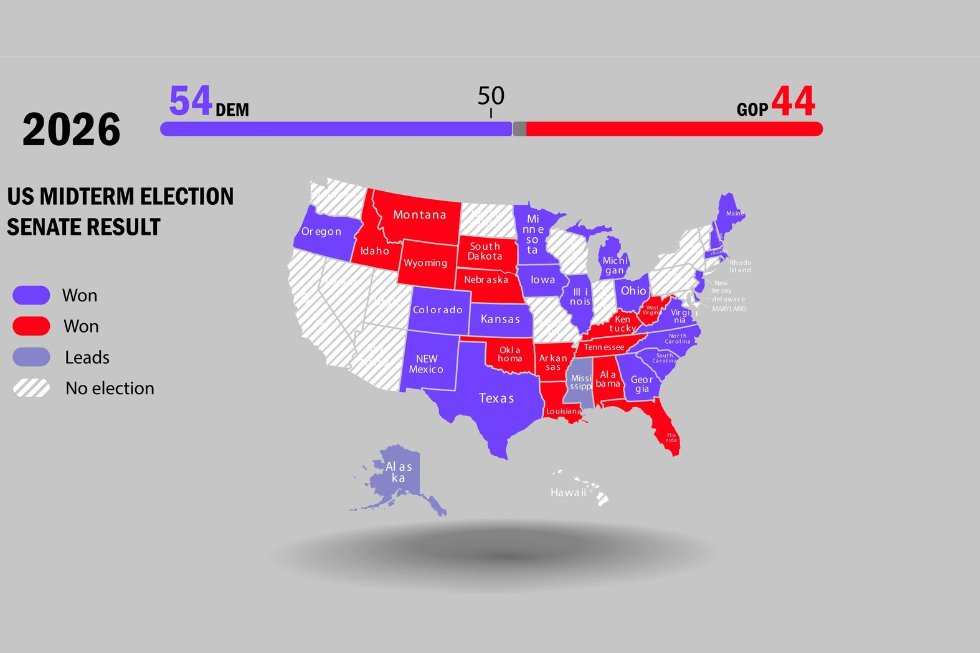
As many of you may have likely already heard, the US midterm elections were held on November 3. The results were dramatic and have been called a generational shift, with the left-leaning Democratic Party trouncing the ruling right-wing Republican Party. The Republicans lost control of both the House of Representatives and the Senate by dramatic margins, as well as many state governorships and legislatures in Republican strongholds such as Texas and Kansas.
While these results were largely fueled by anger at the Republican Party as a whole, the true culprit is US President Donald Trump. Trump has always been a divisive figure at the best of times ever since his first election in 2016, but his latest two years in power have been especially chaotic, with troops deployed in major cities, Immigration and Customs Enforcement (ICE) officers being responsible for multiple deaths and America’s war with Iran resulting in sky-high gas prices.
 Via Shutterstock
Democrats are celebrating their victory now, but that is the rub: this election was not necessarily defined by love for the Democrats, but hate for Republican policies, especially those that raised prices. If Democrats hope to keep their momentum for the next two years in time for the 2028 presidential election, they must find a way to deliver on their promises while fighting against a Republican Trump and a hostile Supreme Court.
Sources:
The Trump Administration’s $1.7 Billion National Guard Deployments Fail To Reduce Urban Crime | Center for American Progress
List of shootings by U.S. immigration agents in the second Trump administration | Wikipedia
2026 Iran war | Britannica
Gerrymandering backfired
Earlier this year, the US Supreme Court severely weakened the Voting Rights Act of 1965, which was created to help prevent racial discrimination in voting. The Republican majority on the bench declared that if redistricting did not intentionally dilute minority votes, they were constitutional.
This instantly sent Republican state legislatures into overdrive, beginning a wave of redistricting for the upcoming midterm election. Largely, the Republicans moved to change electoral boundaries, no matter how unnatural-looking, to secure their seats, a practice known as Gerrymandering. The clear hope of Republicans was to shore up their control of Congress by carving away Democratic seats.
But it seems their math was off by a wide margin. Republicans lost the House of Representatives and at least five state legislatures. Analysis suggests that the Republicans overreached, and participating in such blatant vote-fixing only amplified the already ringing accusations of corruption from the White House, polarizing an already irate electorate even more against the Republicans.
This is not to say Gerrymandering attempts did not succeed. Taking Texas as an example: despite electing a Democratic Senator, Governor, and many other positions, the state still elected 24 Republicans out of 38 possible seats. California, a Democratic-controlled state, voted to Gerrymander itself in response to Republican efforts and is sending at least 47 Democratic representatives.
Sources:
Voting Rights Act | Britannica
Gerrymandering | Britannica
How Republican efforts to redraw congressional maps ‘failed epically’ | The Guardian
State Legislatures | 2026 State Election Results | MultiState
California U.S. House Midterm Election 2026: Live Results | NBC
The blue wave
Democrats flipped at least eight Senate seats and nearly 50 House seats, resulting in large majorities in both chambers. They also flipped seven governorships and won a majority of the 50 state legislatures, sending a clear message to Republicans: Voters are not happy with the status quo.
At first, Trump’s reaction to his party’s defeat was somewhat muted, openly saying he would accept the results. This is despite the fact that many Democratic voters felt Trump would try to steal the election, a fear reinforced by Trump’s Justice Department trying to prevent the US state of Alaska from certifying a Democratic victory.
That did not happen, and the case was quickly dropped. Trump even showed a brief bit of self-reflection in an interview with CBS, saying that voters were turned off by rising gas prices and that he might have gone too far with some of his deportation policies.
This was a far cry from Trump’s behavior in the 2020 election, where he claimed the results to be fraudulent when it became clear he lost, and continued to press frivolous lawsuits to try to contest the results. This ultimately led to Trump attempting an insurrection on January 6, with a crowd of his supporters storming Congress.
But returning to the present, Trump quickly reversed this stance. By the week after the election, Trump openly and baselessly questioned the legitimacy of the results in a post on his Truth Social platform. He also appointed Stephen Miller, a hardline champion of Trump’s deportation policy and a controversial figure in his own right, as the White House chief of staff. This signals that Trump plans to fight, however the next congressional term plays out.
Source:
2026 Midterm Election Results: Senate, House and Governor Races | AP News
Democrats now control majority of state legislatures. Here’s the 6 they flipped | The Hill
Judge tosses Trump’s attempt to block Alaska Senate results if GOP incumbent loses
January 6 U.S. Capitol Attack | Britannica
Trump casts doubt on election results after saying he was ‘absolutely willing’ to accept them | NBC
Hardline Trump aide Stephen Miller takes over as White House chief of staff | The Guardian
What to expect from Democrats
The new Congress will be sworn in on January 3, 2027, and when they are, the Democrats will control both houses of Congress and have power over all federal legislation. Equally importantly, they can also begin investigating many of the corruption allegations against the Trump administration that Republicans have blocked until now. However, Democrats have to contend with the fact that Trump can still veto any bill they send.
Much of the public also believes that the Democrats will introduce a slew of impeachment articles, even against Trump himself, who has already suffered two successful impeachments but has not been convicted. For that, Democrats would have to flip at least 11 Republican votes in the Senate for a two-thirds majority.
Days after the midterms, outgoing Republican congressman Thomas Massie introduced articles of impeachment against Hegseth, citing these and many other crimes. The motion failed, in no small part due to 11 Democrats failing to appear on the floor. These congress members blamed traffic and, in former Speaker of the House Nancy Pelosi’s case, being out of town to receive a lifetime achievement award for her service.
However, it should be noted that multiple Republican lawmakers were also absent, and if they had been there the motion would have been defeated. Furthermore, House Republicans allowed less than 30 minutes for the vote.
Whether this vote portends future impeachment efforts is uncertain. And while Hegseth is currently celebrating, commentators note there is little to stop the next Congress from reintroducing the articles. And that is to say nothing of other administration officials who have their own investigations promised by Democrats, such as Health and Human Services Secretary RFK Jr. Harmeet Dhillon, who gutted the Department of Justice’s Civil Rights division, has already resigned.
As far as the war with Iran goes, Democrats won’t be as effective. Congress has a limited role in foreign policy, but it can greatly pressure the president. The two houses control the government’s purse strings and can force the White House to the negotiating table if they desire. At the moment, the current funding period is set to end on December 11, before the new Congress is sworn in, but expect a lot of noise to be made on the subject as the current Democrats will try to fight to keep the ball in their court.
Sources:
‘If You Can Keep It’: What Democrats Can Actually Get Done | NPR
Can a new US Congress mean an end to the Iran war? | Reuters
Impeaching Peter Brian Hegseth, Secretary of Defense, for high crimes and misdemeanors.
Several Democrats missed the crucial Hegseth impeachment vote. Many blamed traffic | ABC News
Senator opens investigation into evidence RFK Jr ‘unlawfully lied’ to Congress | The Guardian
Harmeet Dhillon resigns after radical reshape of Justice Department’s Civil Rights Division | PBS News
A Historic Upset In Texas
While there were many Democratic victories, and many candidates and states we could discuss, there is one state flip dominating the news: the Lone Star State, Texas. In this midterm election, Texas has seen a historic election victory: the election of Governor-Elect Gina Hinojosa, a Democrat, over the current Republican incumbent governor Greg Abbott.
The role of the Latino vote is an exemplar of the changing voting demographics of Texas. Immigration and its relationship with law enforcement, in particular, has been a central theme during this midterm election. The ACLU of Texas has recently conducted a poll in which 53% of residents across El Paso and the Rio Grande Valley believe that state and local immigration enforcement presence “makes life harder without making their communities safer.”
Another notable election victory occurred: Democrat James Talarico, the newly minted Texas Senator. Talarico won, in part, due to the relatability of his image to ordinary Texans. His background as a preacher has lent him clout among religiously conservative voters in Texas. In addition, his Ucchese cowboy boots, according to The New York Times, have appealed to a sense of Texan “manliness” and the idea of the “frontier and wide-open spaces.”
Somewhat paradoxically, Talarico has also proven himself to be relatable to a Democratic support base by virtue of his pro-abortion stance. In 2022, he stated that “every one of our neighbors with a uterus became the property of the state” after the Roe v. Wade ruling of 2022, which stripped away abortion rights for American women.
Talarico has also earned a degree of relatability among his base by his opposition to the policies of Republican Texas Attorney General Ken Paxton. A recent song by Dallas-based rapper Lil Texxan, “Talafreako,” purposefully turned the term’s pejorative usage by Donald Trump to describe the Senator into a campaign moniker.
This victory in Texas, in particular, also ensures a greater chance of victory for the Democratic Party in the presidential elections of 2028. According to a recent piece in the Texas Tribune, Democrats will gain 40 electoral votes in Texas, which is the “second-biggest prize in the Electoral College.” The potential loss for Republicans is equally apparent: without Texas, Republicans will lose 270 Electoral College votes.
Sources:
The New Political Geography of the Lone Star State: How Surging Metropolitan Growth is Changing the Partisan Balance in Texas | University of Houston
Texas election maps explained: What most people get wrong about gerrymandering | CBS Texas
Dummymandering: Did Texas Republicans Just Hand Democrats a Win? | USinfographics
Gone Too Far: Border Residents in Texas Are Concerned About Immigration Enforcement | ACLU Texas
Paxton and Talarico Battle Over ‘What Makes a Texan’ | New York Times
The Many Meanings of James Talarico’s Cowboy Boots | New York Times
‘Talafreako’ Is, Accidentally, the Campaign Song of the Moment | New York Times
Talarico can’t rebrand his progressive politics with barbecue | USA Today
Blue Tsunami: Texas Turns Blue as Democrats Sweep the Nation | Houston Public Media
After Democratic sweep, Texas looms as “big kahuna” in the 2028 presidential race | The Texas Tribune
Waves on the blue ocean
But before the Democrats can even think about the presidency in two years, they have to deal with an election within the Senate, and possibly the House.
Senator Chuck Schumer has been leading the Democrats in the Senate since 2017. But in the past two years, he has been frequently criticized for not doing enough to stop Trump’s agenda. Senator Chris Van Hollen has launched a leadership bid against Schumer, with several other Senators publicly backing his race. Many in the Democratic base have also called for Hakeem Jeffries, the leading Democrat in the House, to be similarly primaried.
Schumer, age 75, despite helping deliver this victory, is largely seen as part of an old guard of Democrats. The party’s progressive faction blames the old guard for capitulating to corporate interests, and is also angry at Schumer’s stance on Israel after the senator said that his job was “to keep the left pro-Israel.” This amplified frustrations on the left over America’s role in the Israel–Gaza War, as well as the Israel/US–Iran war.
Jeffries is similarly seen as a member of the status quo despite being 56 and only assuming a leadership role in 2023. So far, he has not received a public challenge, despite outrage at his failure to procure the votes for Pete Hegseth’s impeachment.
But it is important to note that, unlike most offices, the Senate Majority Leader and Speaker of the House are not necessarily supposed to be popular. Their roles are to control the party within their chambers to pass legislation, a task that often leads them to be among the most hated politicians in the country. It should also be remembered that former Speaker Nancy Pelosi faced similar calls to resign after the 2018 midterms in Trump’s first term, but then quickly became one of the left’s most popular politicians by irritating Trump’s agenda for two years and coordinating two impeachment votes against him.
Sources:
Chris Van Hollen launches challenge against Chuck Schumer to lead Senate Democrats | CNN
The Case Against Chuck Schumer | The New Republic
There is a showdown looming in the Democratic party over support for Israel | The Guardian
Democrats desperately need unity. Jeffries is built for that | USA Today
Jeffries’ Path to House Speaker Raises Specter of McCarthy-Style Revolt | Newsweek
Pelosi’s path to speakership gets even harder | POLITICO
Nancy Pelosi Approval (February 2020) | The Texas Politics Project
A blue past, a blue future
Many commentators have compared this midterm election to the one in 2006. An increasingly unpopular Republican president was the issue at large. America was sinking into a quagmire of wars in the Middle East with unclear goals and no end in sight. That election was a total blowout for Democrats.
But time marched on. Just four years later in 2010, a frustrated American public voted the Republicans back into power in the House of Representatives in a great shift, erasing most, if not all, of the Democrats’ gains. There were many reasons for this, including an extreme reaction to the first African-American president, Barack Obama, but one less discussed factor was the Democrats’ inability to punish any of the companies that caused the 2007–2008 financial crisis.
With the word “corruption” hanging in the air and people’s finances hurting badly, Democrats need to address real cost of living issues affecting millions if they hope to retain power. Otherwise, this rhyme of history will continue, and before long, the Democrats will be swept out to sea once again.
Sources:
2006 United States elections | Wikipedia
2010 United States elections | Wikipedia
Financial crisis of 2007–08 | Britannica Money
You asked, we answered: Why didn’t any Wall Street CEOs go to jail after the financial crisis? | Marketplace
[Aliyah A. Omar and Cheyenne Torres edited this piece.]
Casey Herrmann and Alexandros Ouzounis
Assistant Editors

















Comment