Dear FO° Reader,
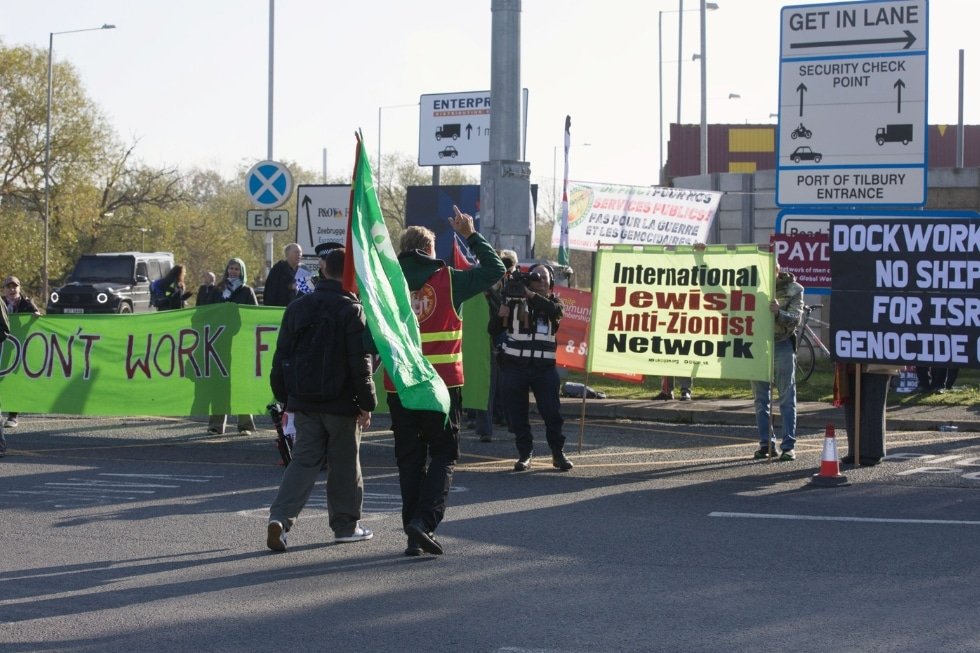
Last week, we covered major elections worldwide. Now, we turn our attention to another global issue: the international dockworker strike. On October 30, port workers across five continents halted operations to protest the sale of weapons. As part of the second International Day of Action (and the third international mobilization since October 2025) by the No Harbour For Genocide (NHG) campaign, unions organized the strikes to end the wars in the Middle East and end the militarization of ports.
The massive 24-hour strikes took place across 113 ports in more than 20 countries, likely mobilizing thousands of workers. Dozens of trade unions rallied around the slogan, “Dockworkers do not work for war.”
 Via Shutterstock
The campaign targets ports shipping weapon components to Israel, following a September 2025 independent UN commission of inquiry that reported Israel is committing genocide in Gaza. Although the groups reached a ceasefire agreement in October 2025, Israel’s bombardment continued killing and injuring Palestinians daily, according to Amnesty International.
Protesters see Israel’s devastation in Gaza as unlawful, disproportionate and indiscriminate acts of violence. Compounded by the US/Israel–Iran War, civilians around the world struggle with economic strain. These protests show that regular people do not want wars. Instead, they expect their governments to comply with international courts’ decisions and solve domestic issues rather than inflate weapons budgets.
Whether world leaders will heed these demands remains to be seen, but this expansive strike highlights growing global frustration with the latest Israel–Gaza war and rising cost of living, all further exacerbated by government spending and the closure of the Strait of Hormuz due to the US/Israel–Iran War.
Sources:
Dockworkers stage international strikes to denounce arms shipments | ABC News
‘We don’t work for war’: Dockworkers strike at 113 ports across 5 continents | Anadolu Agency
Dockworkers do not work for war | No Harbour for Genocide
Israel has committed genocide in the Gaza Strip, UN Commission finds | United Nations Human Rights Office of the High Commissioner
Gaza ceasefire exists in name only, say more than 100 organizations | Amnesty International
Medics smuggle iPhones into Gaza to film documentary | Middle East Eye
Demanding an end to arms shipments
Some of the labor groups joining the strikes include ver.di in Germany, SIPTU in Ireland, 3F in Denmark, CGT Ports et Docks in France, and the Panhellenic Union of Merchant Marine Engineers. The Global Sumud Flotilla has also voiced its support for the dockworkers’ strike, stating that it would execute “coordinated, strategic actions on the water.”
The main demand of these unions, according to Al Jazeera, is “an immediate end to the genocide of the Palestinian people and all imperialist wars.” Other outlets, such as Reuters, concur that this is a coordinated strike by influential dockworkers unions.
The strike is a continuation of protests from earlier this year. According to the LSE Business Review, in February, dockworkers from 21 Mediterranean ports, including Bilbao, Genoa, Livorno, Mersin and Tangier, “coordinated walkouts to protest the use of civilian ports for military purposes and arms shipments.” In May of 2026, dockworkers’ unions from over 35 European countries also published the Istanbul Declaration, which demanded that port facilities not be used to “transport weapons destined for war zones.”
Sources:
What can a global strike of dockworkers achieve for Gaza | Al Jazeera
Dockworkers at more than 100 ports worldwide strike against arms shipments | Reuters
Ships remain docked at seven ports as seafarers strike | eKathimerini
Mediterranean dockworkers are striking to protest against war | LSE Blogs
International dockworkers strike to protest arms shipments, including to Israel | The Times of Israel
What were the strikes for?
The strikes are primarily held in solidarity with Palestine. Workers are concerned about the human impact of the cargo they handle, a stance that closely aligns with Law Scholar Kimberlé Crenshaw’s theory on the intersectionality of struggle. The working-class protestors face their own economic hardship and work to prevent intersectional struggles abroad. They believe that without legal protection, collective action must step in to stop the shipment of weapons.
Past independent movements to refuse service to tankers carrying cargo caused Italy to seize military steel that could have made 13,000 Israeli artillery shells. While this action was successful, other instances only briefly delayed other weapon deliveries. Fully stopping each shipment required international organization because, in a strike, companies can simply send shipments to the next port.
Dockworkers hope to meet UN expectations for governments to end arms transfers, as they risk holding partial responsibility for human rights violations. The International Arms Trade Treaty requires exporting governments to decide if their own weapons transfers risk violating humanitarian law. Commercial operators and receiving countries are not legally obligated to stop the shipments. Analysts believe the port strikes are the only measure that has successfully complied with international law.
Sources:
No Law Can Stop Licensed Arms Shipments: Global Dockworkers Strike at 113 Ports Friday | Tech Times
States and companies must end arms transfers to Israel immediately or risk responsibility for human rights violations: UN experts | UN
Ports abroad assisted in the destruction of Gaza by supplying weapons every month since the ceasefire began. The international campaign tracked 56 commercial ports in 29 countries transferring 315 weapon shipments for Israel’s largest arms manufacturer, Elbit Systems. They also tracked 3,400 shipments of US military equipment through 67 ports in 42 countries since December 2025.
Dockworkers point out the huge profits made by shipowners, business groups and major oil companies in the wake of the US/Israel–Iran War, a stark contrast to the one-meal-a-day rations to 20,000 stranded seafarers. This war — further complicated by closures in the Strait of Hormuz — intensified economic pressure on the working class, giving dockworkers yet another reason to strike.
Unions also criticize employers for exploitation, claiming automation and AI maximize profit through job cuts, for example. This can also lead to decreases in human oversight, making it more difficult for activists to stop supplies to countries committing war crimes in the future.
Additionally, Israel’s actions in Gaza are not the only concern. In the West Bank, settler violence has frequently erupted and escalated since 2023. Reports indicate armed Israelis have raided homes, displaced residents, damaged private property and assaulted journalists since Israel’s elections two weeks ago. Challenging the economy of war would impact the Israeli government’s ability to establish and sustain settlements, which could work to reduce future attacks.
Sources:
30th October International day of action: ‘Dockworkers don’t work for war’ | Hellenic Shipping News Worldwide
Ports In Action Press Conference, Rome – 15 October 2026 | No Harbour for Genocide
Armed Israeli settlers threaten West Bank families, attack journalists | The New Arab
More than 100 Israelis go on rampage in Palestinian town | FT
Government and corporation responses
According to Hellenic Shipping News Worldwide, this delay will cost $57 million in global shipping, not accounting for “cascading delays” the following day. In past port strikes, governments and business owners forced resignations as well as prosecuting and fining dockworkers. Swedish courts once ruled boycotts lawful, but the union’s deputy chair still faced dismissal.
This time, the reaction of governments has seen surprisingly little coverage in mainstream media. The Israeli government has, of course, denied any characterization of Israeli airstrikes on Gaza or the conduct of the Israeli government in general as genocide. Nevertheless, these strikes have showcased the influence of dockworkers’ unions as a political force to be reckoned with. Renaud Foucart, Senior Lecturer at the Department of Economics at Lancaster University (UK), argues that dockworkers’ position within the global supply chain gives them “exceptional” leverage.
Sources:
Ports In Action Press Conference, Rome – 15 October 2026 | No Harbour for Genocide
30th October International day of action: ‘Dockworkers don’t work for war’ | Hellenic Shipping News Worldwide
French port strikes: Unions ‘will get better working conditions’, but can they curb militarisation? | France24
Mamdani Backs International Dockworkers’ Strike Against Arms Shipments to Israel | Philadelphia Jewish Exponent
A storm in the port?
Reactions to the protests by government officials around the world have been muted, as has word of any follow-up action by the dockworkers. However, the sheer scope of the protest, both in the size of the international coordination and the monetary disruption, is significant.
This protest speaks to the rising dissatisfaction around the world with many governments’ foreign and domestic policy, and will likely only intensify if costs keep rising and wages keep stagnating. The ports are only one pressure point for the global economy, and more will likely rear their heads before anything is done, given the quiet response from those in power.
Aliyah A. Omar, Casey Herrmann, Alexandros Ouzounis
Assistant Editors
















Comment