


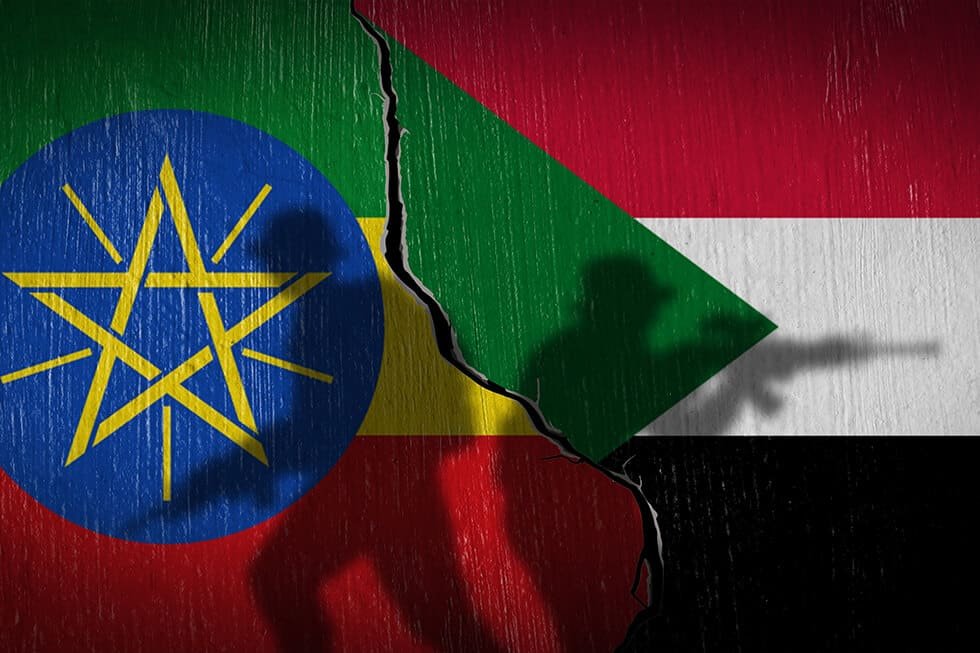



When Ethiopian federal troops walked into Mekelle — Tigray’s regional capital and the seat of the Tigray People’s Liberation Front (TPLF) — on October 3 without a fight, the city’s fall was supposed to mark a turning point in a war that had reignited only ten days earlier. Within days, though, the story shifted from what the army had taken to what it claimed to have found.
Photographs quickly began circulating of an Iranian-designed Mohajer-6 (M-6) drone packed in a foam-lined crate. Alongside them was a one-page Memorandum of Understanding (MoU) recording the inspection and acceptance of three M-6 Unmanned aerial vehicle (UAV) systems, three fire-control units, 12 bomb-release units and four surveillance payloads. A pro-government Amharic outlet published the documents on October 7, reporting that the hardware had entered Tigray through Sudan before the Ethiopian National Defense Force (ENDF) seized it.
On October 13, the ENDF took its case to the diplomatic corps, displaying drones and other weapons to foreign military attachés in Addis Ababa. The ENDF asserted that Eritrea and Sudan had supplied them to the rebels.
If the documents are genuine, Sudan’s army handed a rebel force in a neighboring country a strike drone capable of flying for hours and hitting targets far behind the front line. That would mark a dramatic escalation. But the evidence comes almost entirely from one side of the war, and no one has independently tested it. Whether or not the transfer happened, the fight over it shows how Ethiopia’s latest war has become a regional contest fought through intermediaries, with neighbors accused of arming one another’s enemies and each side using those claims to win diplomatic ground.
What the documents show — and what they don’t
The paperwork raises its own questions. The memo doesn’t say who sold the equipment or where it came from. The buyer’s side is signed by an “Elamin Ahmed,” whom the outlet calls Sudanese, though nothing on the page links him to Sudan’s army or any government office. The dates don’t line up either. The inspection is logged as February 3, 2025, but the top of the page reads June 11, 2025. There may be a simple reason for that, but no one has offered one. The Amharic outlet also cited a confidential Sudanese military transit letter, which has not been independently authenticated. The site itself tags its coverage “TPLF terrorist.”
The drone itself is a harder clue to read. Sudan’s army does fly the M-6. Satellite photos from early 2024 showed several parked at Wadi Sayyidna air base, just north of Khartoum, and the Rapid Support Forces (RSF) say they have shot down at least three.
The trouble is that Ethiopia has them too. During the last Tigray war, open-source researchers spotted M-6s at Semera, an Ethiopian air base in the Afar region. The US State Department later confirmed that Iran had shipped them to Ethiopia in mid-2021. A photo of a crated drone can’t tell anyone whose arsenal it came from. Only its serial numbers can.
Khartoum denies the accusations. In late September, Ethiopia’s army chief, Field Marshal Birhanu Jula, accused Sudan, Egypt and Eritrea of supplying the Tigrayan-led alliance. The Sudanese Armed Forces (SAF) rejected the claims as baseless. Asmara has denied sending troops into Tigray.
Why the allegation is plausible nonetheless
That doesn’t make the story any less plausible. There are solid reasons Khartoum might want to arm Ethiopia’s rebels, and its relationship with Addis Ababa has been getting steadily worse over the past year.
In May, Sudan accused Ethiopia of facilitating drone strikes on Khartoum’s airport, alleging the drones were launched from Bahir Dar. Ethiopia responded by charging that the SAF was funding and arming Tigrayan “mercenaries” along its western border. Ethiopia has also complained that a Tigrayan unit known as Army 70 has fought alongside the SAF inside Sudan. Meanwhile, the RSF has reportedly been allowed to base itself in Ethiopia’s Benishangul-Gumuz region.
The SAF is accused of aiding the Tigray Defense Forces against Ethiopia. The bombs complicate things further. Both the GB25A and its bigger sibling, the GB50A, are Chinese-made and light enough for a drone to carry. Fragments have turned up at strike sites across Sudan, and investigators tied one GB50A to an attack near al-Malha, in North Darfur, last year. Who handed which bombs to whom? Right now, nobody can say for certain.
The stakes for the region
The question is important because Ethiopia is using allegations of foreign sponsorship to justify its next moves. On October 9, Addis Ababa told the UN Security Council that Eritrean troops had pushed some 37 miles into Tigray. Its own forces have since reportedly moved into the border town of Zalambessa.
A credible case that Sudan armed the Tigray Defense Forces with strike drones would lengthen Ethiopia’s list of grievances. It would come at a moment when, as one think tank warns, the SAF and Egypt look primed to come to Eritrea’s defense should war break out.
The quickest way to test Ethiopia’s claims is to let outsiders examine the hardware. UN investigators who track weapons entering Sudan have the mandate to ask. Field researchers who trace arms for a living could do the work in days. They would log each serial number and cross-reference it with export paperwork to see which factory built the drone and who bought it first. Addis Ababa has already given foreign military attachés a look at the cache. Giving investigators the same access would cost almost nothing and might end the argument.
Until then, the memo offers allegation, not proof. It is one more document in a widening propaganda contest among Ethiopia, Eritrea and Sudan. With Ethiopian and Eritrean forces now within miles of each other along the border, that contest carries real risk of tipping the region into a far wider war.
[Kaitlyn Diana edited this piece.]
The views expressed in this article are the author’s own and do not necessarily reflect Fair Observer’s editorial policy.
A Moment of Truth for Ethiopia, Eritrea and the Wider Horn of Africa
Ethiopian forces’ recent advance to the Eritrean border raises fears of imminent invasion. Ethiopian Prime Minister Abiy Ahmed has long...
FO Talks: Drone Warfare and Foreign Meddling in Sudan’s Devastating Civil War
In this episode of FO Talks, Casey Herrmann and Fernando Carvajal examine how military rule, Islamist influence and foreign rivalries...

Is Sudan’s Bloody War Reaching a Tipping Point?
Sudan’s civil war has grown well beyond national conflict — it threatens to explode into a greater war across the...
Support Fair Observer
We rely on your support for our independence, diversity and quality.
For more than 10 years, Fair Observer has been free, fair and independent. No billionaire owns us, no advertisers control us. We are a reader-supported nonprofit. Unlike many other publications, we keep our content free for readers regardless of where they live or whether they can afford to pay. We have no paywalls and no ads.
In the post-truth era of fake news, echo chambers and filter bubbles, we publish a plurality of perspectives from around the world. Anyone can publish with us, but everyone goes through a rigorous editorial process. So, you get fact-checked, well-reasoned content instead of noise.
We publish 3,000+ voices from 90+ countries. We also conduct education and training programs
on subjects ranging from digital media and journalism to writing and critical thinking. This
doesn’t come cheap. Servers, editors, trainers and web developers cost
money.
Please consider supporting us on a regular basis as a recurring donor or a
sustaining member.
Will you support FO’s journalism?
We rely on your support for our independence, diversity and quality.





Comment