Dear FO° Reader,
The world continues to turn, and in many countries, we are rapidly approaching election season. With such a torrent of news, it can be easy to miss key elections for even the most studious reader. As such, we at
Fair Observer
have compiled a brief summary of three elections from the past week that radically reshaped their countries’ trajectories.
These elections took place in Serbia, Brazil, and Israel. Moreover, each of these elections shares a curious feature: in a year when right-wing governments seem to be expanding more and more, all three elections show a notable repudiation of the political right, in big and small ways, even the results are not necessarily clear.

Serbia: A student uprising breaks records and power
In Serbia, a political earthquake has shaken the country to its core. Aleksandar Vučić, who has served as president since 2017, has stepped down after a dramatic parliamentary election on October 25. This ends the 14 years of governance by the right-wing Serbian Progressive Party (SNS).
The troubles began in November 2024, when longstanding corruption and crime allegations came to a boil. A recently renovated railway canopy collapsed, killing 16. This was one of many tragedies and failures brought on by shoddy construction work, which people blamed on government graft and incompetence. Students began holding candlelight vigils, which was met with crackdowns by the authorities. This swiftly transformed these meetings into civil protests. By December 2024, an estimated 100,000 people were gathering in the capital. In March 2025, the crowds swelled to 300,000.
The opposition continued to rally throughout 2025 and 2026, though remarkably, it remained mostly leaderless but highly effective. Students and other volunteers continued to organize rallies and sit-ins throughout the months, and more importantly, pushed their people to the polls nearly two years after the initial spark, dubbing the movement Student List after the list of complaints drafted by its members.
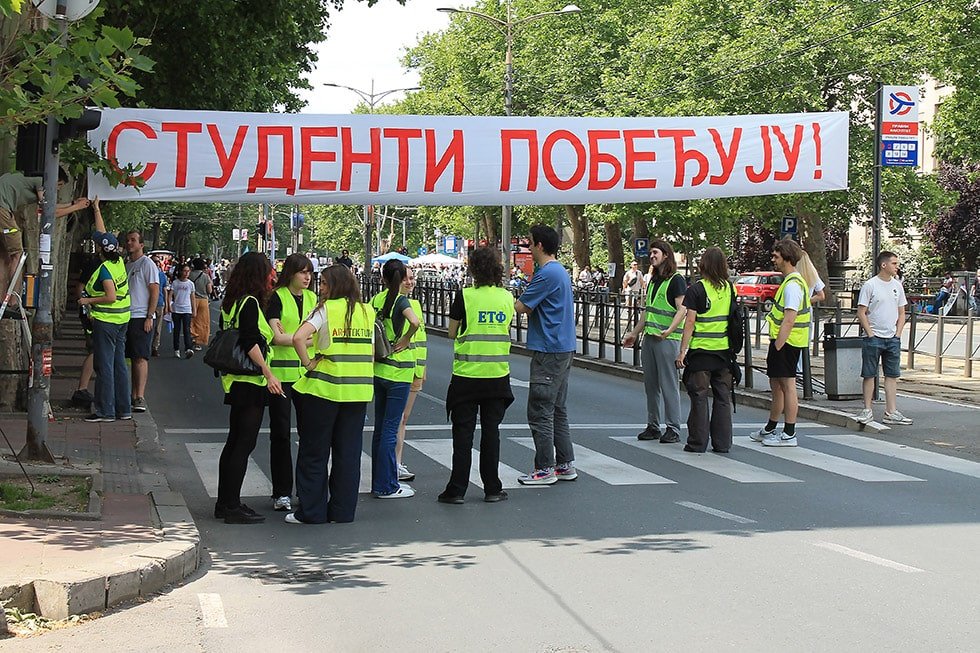
 Students Put up a ‘Students are Winning’ Banner Before the Start of a Big Protest Against the Government in Belgrade, Serbia. May 23, 2026, Shutterstock
The movement won 141 seats of the 250-seat Serbian parliament, more than enough to form a ruling coalition. The new ministers swear to take on corruption and crime, but that presents many challenges, and the party’s decentralized nature may work against it.
Student List is a very large-tent party, encompassing a vast swath of political philosophies, with the only major uniting factor being anti-corruption. Time will tell if the movement can remain united long enough to enact its accountability platform.
Sources:
Serbia Election Marks the End of an Era | Council on Foreign Relations
How Serbian Students Created the Largest Protest Movement in Decades | Journal of Democracy
Explainer: Serbia’s new leaders face host of tough challenges | Reuters
Student List | Wikipedia
Brazil: Lula’s fourth victory and the Bolsonaro family’s latest defeat
In Brazil, incumbent leftist President Luiz Inácio Lula da Silva won in a dramatic upset. Lula defeated his opponent, Flávio Bolsonaro, son of former President Jair Bolsonaro, in the second round of voting, a first in the country’s history. Flávio, who ran partially to escape multiple criminal investigations against him and partially to free his father Jair, who is serving a jail sentence for trying to overturn the results of the 2022 election he lost to Lula, has already fled to the US.
To give fuller context, this will be Lula’s fourth term in office. His first two terms, running from 2003 to 2011, saw Lula fight poverty in Brazil, uplift millions of citizens and greatly expand the country’s prosperity. He was so successful that he ended his terms with an 80% approval rating, marking him as one of the most popular democratic leaders in history.
But it did not last. While Lula remained popular throughout his first two terms, there was a rot lurking under the surface. Members of Lula’s Workers’ Party were implicated in various corruption scandals. This continued to bubble up until it finally burst in Operation Car Wash, which implicated then-President Dilma Rousseff, Lula’s former chief of staff, and finally Lula himself.
Lula was placed under arrest for suspected corruption in the middle of a 2018 campaign for a third presidential term, an event that helped pave the way for Jair Bolsonaro’s victory. This was highly politicized and extremely controversial within Brazil, but was ultimately ended when the Federal Supreme Court declared that Lula’s imprisonment had been unconstitutional.
Sources:
Luiz Inacio Lula da Silva | Britannica
Luiz Inácio Lula da Silva | Wikipedia
Lula wins historic fourth term as Brazilian president in defeat of far-right Flávio Bolsonaro | The Guardian
Brazil’s Flávio Bolsonaro flees to U.S. after election loss | PBS News
8 January Brasília attacks | Wikipedia
Operation Car Wash | Wikipedia
Imprisonment of Luiz Inácio Lula da Silva | Wikipedia
After winning the 2022 election and overcoming the subsequent coup attempt, Lula returned to office. But again, nothing is ever simple. Lula’s new government faced many challenges. Crime, rising prices and other pressures all hammered Lula. By 2025, the once most-popular president on Earth was polling at only 24%. Jair’s son Flávio seized the opportunity to strike, reformed his father’s coalition and turned it into a successful presidential run, with Flávio winning the first round of the presidential vote.
Recent elections in neighboring countries also pointed to a rightward swing in South America. Colombia and Chile both had far-right candidates win within the year, and both men were in the style of far-right US President Donald Trump, another thing shared in common with the Bolsonaro family. The question remained if the now 81-year-old Lula could stand against the rising tide.
But Lula emerged triumphant. After the disappointing results of the first election round, Lula shifted his messaging to economic concerns and intensified his on-the-ground campaigning. The results speak for themselves, with Lula pulling ahead of Flávio Bolsonaro by more than four million votes.
That is not to say things will be easy for Lula now. Brazil’s Congress and public are heavily divided, and Bolsonaro still won nearly 60 million votes despite the controversies surrounding Flávio and his father. If Lula hopes to secure his legacy, he will have to navigate carefully in the coming years.
Sources:
Once called the world’s most popular politician, Lula’s approval in Brazil plummeting | PBS News
Chile elects far-right José Antonio Kast as next president | BBC
Colombia’s new president vows to remake the country — and challenge rebel groups | NPR
More than one million Lula supporters rally on eve of Brazilian election runoff | The Guardian
Lula faces hostile Congress and divided country after Brazil election win | BBC
A Tightly Fought Race in Israel
As of October 30, 2026, Israel’s elections remain in a tie. On October 28, Israeli Prime Minister Benjamin Netanyahu’s far-right Likud party insisted, without any verification, that Israel’s Arab voters had “stolen the elections.” According to
The New York Times
, analysts have said that Netanyahu aims to delegitimize the votes of Arab Israeli citizens. This was due to Netanyahu’s fear that leading Jewish Israeli opponents would ally themselves with the Joint List, a loose coalition of leading Arab Israeli parties.
The election results so far indicate that Netanyahu and his opponents, former defense chief of staff Gadi Eisenkot and Arab Israeli politician Mansour Abbas are the most popular political actors in Israel. Eisenkot is a political centrist and founder of the Yasher Party. Abbas is the leader of the religiously conservative Islamic opposition party Ra’am. Since no clear winner is apparent, Netanyahu could be forced to enter into a coalition with Eisenkot, or, more likely, Eisenkot will form a coalition with Abbas’s Ra’am party.
Sources:
Live Updates: In Tight Israeli Election, Leading Parties Face Tough Path to Power I New York Times
Final Vote Results in Israel Set Up Weeks of Uncertainty About Who Will Govern I New York Times
What happens when nobody wins the Israeli election I BBC News
Israel election results updates: No winner in Netanyahu-Eisenkot blocs race I Al Jazeera
Who is Gadi Eisenkot, Netanyahu’s main challenger in Israel’s elections? I CNN
Netanyahu rivals weigh joining forces with Arab parties I POLITICO
The potential for an alliance between Eisenkot and Abbas has proven to be an anathema to many Israelis, but could also serve to improve relations between Jewish Israelis and Arab Israelis in the long run. This is where Abbas’s reputation as a “kingmaker” comes into sharp focus. Eisenkot would, in effect, be dependent on the support of Abbas in order to gain the total number of seats needed in the Israeli Knesset to depose Netanyahu.
Sources:
Eisenkot’s “Catch-22”: Main Rival of Netanyahu Has No Easy Options I New York Times
The Arab Kingmaker in Israel’s Election Who Wants a Partnership with Jews I New York Times
Anti-corruption on the rise?
In all three elections covered, anti-corruption has played a prominent role one way or another, from SNS’s defeat, the duel between Lula and the Bolsonaro family and the Israeli public’s mounting frustrations with Netanyahu. And for many upcoming elections, it is also an important topic.
The world’s eyes now turn to the US, where congressional midterm elections are set for November 3. The election is widely seen as a referendum on Trump, who is widely seen as corrupt, using his office to enrich himself and erode democratic norms. Whether the United States follows this recent trend of pushing back against corruption remains to be seen, but we are waiting for the answer with bated breath.
Casey Herrmann, Alexandros Ouzounis
Assistant Editors











Comment