Dear FO° Reader,
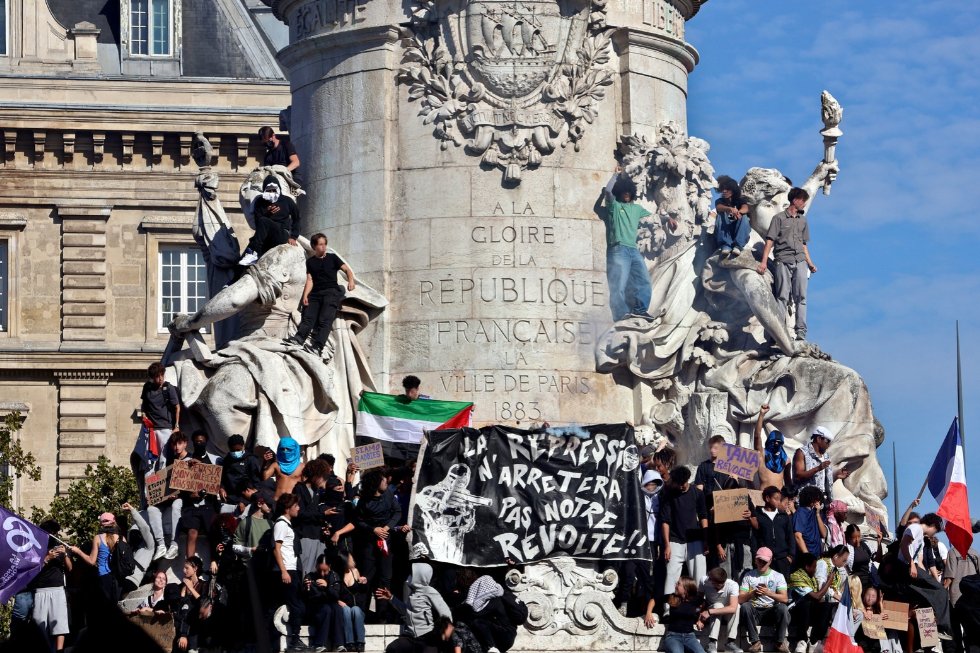
Greetings and welcome back to Fair Observer Spotlight. This week, we are covering the massive student protests erupting across France since September 21. French teenagers are dissatisfied with school conditions, citing educational inequality, a critical lack of staff and resources, and crumbling and unclean infrastructure.
Initially, a teacher strike at Saint-Exupéry High School in Paris had their demands met, but the resolved issue did nothing to stop the protests spreading to other schools. This sparked the largest student protest in decades, marked by brutal treatment of minors and violent arrests.
 October 2026, students protests in Paris, Wikipedia
Global media outlets note that the protests expanded beyond teenagers to include parents, young adults and unions. The public has grown increasingly outraged by police violence. Some coverage examines the protests’ implications on the 2027 presidential elections and the underlying left-wing objectives at play.
Certain outlets point out that specific groups are orchestrating the protests, alleging that the riots are a consequence of mass immigration and are not a reflection of “French culture.” As the protests rage on, domestic and international outlets attempt to unravel the unprecedented scale of unrest, which highlights broader societal concerns shared by many around the world. Moreover, this breakdown in education reflects a breakdown in the social order.
Sources:
Unprecedented student protests are rocking France. Here’s why they’re angry | CNN
Watch: Riot police clash with school protesters and use tear gas in France | BBC
France’s Bonfire of Inanities | WSJ
French school riots deepen as experts point to far-left alliance fueling ‘broader confrontation’ | Fox News
What started these latest protests?
These protests began in the middle of September. Primarily, the protesters are rallying against the poor condition French schools are in, which suffer from poor funding, bad building maintenance, low staffing along with many other frustrations and points of mismanagement.
The inciting incident occurred on September 17, when a number of teachers working at Saint-Exupéry High School went on strike. Students joined teachers in solidarity at the Parisian school. After their protests went viral on social media, other teachers and students across the country joined in, and the moment became a movement.

Placard: Sorry for the disturbances, we’re trying to save our future! From video: https://www.youtube.com/watch?v=hwFf4XfjYf0&t=29s
Sources:
Why French students are leading massive protests across the country | PBS News
What France’s student protesters want – and what the government is offering | France 24
France’s school protests: what lies behind the anger | BBC
French interior ministry estimates 250,000 join student protests; organisers claim 450,000 | France 24
The domestic opinion: French government and media reports
In France, news coverage reflects the country’s growing domestic tensions. Left-wing media outlets often frame protest demands as legitimate concerns and outline the excessive response from law enforcement. Basta! reported first-hand testimonies of students’ concerns, noting that “their learning conditions are at stake” due to staff shortages.
The students mention their schools have no temperature regulation, which is a huge concern after the summer’s European heat wave. Their reporting suggests student demands align with those of the teachers, but the government dismisses the youth protests as mere “urban violence,” ignoring genuine concerns.
In an article from Blast, biased reporting drew criticism from journalists. The left-wing outlet provided statistical evidence showing that media coverage disproportionately focuses on violence from minors, largely ignoring police violence, government responses and student demands.
This concerns journalists as it influences viewers’ impressions of what aspects are most prominent in a conflict. Meanwhile, Basta! reporting outlines that the police response is excessive and Mediapart France calls government bans an “unprecedented and intensive use of administrative force.”
Le Monde, a center-left publication, says that the government undermined the constitutional right to protest. They contend that the actions of unions and civil organizations made demonstrations peaceful, though they are the very institutions weakened by government policies in the past. They also highlight that government figures yield to pressure from the right as they dismiss rampant police violence as accidents.
Sources:
More than 300 high schools blockaded: “They bring us police officers, but never solutions.” | Basta!
“A pitiful report”: at France Télévisions, journalists are angry about the coverage of the high school student movement | Blast
High schools blockaded: is the police response proportionate? | Basta!
Against the high school student movement, an unprecedented and intensive use of administrative force | Mediapart
French high school protests: The assertion of a social movement | Le Monde
Right-wing outlets like CNews, one of the most read publications in France, mention terrorism, the far-left, criminals and damage costs in relation to the student protests. The headlines on its site largely depict the blockades as harmful, unlawful and morally wrong. They also point to the injuries incurred by police and school administrators, showing video evidence of violent outbursts.
Le Figaro reports testimony from a high schooler crowdfunding to replace damaged property. They also reveal that some students believe the protests are “counterproductive” without a clearer, unified message. The student says protests at well-funded schools are not necessary, and they believe this massive scale of demonstrations consequently undermines the movement.
Europe1 comments on government actions to resolve the issue, punishments for youth like funding cut offs, and calls the protests politically motivated. Reporters at Europe1 even present the case that stun grenades (ASSDs) are not weapons of war like the “radical left” believes. This analysis comes in response to the Interior Minister banning ASSDs in the youth protests, an indication that the government feels the need to reduce the use of dangerous equipment.
Meanwhile, Sébastien Lecornu, the French prime minister, promises to tackle the issue, with ministers to draw up plans by the end of the month. Debates on federal budget strains make a harder case for complete education reforms. The government promises to support regional councils fulfilling building maintenance responsibilities and public school staff to deal with timetabling issues. These reports from France24, the state-owned news agency, address issues from both sides of the conflict. Other domestic outlets, however, are as divided as the protestors and the government on this issue.
Sources:
blockade | CNEWS
High school blockades: 65 education staff members injured nationwide | CNews
After her car was set on fire during the high school blockades, a student from Nantes received over 4,000 euros in donations. | Le Figaro
“I just want to go to school so I can have a future”: a petition against high school blockades gathers more than 22,000 signatures | Le Figaro Étudiant
High school student mobilization: Charles Alloncle denounces the “failure of the French educational model” | Europe 1
Why the ASSD stun grenade, suspended by Laurent Nuñez, is not a weapon of war | Europe1
Share High school blockades: Auvergne-Rhône-Alpes, Île-de-France… These regions are cutting off funding to the rioters | Europe1
The Far-Right Billionaire Who Is Buying Up French Culture | Byline Times
What France’s student protesters want – and what the government is offering | France24
Government reactions are not enough
At first, Education Minister Edouard Geffray accepted students’ grievances as legitimate. He wrote a letter to school heads and principals on October 1, asking them to strengthen dialogue with the protesting students, presenting speech as the only legitimate alternative to violence. In his letter, he supports injured police and staff, but does not mention pupils apprehended or injured by police.
The next day, he held a video call with teachers’ unions and parents’ associations, then received the students’ representatives. Afterwards, he admitted that school democracy “isn’t functional enough,” saying that students are consulted but not always heard, and that had to stop. An anonymous consultation website opened on October 5. The answers are to be published as open data, and a national report on the results is promised. It received more than 1,700 contributions before 10 AM the next day.
On October 4, Lecornu sent a public four-page letter to seven ministers. It set up five main points for the government to follow: better teaching hours, more money spent on school building upkeep, better student schedules, more transparency in university admissions and listening to students’ voices.
Sources:
High school blockades: student unions call for continued mobilization | L’Etudiant
High school student mobilization: the consultation platform accessible for 15 days | L’Etudiant
The Ministry of Education is launching the high school consultation platform, with national feedback expected at the end of October. | AEF
The Prime Minister launches five initiatives to address the anger of high school students | Le Café Pédagogique
On the very day Geffray wrote to school heads, the Interior Ministry declared that the unrest “no longer has anything to do with the legitimate expression of high-school students’ demands,” describing it, according to Le Monde, as “urban violence.” The next day, Interior Minister Laurent Nuñez gave the police his “total support.”
In practice, it was the second voice that shaped the State’s response on the street. Later, Nuñez even said that “a movement of such intensity of violence against the police and the teachers was never seen,” which seems a bit of a stretch, as teachers are supporting students and there are few reports of students attacking teachers.
Sources:
“A highschool movement of this intensity is unprecedented” Laurent Nuñez, Minister of the Interior | franceinter
The questionable role of state security forces
Many suspect and even accuse the police of disproportionate reaction. The police forces in France have a specialized body, the national police’s crowd-control units, responsible for maintien de l’ordre, CRS and mobile gendarmes, which are trained to contain mobs and protesters while avoiding violence.
However, several documented arrests were made by the BAC (brigades anti-criminalité), plain-clothes anti-crime units that are not primarily trained for crowd control. In Caen, two 15-year-olds say they were seized by plain-clothes BAC officers; one spent 20 hours in custody. Using BAC officers to police protests is a long-standing criticism in France.
Some activists argue that arrests are used to frighten and deter. He believes that their methods, when confronted with non-violent teenagers, are doing the exact opposite of what they claim they want to do. There are documented cases of force used against non-violent students, and arrests on a scale out of proportion to the violence actually established.
More than 87% of the arrested are minors. One 15-year-old had to have his hand amputated. Another student, Eden, 14, had his jaw broken and lost most of his teeth. The pupil’s parents and their lawyer have now filed a criminal complaint alleging attempted murder.
Across the Paris region, parents and teachers placed themselves physically between pupils and the police. Outside Hélène-Boucher High School, Le Monde reported, dozens of adults formed a human chain when mobile gendarmes lined up facing the teenagers.
Sources:
“Ambush”, “Manhunt”: Did the police respond disproportionately to the high school student protests in Caen? | FranceInfo
Décision du Défenseur des droits | Défenseurs des Droits
Lycéen blessé au visage : dépôt de plainte pour tentative d’homicide par les parents
On October 7, as the Interior Minister faced calls from the left to resign, which he rejected, he announced that stun grenades would be suspended for the duration of the school protests. By then, the IGPN, France’s police inspectorate, had opened 18 inquiries into police conduct during the movement. The figure deserves caution. The IGPN is not an independent body: it reports to the head of the national police, its investigators are police officers who return to ordinary police posts afterwards, and the gendarmerie’s equivalent, the IGGN, works the same way.
Critics have long argued that police investigating police carries an inherent risk of collusion, or at least of professional solidarity. In 2021, France’s National Consultative Commission on Human Rights (CNCDH) concluded that the IGPN and IGGN do not offer the appearance of independence and impartiality required by the European Court of Human Rights.
Sources:
High school protests: criticized for his handling of public order, Laurent Nuñez is under pressure to find a way to calm tensions. | Public Senat
The IGPN and its future | Cairn.info
Assemblée nationale, QE 11564
Police violence: an inevitable reform for the IGPN oversight body | France 24
The protests have spread to overseas territories
France’s territory includes more than the land in Europe: Les Départements et Régions d’Outre-Mer (DROM) governs many of its official colonial holdings, which include La Réunion, a 40-mile-wide island west of Madagascar in the Indian Ocean; Mayotte, another small island in the channel between Madagascar and Mozambique; La Martinique and Guadeloupe, two more small islands in the Caribbean Sea north-east of Barbados and Guyana.
Since late September, the lycée (high school) protest movement that began in mainland France has spread to all five overseas departments, carrying the same national demands but with sharper local grievances. In Guadeloupe, the rectorat, the regional education authority, counted 21 schools protesting on October 6, with tear gas used at Les Abymes and a fire at Capesterre-Belle-Eau. In Martinique, clashes near Bellevue High School in Fort-de-France led to the arrest of three minors and pushed five lycées, including Lycée Frantz Fanon in La Trinité, to teach remotely.
In La Réunion, protests have reached more than a third of the island’s schools. 22 people were arrested on October 6, and stones were thrown at officers. In Guyane, pupils have blockaded schools from Cayenne to Kourou and Maripasoula, and there were clashes in Saint-Laurent-du-Maroni; the rectorat and the prefect have called the demands legitimate while condemning the violence.
In Mayotte, the Bandrélé lycée was blockaded over missing teachers, and another school had already been on strike for five weeks before the national movement began. Overseas pupils describe a deeper version of the mainland grievances: heat in classrooms without air conditioning, damaged and unsanitary buildings, unreplaced teachers, and very long days caused by long commuting and poor transportation, with some pupils leaving home before dawn.
Local unions and parents’ federations broadly support the demands and condemn the violence. These complaints sit against a background of structural underinvestment and repeated social unrest in these territories, even though the law requires resources to be weighted toward such disadvantaged areas.
Sources:
“Our working conditions must no longer be ignored”: high school students mobilize in French Guiana | France Guyane
In Bandrélé, high school students are mobilizing against overcrowded classrooms and unpaid internships. | L’info Kwezi
Protests in high schools: three minors arrested near Bellevue High School in Fort-de-France | RCI
News coverage of the protests has gone international
Wider European media coverage has highlighted the political polarization happening in France. La France Insoumise, led by Jean-Luc Mélanchon, has been accused by far-right Rassemblement National leader Marine Le Pen of encouraging the protests.
American news media outlets have reflected the general gist of international media coverage as a whole. However, the media coverage of the protests in France is also very reflective of the polarized media environment domestically. This is especially exemplified by a recent Fox News article in which a researcher in the field of “radicalization” is quoted as saying that the protests quickly became symbolic of “hate against the system.” In another piece, Fox quotes US President Donald Trump as stating that the riots were caused by “out of control migration.”
Outlets such as Huffington Post and NPR take the more mainstream approach of highlighting French police brutality, often taking much of their source material from outlets such as the Associated Press. Huffington Post states that French police have made “more than 6,000 arrests — mostly of people under 18.”
Other international outlets, such as Al Jazeera, focus on on-the-ground reportage. In a recent video published on their YouTube channel, the reporter Natacha Butler is exposed to tear gas and water cannons fired by French police. Outlets such as CNN, USA Today, and PBS have delved into student motivations for protesting and also interviewed students themselves.
Sources:
France explodes again as students riot over education | Fox News
Trump, Waltz link France riots to mass immigration as thousands are arrested | Fox News
Gruesome Injuries Throw Spotlight on France’s Policing of High School Protests | Huffington Post
French police use tear gas as education protests escalate in Paris | Al Jazeera
Hundreds of thousands flood French streets in student-led protests | CNN
France protests: Paris riot police & protesters clash, future teacher ‘concerned’ for what’s ahead | USA Today
Why French students are leading massive protests across the country | PBS NewsHour
What does it all mean?
Like many other protest movements throughout the years, this latest wave of unrest reflects something much deeper than what’s plain to see on the surface. While the French public is well known for protesting en masse more than many other countries, the French education system has clearly been rotting for years to get to this point.
This does not reflect well on French President Macron’s government, which has been in power for nearly ten years. And with elections looming in 2027, it seems clear that the French public is ready for change. Which way that change will go is unknowable at this point, be we can all only hope it is for the better.
Roberta Artemisia Campani, Aliyah A. Omar, Casey Herrmann, Alexandros Ouzounis
Media and Outreach Officer & Assistant Editors
















Comment