Dear FO° Reader,
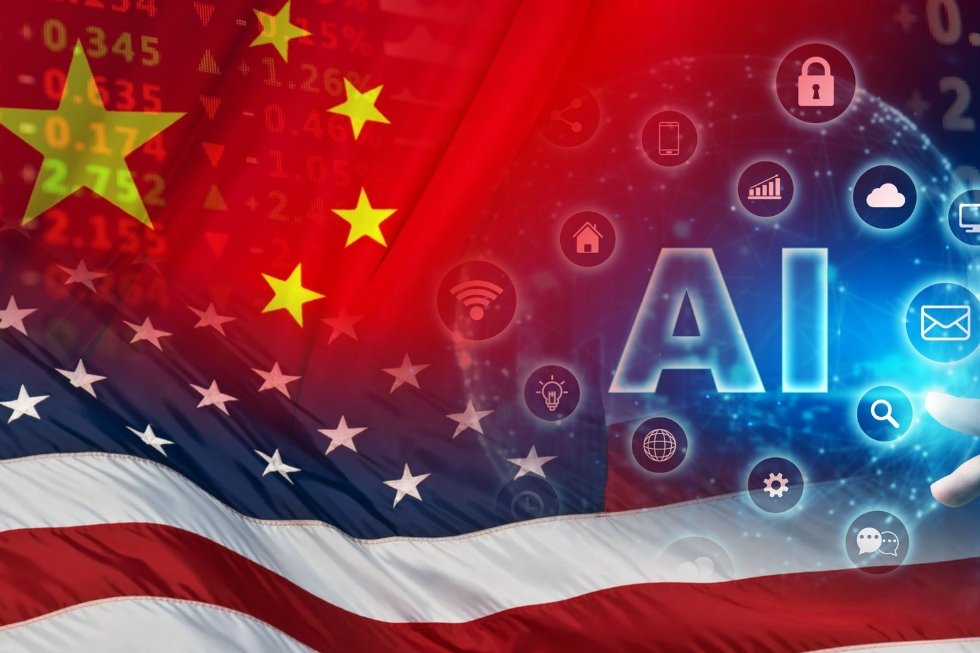
This week, we turn our attention to one of the latest friction points between the US and China: AI. The two global superpowers have invested heavily in this new technology, using it in public and private sectors. However, recently, two CEOs of American AI companies have called for a major slowdown in AI development, saying that the technology is at risk of spiraling out of human control.
In contrast, the Chinese government has dismissed these claims as Cold War-era fearmongering. This sentiment coincides with US President Donald Trump dismissing safety concerns as well. In a statement, Trump emphasized that the US is outpacing China with the new technology, which suggests the leadership of both countries is more concerned with competing with each other than anything else.
In fact, it seems like AI development may be a runaway train. With many critics already calling for AI to be restrained due to a host of issues, including environmental and privacy concerns, the development of the new technology continues at breakneck speed. The clash of superpowers only adds more fuel to the fire, making safety legislation all the more difficult to implement.
Sources:
Two of the world’s top AI chief executives publicly agree on slowing AI development | NBC News
China dismisses AI slowdown calls and blasts ‘fearmongering’ from U.S. tech leaders | NBC News
Perception of AI in the USA
Within the US, AI remains a hotly discussed and debated topic from nearly all sides of the political spectrum. The general public has grown increasingly frustrated with AI, with 39% saying that the technology does more harm than good. This is in comparison to a shockingly low 9% of Americans who say the technology does more good than harm, and 52% of people who think AI is equally good and bad.
This negative sentiment is driven by many concerns, the foremost likely being economic. 79% of Americans believe that AI is reducing the number of jobs available. While that has yet to play out in the data, an already ugly jobs market in the US does no favors to the technology’s reputation.
 Via Shutterstock
Another major concern is privacy. In recent months, the company Flock Safety has deployed AI security cameras on city streets and highways, ostensibly to capture potential crimes and help police respond to emergencies. This has triggered a major backlash in many US states, with protesters going so far as to tear down these cameras and even shoot them. Cases of police officers abusing Flock cameras for personal use, and general distrust of mass surveillance fuels the public outrage further.
Of course, all this negativity has dripped up the corporate ladders. As mentioned, several CEOs have called for better regulation of AI in recent months. However, it should be pointed out that CEOs have been quietly calling for reforms for nearly a decade. Since 2017, Elon Musk of X, Tesla and other companies, Mark Zuckerberg of Meta, Sam Altman of OpenAI, among others, have said there should be more regulation of the AI industry in one way or another.
However, in that time, there has been minimal change, and AI companies and their CEOs have done little to regulate themselves. It isn’t quite clear how much of this talk of oversight is genuine or simply lip service by the corporate class to an angry public. Congress has also done little, even with similar calls to action by former President Barack Obama and legislation put forward by US Senator Bernie Sanders and others.
But in the end, the buck stops at the president’s desk, and Trump has done nothing but say he is fully behind AI technology. He appears to view AI as a market driver, fueled by an insatiable need for computer chips and other parts to construct AI data centers.
As Trump is increasingly unpopular due to the ongoing US/Israel–Iran War, driving up the price of fuel, and thus all expenses, the president seems to cling to something keeping the overall stock market high. Trump also views the AI race as a battle against China, a persistent boogeyman in his speeches.
Sources:
Americans Cool Toward AI | Gallup
What is really happening to jobs? Separating AI hype from reality | Stanford Institute for Economic Policy Research
Flock cameras trigger nationwide backlash over privacy concerns, police abuse | ABC News
A brief history of AI executives calling for regulation | The Verge
Obama reportedly urges Democrats to prioritize safety plan for AI | The Guardian
Sanders, Casar to Introduce Legislation to Ban Artificial Superintelligence and Temporarily Pause Advanced AI Development | Bernie Sanders Press Release
Why Trump is all-in on AI despite the warnings | BBC
Public opinion on AI in China
The common consensus in Chinese public opinion regarding AI is far more positive than their peers in the West, with 87% of the Chinese public trusting AI. This fits into a wider global pattern. According to a recent poll conducted by Stanford University, the rate of global trust in AI rose from 55% in 2024 to about 59% in 2025. This stands in stark contrast to public sentiment in the US, where two-thirds of the American public believe that AI poses a significant risk to humanity.
In addition to the positive public opinion, Chinese President Xi Jinping also established the World AI Cooperation Organization in July 2026, reflecting their attempt to coordinate efforts to regulate the technology. The country hopes to create institutional frameworks to kickstart tech governance. This global initiative seemingly gestures towards multilateralism, but no Western nations are listed among the founding leaders, revealing the unavoidable geopolitical split impeding the aim for global coordination.
Furthermore, the Chinese government has announced plans to become a global AI power by 2030. This optimism is mirrored in a recent study of attitudes towards the Chinese Large Language Model (LLM) called DeepSeek. According to the study, between January 19 and March 22, 2025, reactions to posts on the Chinese social media platform Weibo remained consistently high at 47%, showing a generally favorable view of the platform. However, there is reasonable evidence suggesting that much of the positive view of AI in China is due to Chinese media promotion of the CCP’s stance on AI development.
Sources:
Trust in AI far higher in China than West, poll shows | Al Jazeera
Public Opinion | The 2026 AI Index Report | Stanford HAI
Poll: Americans say there’s a serious risk of AI destroying humanity | POLITICO
China proposes new global AI cooperation organisation | Yahoo News
China’s New AI Club: The World Artificial Intelligence Cooperation Organization | The Diplomat
How the Chinese Public View AI | Berggruen Institute
China’s New AI And Energy Strategy Explained | Forbes
The digital dystopian state
The most important example of China’s nascent digital authoritarianism is its treatment of the Uyghur minority. A recent academic study highlighted how the Xinjiang region has “occupied a central role in China’s plans to deploy facial recognition technology for nationwide security purposes.” It also highlighted that the usage of smartphone or vehicle location data, checkpoint records, in addition to video footage from buses, streets and drones, “can be used to identify gatherings of people within the same religious network.” This takes place alongside China’s mass incarceration and forced assimilation policies, as well as the “deliberate erosion of cultural identity.”
However, an even more important example of how states have utilized AI in a digitally authoritarian manner is Israel, particularly through its usage of “algorithmic warfare” in Gaza. Linde Arentze, Lauren Gold and Marijn Hoijtink argue in a recent study that evaluating algorithmic warfare solely through the lens of efficiency masks the civilian suffering these AI innovations cause. According to this study, IDF officers have delegated “critical decision-making responsibilities” to machines.
An important example of this would be the “Blue Wolf” app that the IDF has used as a means of automated mass surveillance in the occupied West Bank. Blue Wolf is an application “that allows soldiers to detect and categorize Palestinians across the West Bank” via an “extensive biometric database” in which most Palestinians have declined to enroll. This app is also part of a wider pattern of “surveillance capitalism,” which, from the beginning of the 21st century, has enabled technology firms to “capitalize on users’ private information.” This then turns human data into a source of profit.
Software firms such as Palantir, which create AI tools for data analytics, also exemplify this trend of data collection for profit. According to the ACLU, Palantir has developed what it calls an “ELITE” (or Enhanced Leads Identification and Targeting for Enforcement) system, which it claims identifies “high-value targets through advanced analytics.” In addition to the ACLU’s coverage of Palantir’s partnership with ICE, NPR has also criticized Medicaid officials for sharing the data of millions of medical patients with ICE, who then shared this data with Palantir.
Sources:
(PDF) China’s Digital Surveillance and Religious Practices in the Xinjiang Uyghur Autonomous Region | Journal of Kocatepe Islamic Sciences
Digital Authoritarianism and Uyghur Identity Erasure as a Global Inflection Point | Pubmedia Social Sciences and Humanities
Tracing algorithmic harm: from innovation to deployment and impact on civilians | Critical Studies on Security
All the Ways Palantir is Assisting Trump’s Abusive Removal Campaign | American Civil Liberties Union
ICE shared Medicaid data it wasn’t supposed to have with Palantir | NPR
AI regulation attempts
AI regulations are few and far between in many countries. The strictest regulations, coming from the EU, were cut down to size by Silicon Valley lobbyists in 2024. This includes OpenAI lobbyists working for Altman, despite the fact that the OpenAI CEO had called on the US Congress to regulate AI technology as early as 2023. Other nations, such as India and Japan, have focused on much more business-friendly guidelines.
A small number of US states and European countries have put a halt to new AI data centers being built, citing the extreme environmental impact that the water and electricity-hungry buildings have on human communities and the natural world. In fact, the UN projects that by 2030, the water used to cool AI data centers will exceed the needs of 1.3 billion people. Additionally, Altman rejects public concerns about the consumption of water by data centers, but his statement ignores the massive amount of indirect water consumption through the electricity that powers data centers. In this way, he seems to desire regulation to slow the pace of AI development, yet disputes the need to regulate the industry’s unchecked conservation practices.
Sources:
AI Regulations around the World | Mind Foundry
Europe’s AI crackdown looks doomed to be felled by Silicon Valley lobbying power | John Naughton | The Guardian
Where are authorities restricting data centres amid AI boom? | Reuters
There’s one issue where Republicans and Democrats are unified before the midterms, a new poll finds | AP
Hot Summers, Water Supply And Frivolous AI Use On Social Media | Forbes
Data centers consume massive amounts of water – companies rarely tell the public exactly how much | The Conversation
OpenAI’s Sam Altman blasts AI concerns around water usage as ‘fake:’ ‘Humans use energy, too’ | New York Post
No cooldown in sight
Despite everything, Trump and Beijing continue to pound the AI drums. While CEOs make noises of protest, they seem unwilling to implement regulations themselves. With the ecosystem’s health also on the line, it is unclear what will give first, but as always, one thing remains clear: while the time for reform was yesterday, the best we can hope for is a solution tomorrow.
Casey Herrmann, Alexandros Ouzounis
Assistant Editor
[Aliyah A. Omar edited this piece]

















Comment