


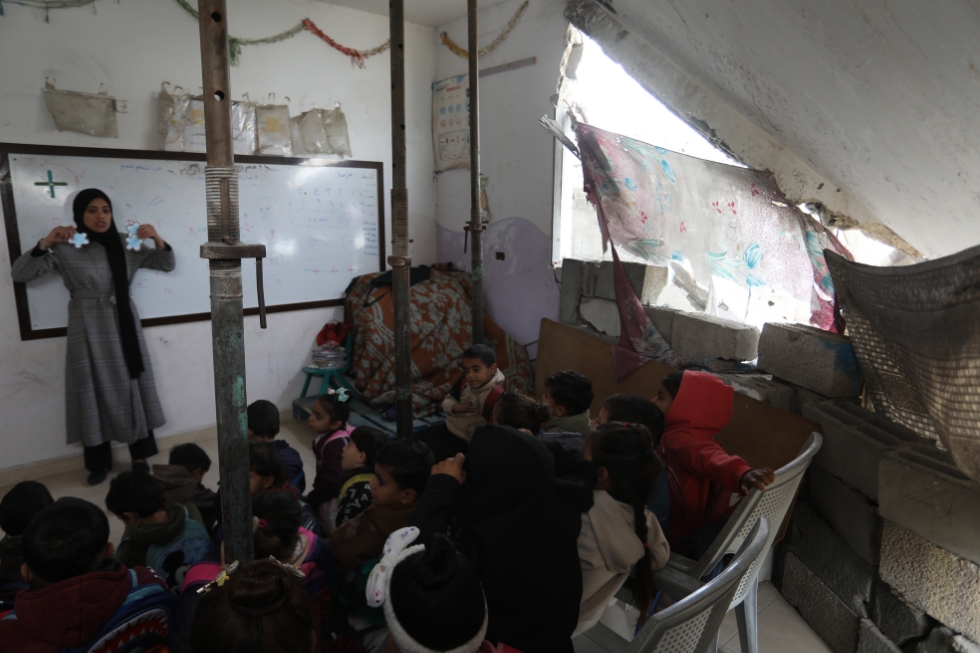



Over the past year, in several parts of the world, children have gone to school in the shadow of war, and too many have not made it home.
In Gaza, schools and universities have been destroyed or damaged on a devastating scale. In Ukraine, schools continue to be damaged by missiles and drones. In Sudan, where millions of children have been caught in a brutal conflict, education has been disrupted on a massive scale. In Nigeria, attacks on schools and abductions of students and teachers spread a wave of fear and anxiety in the country.
Such attacks on education are becoming part of a global pattern and could be among the chief reasons why 273 million children, adolescents and young people remain out of school worldwide. According to the latest Education Under Attack 2026 report by the Global Coalition to Protect Education from Attack (GCPEA), there were at least 8,566 attacks on education in 2024 and 2025. This is more than 40% higher than in the previous reporting period.
Additionally, at least 10,600 students, teachers, professors and other education personnel were harmed. The highest incidence of attacks was recorded in Colombia, the Democratic Republic of Congo, Ethiopia, Haiti, Palestine and Ukraine. Attacks on education were reported in 83 countries.
Education has been caught in the crossfire of wars for years, and now these figures tell us how it is increasingly becoming part of the landscape of conflict itself. That is why this International Day to Protect Education from Attack matters more than ever. Countries, governments and the overall international community need to remember that a child should be able to go to school without becoming a casualty of war. We cannot wait for these conflicts to end; action must be taken now to ensure that children around the world have an education — and with it a future.
The human cost in conflict zones
GCPEA recorded around 900 attacks on schools in Ukraine during 2024 and 2025, and at least 2,400 attacks affecting students, teachers and education personnel in Palestine. On the ground, these numbers translate to classrooms that no longer exist, teachers who cannot teach and children whose education has been interrupted, sometimes indefinitely.
The bigger concern is that the damage does not end when the fighting stops. A destroyed school can take years to rebuild, a child who has missed months or years of learning may struggle to catch up, and teachers may have fled or been killed. Also, families displaced by conflict may move repeatedly — as was seen after the Thailand-Cambodia border conflict last year — making it difficult for children to enroll and remain in school. And the longer children remain out of school, the greater the risk that they will never return.
This is even more serious for girls and children who were already facing barriers to education. Conflict can deepen those inequalities, exposing children to displacement, child labor, early marriage, recruitment by armed groups and other forms of exploitation.
Military use of education facilities
The military use of education facilities is another growing problem that receives less attention. GCPEA reported more than 1,900 cases of schools and universities being used for military purposes during 2024 and 2025, which is almost twice the number recorded in the previous reporting period.
We have seen this several times in the past few years: When soldiers occupy a school, it stops being a safe space for children, and as a military position, it can become a target. Either way, children lose. This is why protecting education cannot be treated as something that begins after a ceasefire. There is enough evidence to show that education needs protection during conflict, not simply reconstruction after it.
Translating commitments into action
The international community has already made important commitments. The Safe Schools Declaration, adopted in 2015, has provided countries with a framework for protecting schools and universities from attacks and military use. But these commitments will matter only when they are translated into action.
So, what will ensure this? First, governments must strengthen national laws and policies to protect education. Then, military forces must ensure that schools are not used for military purposes and that their operations minimize risks to students and education personnel. Also, attacks must be documented and investigated, and those responsible must face consequences.
Lastly, and most importantly, prevention requires listening to communities. Teachers, parents and students often know before anyone else when a school is becoming unsafe. Early-warning systems, local networks and clear evacuation and continuity plans can help communities respond before violence reaches the classroom.
Education must continue amid conflict
What is clear is that when schools are damaged or destroyed, education cannot be put on hold. Children need safe ways to continue learning, whether through temporary classrooms, community learning spaces, remote education or other forms of emergency education. They need teachers, learning materials and psychosocial support. Most of all, they need to know that their education still matters.
Through Education Above All’s work in conflict areas, including Gaza and Sudan, we have seen how education can provide children with stability when almost everything around them has been disrupted. A school becomes a place of safety, belonging and hope.
This September 9, as we mark International Day to Protect Education from Attack, we must shift our focus from rebuilding after war to what we are doing now to make sure children can keep learning while the war is still being fought. Waiting for peace to protect education doesn’t work for our children and youth now, or for their futures.
For millions of children living through conflict, school may be one of the few things that connects them to a future beyond the violence around them, and we owe them more than a promise to rebuild that future someday.
[Kaitlyn Diana edited this piece.]
The views expressed in this article are the author’s own and do not necessarily reflect Fair Observer’s editorial policy.
Support Fair Observer
We rely on your support for our independence, diversity and quality.
For more than 10 years, Fair Observer has been free, fair and independent. No billionaire owns us, no advertisers control us. We are a reader-supported nonprofit. Unlike many other publications, we keep our content free for readers regardless of where they live or whether they can afford to pay. We have no paywalls and no ads.
In the post-truth era of fake news, echo chambers and filter bubbles, we publish a plurality of perspectives from around the world. Anyone can publish with us, but everyone goes through a rigorous editorial process. So, you get fact-checked, well-reasoned content instead of noise.
We publish 3,000+ voices from 90+ countries. We also conduct education and training programs
on subjects ranging from digital media and journalism to writing and critical thinking. This
doesn’t come cheap. Servers, editors, trainers and web developers cost
money.
Please consider supporting us on a regular basis as a recurring donor or a
sustaining member.
Will you support FO’s journalism?
We rely on your support for our independence, diversity and quality.




