


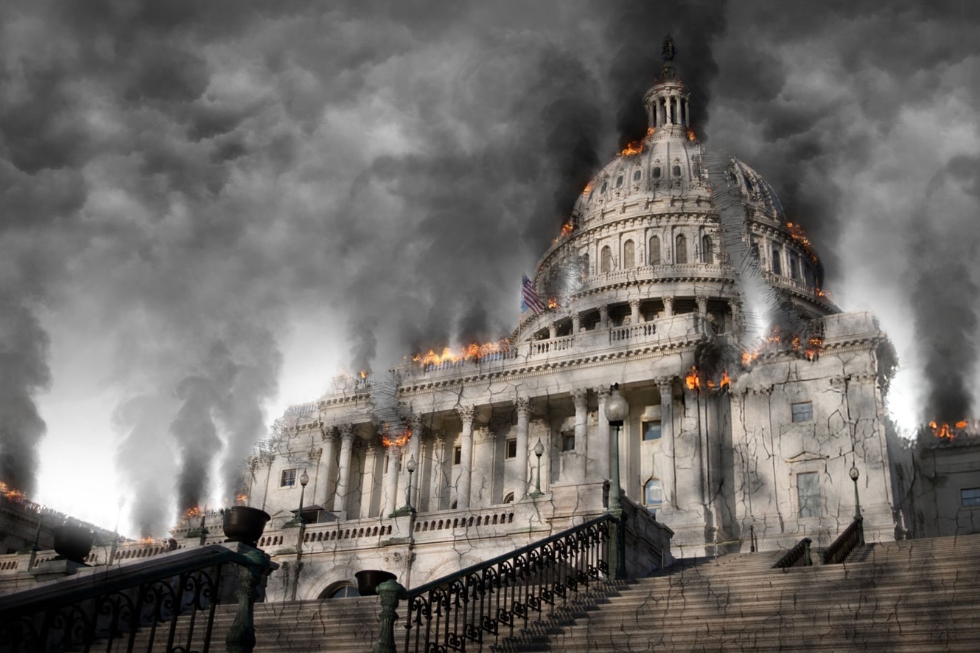



While Washington’s war with Iran drags on, month after month, without any end in sight, the world is witnessing the very real limits of US global power. As US President Donald Trump lurches repeatedly from threats of devastation to promises of peace, it’s becoming increasingly clear that US military might is no longer capable of subduing even a mid-sized power like Iran, much less holding the rest of the world in its thrall.
Amid all the drama of air raids, drone strikes and naval blockades, there are deeper geopolitical forces at play that lend a lasting historical import to events in the Persian Gulf. We can best see these dynamics when comparing two newspaper editorials with revealing similarities despite the 80 years separating their publication.
Writing in 1942, during some of Britain’s darkest days in World War II, the editors of the venerable Times of London looked far beyond the relentless German attacks on their forces in Egypt or the Nazi U-Boat sinkings of Royal Navy ships in the Atlantic to predict their empire’s future with an uncommon prescience. With its contradictory motto of “Imperium et Libertas” (Empire and Liberty), the vast British Empire, which still covered a quarter of the globe, had already become what those editors called “a self-liquidating concern.” Once the “temporary circumstances” that had allowed Britain’s ascent — naval dominance, industrial preeminence and “the relative weakness of rival states” — faded, that empire’s “ultimate reliance on coercion” could no longer hold. Ready for self-governance, Britain’s many colonies, the editors suggested, would soon begin breaking away and so eclipse the empire. And that prediction couldn’t have been more accurate. Within five years of that editorial’s publication, the British Empire had already started to break apart.
Writing in a May 2026 edition of The New York Times, contributing editor Christopher Caldwell made a strikingly similar prediction about the future of US global hegemony. Under the provocative headline, “America Is Officially an Empire in Decline,” Caldwell noted some unsettling parallels between the fate of America today and Great Britain 80 years ago. Back then, England was “deindustrializing, overcommitted, complacent,” and found itself “essentially bankrupt” by the end of World War II. Apart from its “ill-fated attempt” to seize the Suez Canal from Egypt in 1956, however, it managed to decolonize in a successful fashion by giving up “territories it could no longer afford.” As he points out, Britain even “wound up on reasonably good terms with its former colonial possessions.”
At the start of his second term as president in 2025, Donald Trump, Caldwell continued, “had a chance of pulling off something similar” by withdrawing “to a less expansive sphere of influence” and “refocusing American attention on the Western Hemisphere.” Caldwell considered that strategy potentially “workable” since “imperial systems, whatever you call them, last only as long as their means are adequate to their ends.” Instead of keeping to that plan, however, Trump “has overextended the empire dangerously” by his intervention in Iran, which has now become nothing less than a “watershed in the decline of the American empire.”
To test the probability of Caldwell’s prediction coming true, we need to go beyond the immediacy of the Iran crisis to explore both the deeper causes of US global decline and its likely long-term consequences for both the United States and the rest of the world.
Explaining US imperial decline
Since most Americans came late (if at all) to the realization that their country was indeed an imperial power, and a stunningly powerful one at that, they have generally remained oblivious to its aging and the inevitable erosion of global power that accompanies such aging. Ever since English scholar Edward Gibbon published his monumental, multi-volume study, The Decline and Fall of the Roman Empire, in the late 18th century, succeeding imperial rulers have tended to assume that their imperial realms would last, like ancient Rome’s, half a millennium or more. Adolf Hitler, with his dream of “the Thousand-Year Reich,” was hardly the only one to share such an illusion.
But the modern age, with its rapid economic and technological change, has only accelerated the process of imperial decline. Britain’s sprawling global empire lasted just 90 years (1857–1947) and France’s African empire, covering a quarter of that continent, was about the same, while the Soviet empire in Eastern Europe barely lasted 40 years (1945–1989). So, for the US global imperium to have survived for 80 years (1945–2026) should be considered the most anyone could realistically expect for a modern empire.
Since the US-led global order — exemplified by the International Monetary Fund (IMF), the World Bank, and the World Trade Organization (WTO) — has indeed presided over 80 years of sustained global economic growth, there is a distinctly American twist to the British concept of the “self-liquidating concern.” As the rest of the world enjoyed a rapid economic recovery from the ravages of World War II, America’s share of the global economy declined from an overwhelmingly dominant 50% in 1945 to less than half that figure today. Using an index called PPP (Purchasing Power Parity) that measures the real value of economic growth, the IMF calculates that, in 2026, China is producing 20% of global economic output, the US just 15% and the European Union 14%.
But the relative economic decline of the US should by no means be the crucial measure of its failure. Quite the opposite, in fact. It should be considered a tribute to Washington’s success in leading the world economy to unprecedented prosperity. In those 80 years since the end of World War II, the US economy has grown fast, but many other nations have grown faster still. Although an economic giant that could structure the global economy as it wished in 1945, the US must now negotiate the terms of trade with a host of peer rivals — whether economic powers like China, major players like India and Japan or a growing number of regional blocs like the EU, South America’s Mercosur and Asia’s ASEAN.
Probe deeper for the forces now driving America’s decline and you’ll notice an underlying geopolitical dimension. As I explained in my new book, Cold War on Five Continents, the US achieved its global hegemony after World War II by maintaining an unwavering geostrategic dominance over the Eurasian land mass. Through its military alliances at both axial ends of that vast continent — the multilateral North Atlantic Treaty Organization (NATO) in the West and five bilateral defense pacts with countries ranging from Japan to Australia in the East — the US imposed an “Iron Curtain” for 5,000 miles of anti-communist containment across Eurasia.
Using those axial ends as anchors, the US encircled that vast continent with three naval armadas, hundreds of military bases and thousands of jet aircraft. With Moscow geopolitically isolated and Beijing still a developing power, Washington could simply sit back and wait for the Soviet Union’s increasingly stagnant socialist economy to collapse and its dozens of restive satellite states to break free — as they all did between 1989 and 1991.
In the 35 years since that great Cold War victory, Washington’s foreign policy elites have pursued policies that might all too accurately be branded “bipartisan mismanagement” of the US geopolitical position in Eurasia. As home to 70% of the world’s population and an even greater share of its productivity, that continent remains the epicenter of global power (as it has been for the past 500 years). No nation can contend for world leadership without competing for geopolitical influence there.
From 2001 to 2021, both Democratic and Republican administrations oversaw long-term military occupations of Afghanistan and Iraq that cost thousands of American lives, millions of civilian deaths and trillions of dollars in treasure. While Washington was wasting an estimated $5.8 trillion on those pointless, profitless wars, China’s foreign currency reserves surged from just $200 billion in 2001 to a massive $4 trillion by 2014. Drawing on such unprecedented reserves, Chinese President Xi Jinping launched his trillion-dollar Belt and Road Initiative that quickly laid down a grid of railroads, roads, pipelines and ports across Eurasia from the Baltic to the South China Sea. By the time American troops finished their humiliating retreat from Afghanistan in August 2021, China had become the dominant power in Central Asia and the US position in Eurasia was starting to crumble.
In his second term, Trump’s foreign policy has further weakened the US global position. At the western axial end of the Eurasian continent, he compromised NATO, the largest and longest-lasting alliance in modern military history, by pressing Denmark, a founding member of the alliance, to cede its sovereign territory of Greenland. This created a serious crisis and compelled the Europeans to begin acting autonomously when it came to both trade and defense issues.
At the eastern end of Eurasia, Trump’s intervention in Iran and the blocking of key oil supplies to Asia, thanks to the closing of the Strait of Hormuz, weakened longstanding bilateral alliances with Australia, Japan, the Philippines and South Korea. The thousands of missiles the US has fired at Iran have also reduced its ability to defend the island of Taiwan and forced Washington to begin withdrawing stocks of missiles from South Korea — exposing both the limits of its military power and Asia’s lowered priority.
As The New York Times editorial board put it after Trump’s recent Beijing summit with Xi (where the US president showed a “worrisome lack of interest” in Taiwan), “America’s inability to defeat Iran’s much smaller military has raised questions about whether it could help defend Taiwan from a mainland invasion.” If China ultimately takes that island, the US defensive perimeter in the Pacific would be pushed back from the “first island chain” (Japan, Taiwan and the Philippines) to the “second island chain” (Japan and Guam) — inflicting a major geopolitical blow on the US by crippling its capacity to aid its Asian allies.
More broadly, the Trump administration’s plans, as stated in its recent National Security Strategy, for “a readjustment of our global military presence” by shifting forces into the Western Hemisphere would be tantamount, if fully implemented, to a unilateral surrender in what foreign policy experts have come to call “the new Cold War” with Beijing and Moscow.
Imperial energy
Probe deeper still for the causes of the ongoing all-American imperial decline and you’ll come to the most fundamental but generally least noted factor in the rise and fall of every world empire for the past 500 years: energy innovation.
In the 16th century, Spain and Portugal maximized the caloric output of the human body by developing the slave plantation, whose phenomenal profitability allowed a uniquely cruel form of commercial agriculture to spread from West Africa along the coast of Brazil to the Caribbean and then, of course, to the American South. A century later, the Dutch mastered wind power, using windmills to saw uniform planks to build efficient sailing ships that won them a commercial empire stretching from the Spice Islands of Indonesia to the island of Manhattan. In the 19th century, Britain’s industrial revolution developed coal-fired steam engines for factories, trains and ships that facilitated its conquest of colonies covering a quarter of the globe. After 1945, America’s ascent to global hegemony would be synonymous with the rise of petroleum, quickly supplanting coal as the world’s primary form of energy and leading to repeated US interventions in the Middle East for the past 70 years.
In recent years, however, Beijing has launched a revolution in green energy from the sun and wind whose accelerating pace, driven by its sheer economic efficiency, has the potential to transform much of the global economy, while simultaneously making China the world’s preeminent economic power. With surprising speed, solar-powered electrical generation has become 41% cheaper (and wind 53%) than the least expensive form of fossil fuel. In addition, engineering innovations in battery design for both driving and electrical storage are likely to make the cost of carbon-fueled power prohibitively expensive within a decade or less.
Under the Biden administration, Washington invested a trillion dollars to fund America’s baby steps toward a green-energy future. However, as soon as Trump returned to the White House in January 2025, he began working to smother that infant initiative in its cradle beneath a sheaf of executive orders — canceling coastal wind farms, voiding the tax credit for electric vehicles (EVs) and opening vast stretches of US offshore waters for yet more oil and natural gas drilling.
Meanwhile, China increased its total power generation by 16% in 2025, with solar and wind energy accounting for half of its total capacity. And just as China already produces 80% of the global supply of solar panels, so its recent innovations in EV battery design have allowed it to rack up 70% of global electric vehicle production. While China’s auto industry surged in the last five years to capture 24% of global car production in 2025 (and is projected to reach 35% in just four more years), Detroit’s share has fallen to only 16%, driven in part by its costly retreat from EV production since Trump’s return to office.
Given rapid advances in battery range, charge time and temperature range, it’s only a matter of years before the low-cost cars rolling out of China’s vast robotic factories supplant legacy brands and come to dominate the global auto market. With the Detroit vehicle industry, America’s largest manufacturing sector, now struggling to survive (along with other industries wedded to overpriced carbon-generated fuel), the future of much of US manufacturing looks increasingly dim.
The consequences of America’s decline
Yes, the world of a Pax Americana in the previous century (though imperial America never could fully avoid wars) is gone. And a world without active US international leadership will not necessarily be a better place. Without a single superpower or set of superpowers to backstop otherwise toothless resolutions from the United Nations, international relations in a post-American world order will likely be both more complex and possibly more conflict-ridden as well.
In the new multipolar world likely to emerge in the next decade (if not sooner), even major countries like the US and China will undoubtedly find themselves exercising their asymmetric power ever closer to home. While some global areas will suffer from localized rivalries –- Beijing versus Tokyo in East Asia, Ankara versus Cairo, Tehran and Riyadh in the Middle East –- regional associations like ASEAN, Mercosur and the EU are likely to play an increasingly important role in forging diplomatic consensus and mediating local conflicts.
Instead of the bipolar rivalry of the old Cold War era or American-led interventions in places like Afghanistan, Panama or Kuwait during the more recent decades of its unipolar power, regional rivals will likely wage future local wars in hot spots around the globe over boundaries, the control of minerals, water rights or climate-change refugees. To take but one example, Ethiopia, an arid, landlocked, overcrowded nation of 140 million people in East Africa, faces potential conflicts with Egypt over the Nile’s headwaters, with Eritrea over port access and with Somalia over the fate of the breakaway state of Somaliland.
Though their scope might be narrow, regional wars can potentially cause massive human carnage, as shown by the Second Congo War (1998–2003) that ravaged eastern Congo, as neighboring states like Rwanda and warlord armies like the murderous M-23 militia battled over mineral rights, killing an estimated 5.4 million people. That made it the world’s bloodiest (if least noticed) armed conflict since World War II. Even today, more than 20 years later, warlord armies are still battling for control of the eastern Congo, capturing cities and displacing more than a million refugees.
On the wider world stage, the international institutions that the US created at the peak of its power in the 1940s (the UN, the IMF and the WTO) might survive. However, the liberal international principles that once inspired Washington’s world order — human rights, humanitarian aid, respect for refugees, women’s rights and immutable national sovereignty — are likely to fade, even as aspirational ideals. (They already are, of course, in Trump’s America.) And that will undoubtedly prove to be a genuine loss. After all, even under our current world order, a combination of Western foreign aid, Chinese economic growth and World Bank loans led to a significant reduction in the percentage of the world’s population living under “extreme poverty” (less than $2.00 a day) from 44% in 1981 to just 9% in 2019.
Now, of course, while leading the West in shifting funds from foreign aid to military defense, the second Trump administration has already abolished the US Agency for International Development (USAID), cutting food and medication aid globally that could cause an extra 14 million deaths by 2030. Such humanitarian efforts and their supporting principles are already giving way to a far more transactional world order, exemplified by China’s current foreign policy, which will be grounded in mutual self-interest and largely devoid of ethical concerns.
One of the major achievements of Washington’s old order, the avoidance of a world war among the superpowers for more than eight decades, could face increasing strain in the coming years. Instead of pooling scarce resources to cope with the challenge of climate change, the planet’s leading nations are continuing to raise their military budgets, producing a 13% increase in spending on nuclear weapons in 2023 alone. To keep pace with China and Russia in a great power rivalry that is clearly in danger of becoming a new Cold War, the US began revamping its nuclear triad in 2010 at a projected cost of $1.7 trillion over the next 30 years. And mindful that nuclear-armed North Korea remains safe while Iran has suffered, even medium-sized states will undoubtedly be seeking the security of nuclear arms, potentially producing a dangerous proliferation of such world-ending weaponry.
Weighing all the changes likely to accompany Washington’s Trump-era retreat from global leadership, I suspect that, surprisingly enough, the world may have good reason to regret the passing of Washington’s world order in the years to come. Maybe it was growing up on US Army bases where patriotism was pervasive; maybe it was the way I hero-worshipped my dad when he came back from fighting communism in the Korean War; or perhaps it was saluting the US flag every day in Mrs. Stabler’s 6th-grade class. Whether my view comes from those personal wellsprings or from my professional training as an historian of empires, I’m pretty sure that, within the narrow limits imperialism allows, America’s imperial era did give the world at least some chance for progress.
Despite its many excesses and a frequent failure to honor its own principles, imperial America did offer this planet more opportunities for change than the great powers that preceded it and possibly the ones likely to succeed it as well. For all those reasons, I say, “Requiescat in pace (rest in peace), Pax Americana, you will be missed.”
[TomDispatch first published this piece.]
[Lee Thompson-Kolar edited this piece.]
The views expressed in this article are the author’s own and do not necessarily reflect Fair Observer’s editorial policy.
Imperial Decline in the Strait of Hormuz: The Iran War as America’s Very Own Suez Crisis
Empires rise and fall — one major example being the British Empire following the 1956 Suez Crisis. The US–Israel war...
Ending the American Dream by 2029?
The Trump administration is reshaping America’s global role and domestic economy through policies that threaten long-standing alliances, undermine scientific research...

The World’s Four Legacy Empires Are Going Down
The world’s four established empires — China, Russia, the United States, and France — face mounting challenges that threaten their...

Requiem for an Empire: How America’s Strongman Will Hasten the Decline of US Global Power
In 2010, I predicted that US international power would decline by 2025 thanks to a right-wing president. With President-elect Donald...

Is the American Empire Now in Its Ultimate Crisis?
The United States, like past empires, faces crises — Ukraine, Gaza, Taiwan — amidst domestic division. Mismanagement, particularly in NATO...

Support Fair Observer
We rely on your support for our independence, diversity and quality.
For more than 10 years, Fair Observer has been free, fair and independent. No billionaire owns us, no advertisers control us. We are a reader-supported nonprofit. Unlike many other publications, we keep our content free for readers regardless of where they live or whether they can afford to pay. We have no paywalls and no ads.
In the post-truth era of fake news, echo chambers and filter bubbles, we publish a plurality of perspectives from around the world. Anyone can publish with us, but everyone goes through a rigorous editorial process. So, you get fact-checked, well-reasoned content instead of noise.
We publish 3,000+ voices from 90+ countries. We also conduct education and training programs
on subjects ranging from digital media and journalism to writing and critical thinking. This
doesn’t come cheap. Servers, editors, trainers and web developers cost
money.
Please consider supporting us on a regular basis as a recurring donor or a
sustaining member.
Will you support FO’s journalism?
We rely on your support for our independence, diversity and quality.





Comment