


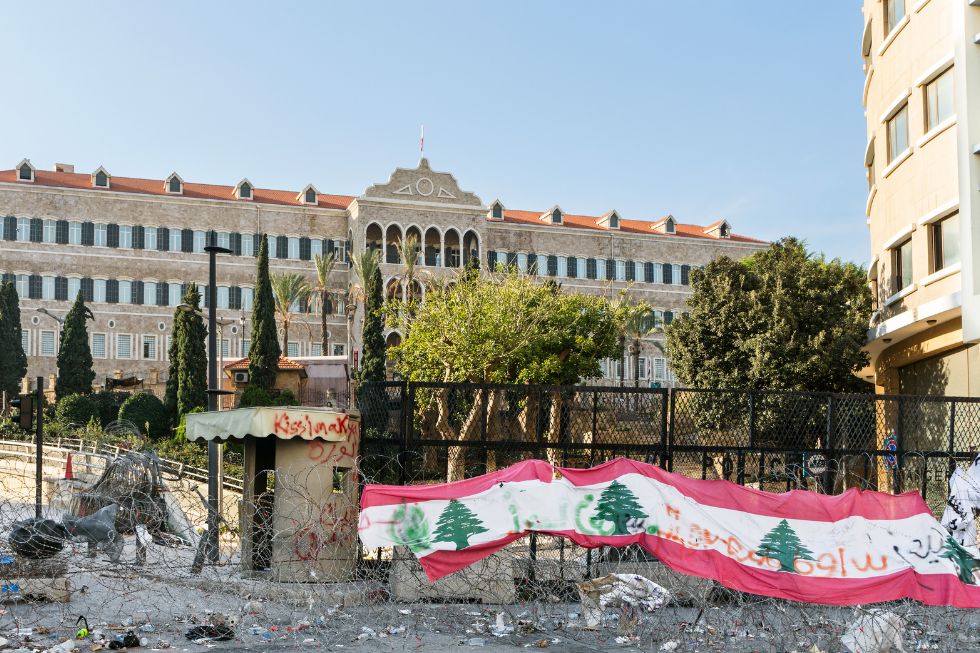



For decades, Lebanon has stood at the crossroads of regional politics. Once celebrated as the “Switzerland of the Middle East” for its banking sector and cosmopolitan capital, the country has — since 2019 — endured one of the world’s worst economic collapses in more than a century, according to the World Bank. A sovereign debt default, a currency that lost most of its value and widespread poverty have hollowed out the state and left many Lebanese with little faith that their institutions can serve them. Its strategic location, diverse society and complex political system have made it particularly vulnerable to external pressures and internal divisions.
In seeking a way out, the country has repeatedly looked outward, turning to regional patrons, foreign creditors and international mediators for rescue rather than to reform at home. Yet despite the attention given to foreign influence and geopolitical competition, I believe the most important question facing Lebanon today is a domestic one: Can the Lebanese state regain the authority, legitimacy and public trust necessary to govern effectively?
The answer to this question will shape not only Lebanon’s future but also its ability to navigate an increasingly unstable regional environment.
Many discussions about Lebanon focus on external factors: Regional powers, international alliances and geopolitical rivalries undoubtedly affect the country’s political landscape. However, attributing Lebanon’s challenges solely to outside influence risks overlooking deeper structural problems that have accumulated over decades.
A crisis of governance
The Lebanese state has struggled to provide many of the services that citizens expect from modern institutions. Economic instability, infrastructure deficiencies, administrative inefficiency and political deadlock have weakened confidence in public authority. As trust declines, citizens increasingly rely on sectarian networks, political patrons or alternative structures to meet their needs. This dynamic further weakens the state and reinforces existing divisions.
The economic crisis that intensified in recent years exposed these vulnerabilities with unprecedented clarity. This deliberate depression has led to a catastrophic collapse of confidence in public institutions, the deterioration of essential services and unprecedented economic pressures on ordinary families, demonstrating the urgent need for structural reform.
Furthermore, data from the United Nations indicates that multidimensional poverty now affects the vast majority of the population, leaving many Lebanese citizens to watch opportunities disappear. At the same time, political disputes continue without meaningful solutions. These developments were not simply economic events; they represented a profound crisis of governance. Citizens were confronted with a reality in which institutions appeared unable to protect their interests or provide credible solutions.
In my view, Lebanon’s future depends on reversing this cycle. Economic recovery is important, but, as emphasized in International Monetary Fund reports, a sustainable recovery cannot occur without comprehensive institutional and structural reforms. Citizens must believe that public institutions operate according to law, transparency and accountability. Without that confidence, even well-designed economic initiatives are likely to face significant obstacles.
Institutions and sovereignty
The question of sovereignty is equally important. Every state faces political disagreements and competing visions for the future. Such debates are a normal part of democratic life. However, democratic systems function most effectively when political competition occurs within a framework of recognized institutions and constitutional rules.
Competing centers of influence and authority have often shaped Lebanon’s political environment. Since independence, power has been divided under a confessional system that reserves the presidency for a Maronite Christian, the premiership for a Sunni Muslim and the speakership for a Shia Muslim. Critics say the arrangement entrenches sectarian elites and paralyzes the state: The presidency sat vacant for more than two years after October 2022, with parliament failing 12 times to agree on a candidate before finally electing Joseph Aoun in January 2025.
Authority is further contested by powerful non-state actors, most notably Hezbollah, which maintains an armed wing that operates outside state control and, with its allies, has used its parliamentary bloc to block presidential candidates it opposes. External powers have shaped domestic politics as well, from Syria’s military and political dominance of Lebanese affairs between 1976 and 2005 to the continuing regional rivalry between Iran, which backs Hezbollah, and Saudi Arabia.
This reality has generated recurring debates about sovereignty, national decision-making and the relationship between state institutions and non-state actors. These debates are frequently controversial, but they remain central to any discussion about Lebanon’s future.
From my perspective, a stable and democratic Lebanon requires institutions that possess both legitimacy and effectiveness. Political disputes should be addressed through elections, parliament, independent courts and constitutional processes. When institutions are strong, they create mechanisms for resolving disagreements peacefully. When institutions are weak, polarization tends to deepen.
A regional lesson
This challenge extends beyond Lebanon. Across the Middle East, many societies continue to confront questions regarding governance, representation and state capacity. Some countries have made progress in strengthening institutions and diversifying their economies. Others remain trapped in cycles of conflict, polarization and political fragmentation.
One lesson emerges repeatedly throughout the region: Durable stability cannot be built solely through security measures or political alliances. It requires institutions that enjoy public confidence and provide citizens with meaningful opportunities for participation. States that fail to build such institutions often face recurring crises regardless of their geopolitical position.
As a Lebanese Palestinian writer living in Europe, I have observed how strong institutions contribute to social stability and public trust. No political system is perfect. Democracies experience disagreements, polarization and policy failures. Yet effective institutions provide mechanisms for addressing problems without threatening the foundations of the state itself.
Lebanon’s greatest resource
This experience reinforces my belief that Lebanon’s greatest resource is not any external alliance or geopolitical alignment. Its greatest resource is its people. Lebanon possesses a highly educated population, a vibrant civil society and a long tradition of intellectual, cultural and entrepreneurial achievement. These strengths persist despite years of crisis.
The challenge is creating a political environment capable of harnessing that potential. This requires reforms that strengthen accountability, improve transparency and reduce dependence on sectarian structures. It also requires a renewed commitment to citizenship as a unifying principle that transcends political and communal divisions.
The road ahead will not be easy. Reform is rarely a linear process, especially in societies facing economic hardship and political fragmentation. Nevertheless, meaningful change remains possible. Lebanon has repeatedly demonstrated resilience in the face of adversity. What it needs now is a long-term vision centered on institution-building rather than short-term political calculations.
The debate over sovereignty, governance and reform will continue. Yet no sustainable solution can emerge without a state capable of enforcing the rule of law, managing public resources transparently and providing equal protection for all citizens. These are not abstract principles. They are practical requirements for economic recovery, political stability and social cohesion.
As a Lebanese Palestinian observing developments both within the region and from Europe, I believe that Lebanon’s greatest opportunity lies in strengthening citizenship, accountability and democratic institutions. The country has endured wars, crises and repeated political deadlock. Its resilience is undeniable. The challenge now is transforming that resilience into institutional renewal.
Regional rivalries will continue to influence Lebanon. However, they should not define its destiny. Ultimately, the future of the country will depend on whether its leaders and citizens can place the long-term interests of the state above short-term political calculations. If they succeed, Lebanon may yet become an example of recovery and reform in a region that continues to search for both.
Lebanon’s path forward begins with a simple principle: The state must be strong enough to serve its citizens, and citizens must be able to trust the state in return.
[Yash Desai edited this piece.]
The views expressed in this article are the author’s own and do not necessarily reflect Fair Observer’s editorial policy.
Contradictory Strategies for Achieving Sovereignty and Stability in Lebanon
From political disarray to economic crisis, and substandard human rights to alarming border violence, chaos proliferates in Lebanon. Key security...
Lebanon’s Future as an Inclusive Democracy in Doubt
The latest violence in Lebanon, coming shortly before the anniversary of protests that brought down the government, does not bode...
Can Lebanon Overcome Its Sectarian Political Order?
Fixing Lebanon’s myriad of interconnected crises would require nothing short of a biblical effort.
Support Fair Observer
We rely on your support for our independence, diversity and quality.
For more than 10 years, Fair Observer has been free, fair and independent. No billionaire owns us, no advertisers control us. We are a reader-supported nonprofit. Unlike many other publications, we keep our content free for readers regardless of where they live or whether they can afford to pay. We have no paywalls and no ads.
In the post-truth era of fake news, echo chambers and filter bubbles, we publish a plurality of perspectives from around the world. Anyone can publish with us, but everyone goes through a rigorous editorial process. So, you get fact-checked, well-reasoned content instead of noise.
We publish 3,000+ voices from 90+ countries. We also conduct education and training programs
on subjects ranging from digital media and journalism to writing and critical thinking. This
doesn’t come cheap. Servers, editors, trainers and web developers cost
money.
Please consider supporting us on a regular basis as a recurring donor or a
sustaining member.
Will you support FO’s journalism?
We rely on your support for our independence, diversity and quality.





Comment