

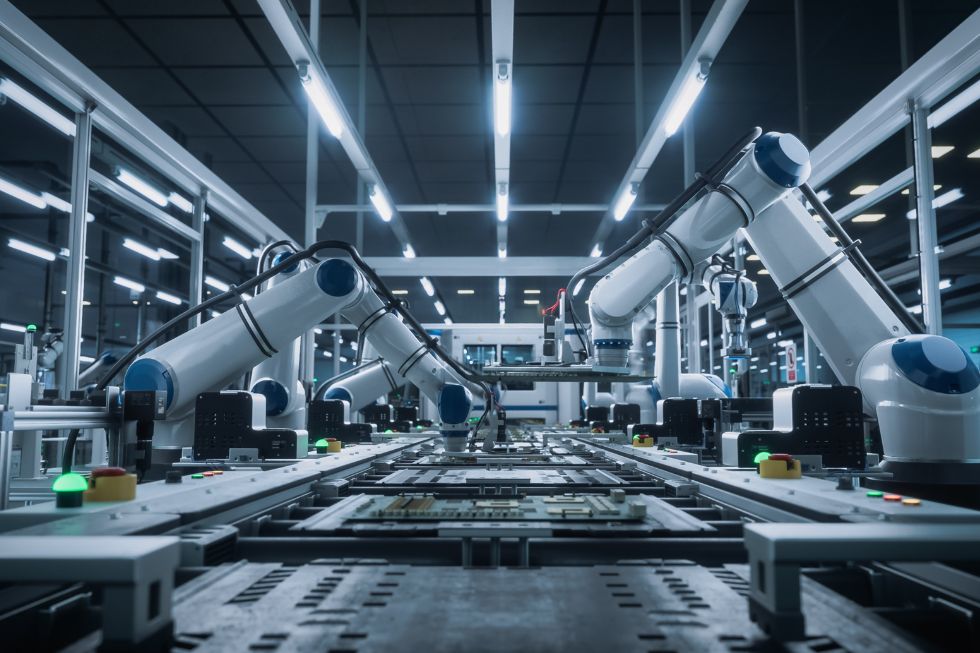


Policymakers can use two basic strategies to attract manufacturing investments. These involve attractive incentives — the carrot — which include subsidies, grants and tax credits, or negative incentives — the stick — which include tariffs and threats.
Using credible data that tells a compelling story, I will explain why the carrot has been and will continue to be much more effective than the stick in attracting manufacturing investment.
The data
The St. Louis Federal Reserve publishes US Census Bureau data on actual investments in new or expanded manufacturing facilities, titled “Total Construction Spending: Manufacturing in the United States.” It is seasonally adjusted and reported monthly on an annualized basis.
During the Biden administration, manufacturing construction spending tripled from $76.5 billion in January 2021 to $230.9 billion in January 2025. This represented one of the largest industrial construction booms in US history, driven primarily by large semiconductor, battery and advanced manufacturing projects.
Due to normal megaproject investment cycles, these projects are front-loaded with capital-intensive spending on site preparation, foundation work and structural construction, using massive volumes of concrete and steel. Consequently, manufacturing construction spending peaked in June 2024 at $240.1 billion and slowed in later phases due to less capital-intensive spending on machinery, equipment and installation, much of which is recorded outside of the St. Louis Fed’s manufacturing construction spending data.
The carrot
Using subsidies, grants, loans, tax credits and state incentives, the CHIPS and Science Act signed by President Joe Biden in August 2022 attracted large amounts of capital into semiconductor manufacturing, spurring new fabrication plants and related infrastructure. It also created an entire ecosystem of suppliers, workers and innovation improving American competitiveness, and is primarily responsible for the manufacturing construction boom reflected in the St. Louis Federal Reserve data.
Stated by the Semiconductor Industry Association, enactment of the CHIPS and Science Act was a pivotal moment in recent American history, uniting government leaders from across the political spectrum to reinvigorate US semiconductor production and reinforce America’s economic strength, national security and technological competitiveness.
The carrot or positive incentives offered by the CHIPS and Science Act, combined with the Infrastructure Investment and Jobs Act, signed in November 2021, and the Inflation Reduction Act, signed in August 2022, boosted broader industrial and clean-energy facility investment. The message was clear: America is open for business, and we’re willing to invest in your success. This approach made investing in the US manufacturing sector very attractive.
The stick
Beginning with President Donald Trump’s second term through October 2025 (the latest available data), construction spending in manufacturing declined to $214.1 billion. Some of this is attributed to less capital-intensive spending in later phases, as explained above. However, the primary factor likely is trade uncertainty caused by President Trump’s on-again, off-again tariffs, delays, reversals and threats — the stick.
According to Anirban Basu, chief economist for the Associated Builders and Contractors, “With CHIPS Act-enabled megaprojects winding down and the stiff headwind of trade policy, manufacturing construction spending has fallen by nearly 10% over the past 12 months.”
There are many examples of stiff headwinds caused by erratic policies. Take South Korea, for example. On April 2, 2025, Liberation Day, President Trump announced tariffs of up to 25% on South Korea. Critics argued this was inconsistent with the United States–Korea Free Trade Agreement (KORUS FTA), which has been in force since March 15, 2012. Three months later, on July 30, 2025, the two countries announced and later finalized the Korea Strategic Trade and Investment Deal, which reduced tariffs to 15% and included the understanding that South Korea would invest $350 billion in the United States.
Two months later, on September 4, 2025, US Immigration and Customs Enforcement (ICE) raided the construction site of the South Korean-owned Hyundai Motor Group/LG Energy Solution battery plant in Ellabell, Georgia. ICE detained several hundred South Korean nationals, many of whom were engineers and technicians training American workers and installing specialized machinery. According to immigration attorney Charles Kuck, his South Korean clients were legally in the US under B-1 visitor visas or the Visa Waiver Program (ESTA).
Even though the Trump administration offered to allow the South Korean workers to remain in the United States to complete their work, most decided to leave due to the unpleasant experience of being shackled, treated like criminals and unsure if they could trust the visa process. In response, South Korean President Lee Jae Myung said, “Under the current circumstances, Korean companies will be very hesitant to make direct investments in the United States.”
The problems did not end here. In January 2026, President Trump announced that because the South Korean National Assembly had not yet passed implementing legislation for the 2025 deal, he would increase tariffs on Korean imports back up to 25%.
Uncertainty and the pause button
The chaotic tariffs and threats have caused economic uncertainty to skyrocket, costs to escalate and investors to be unable to predict what’s ahead. As a result of this and the Georgia immigration action, firms have become more cautious about committing to long-term capital projects in the United States and have hit the pause button.
Stated by Andrew Yeo, a senior fellow at the Brookings Institution, “Allies are receiving mixed signals. The South Korea case has made countries like Japan and even EU nations nervous.”
According to the American Institute of Architects’ January 2026 Consensus Construction Forecast, “Producers and investors typically have not had much clarity as to what countries, what products, or what tariff levels might be in place over the longer term. This makes decision-making difficult and often encourages inaction in supply chain sourcing and investment decisions.”
Not surprisingly, industry forecasts predict a continued decline in manufacturing construction spending.
A better approach
If the goal is to strengthen American manufacturing, US policy needs to focus more on carrots and less on sticks. The CHIPS Act demonstrates that positive incentives work. Expanding similar programs to attract capital to critical industries — advanced materials, batteries, clean energy and biotechnology — would help boost US competitiveness.
This approach is especially urgent given China’s relentless investment strategy and potential US-China hostility. The US cannot afford to cede its competitive advantages through policy uncertainty.
Importantly, strengthening relationships and working more closely with our allies to achieve our manufacturing goals would be an essential step in the right direction. America’s advanced semiconductor manufacturing depends on global supply chains. Alienating these partners through unpredictable tariffs and immigration raids undermines our own competitiveness.
The choice is clear: we can invest in our future through strategic incentives and stable partnerships or watch manufacturing investment go to more predictable shores. This may be a tall order today, but it will be necessary tomorrow.
[Kaitlyn Diana edited this piece.]
The views expressed in this article are the author’s own and do not necessarily reflect Fair Observer’s editorial policy.








Join the conversation
Share your perspective
Log in to share your thoughts and take part in the discussion.