


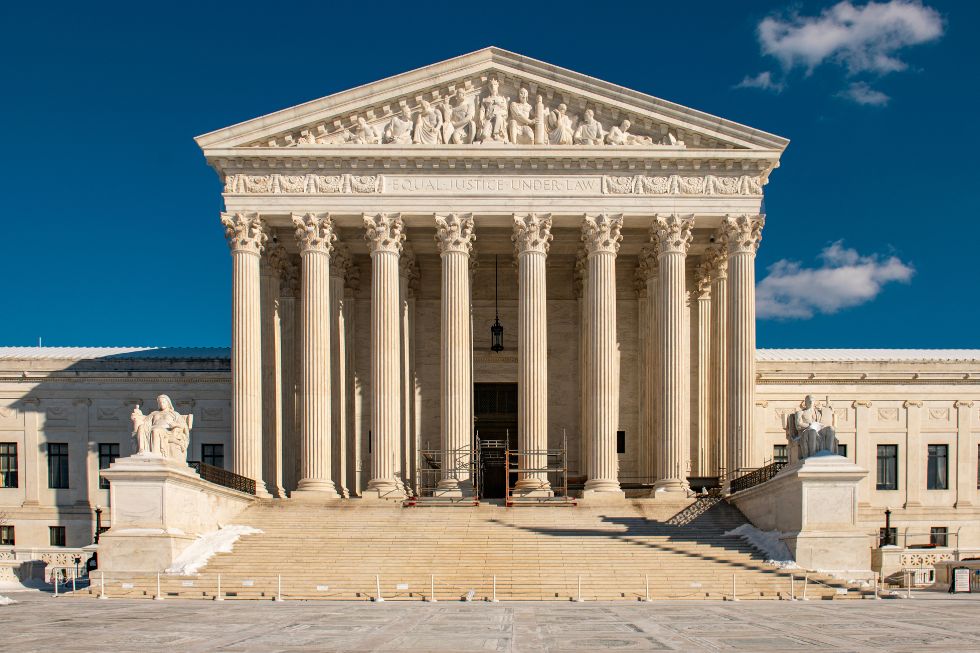


At the risk of mixing metaphors, much of the usually relentlessly partisan Republican majority’s “shadow docket” strategy to facilitate US President Donald Trump’s anticonstitutional excesses always had a problem. Much of the conservative justices’ actions consisted transparently of “kicking the [constitutional] can down the road,” delaying judgment — but sooner or later, that can was going to meet an insurmountable curb.
So, the “Sinister Six” (as the conservative justices have been dubbed) followed a strategy of suspending or revoking lower court injunctions against Trump’s blatant violations of the Constitution, pending a final ruling by the Supreme Court. The curb this can-kick would inevitably encounter was the need for the Supreme Court to eventually issue a final ruling. That curb came on February 20, when the Supreme Court ruled that US President Trump’s tariffs were unconstitutional.
The issue, the decision and the impact
In the case of Trump’s tariffs, they were facially contrary to the plain text of the US Constitution:
The Congress shall have Power To lay and collect Taxes, Duties, Imposts and Excises, to pay the Debts and provide for the common Defence and general Welfare of the United States; but all Duties, Imposts and Excises shall be uniform throughout the United States … To regulate Commerce with foreign Nations, and among the several States, and with the Indian Tribes.
– Article 1, Section 8, Clause 1
The Supreme Court’s decision was split 6-3. What is interesting about this decision is not necessarily the fact that the Supreme Court came to a decision, but the fact that the decision was not split along party lines. Even with the inevitable partisanship that comes with the Supreme Court’s makeup, three conservative justices, Chief Justice John Roberts, Justice Neil Gorsuch and Justice Amy Coney Barrett, joined the liberal justices.
However, our focus should also be on the three conservative dissenters — Justices Clarence Thomas, Brent Kavanaugh and Samuel Alito ruled that Trump’s tariffs were, in fact, legal. Even though they were a minority, these dissenters point out a major issue with the Supreme Court. If the Supreme Court continues to forgive Trump’s overreach, the trust the American public has in the Court will continue to decrease. Therefore, the Democratic Party will have more of a chance to garner support for “court packing,” or increasing the amount of justices to counter the heavy conservative majority. Court packing, if achieved, will deal a massive blow to the conservative side of the Supreme Court and also open up a host of legal problems.
Why now?
The Supreme Court has been politicized quite intentionally by the Republican Party in an effort to create a pro-business court. And, having secured their clear majority, the right-wing justices have spared no effort to secure their wish list, with a secondary objective of fulfilling the hard-right social objectives. Legal commentators in Washington DC, have, from time to time, explained that the so-called “Sinister Six” right-wing justices have expressed a “YOLO” — You Only Live Once — mentality as the driving factor in their approach since 2016. In other words, the Sinister Six believe they have this single opportunity to deliver the right-wing fever dreams of the Federalist Society.
Conservative justices have turned the Supreme Court into a partisan game where they force the ball to always remain in their court. One way they do this is by deploying the restrictive Major Questions Doctrine — a principle in US administrative law that requires clear congressional authorization for agencies to address significant political or economic issues. The Doctrine was invented under President Barack Obama and applied almost exclusively to frustrate Obama and, later, President Joe Biden.
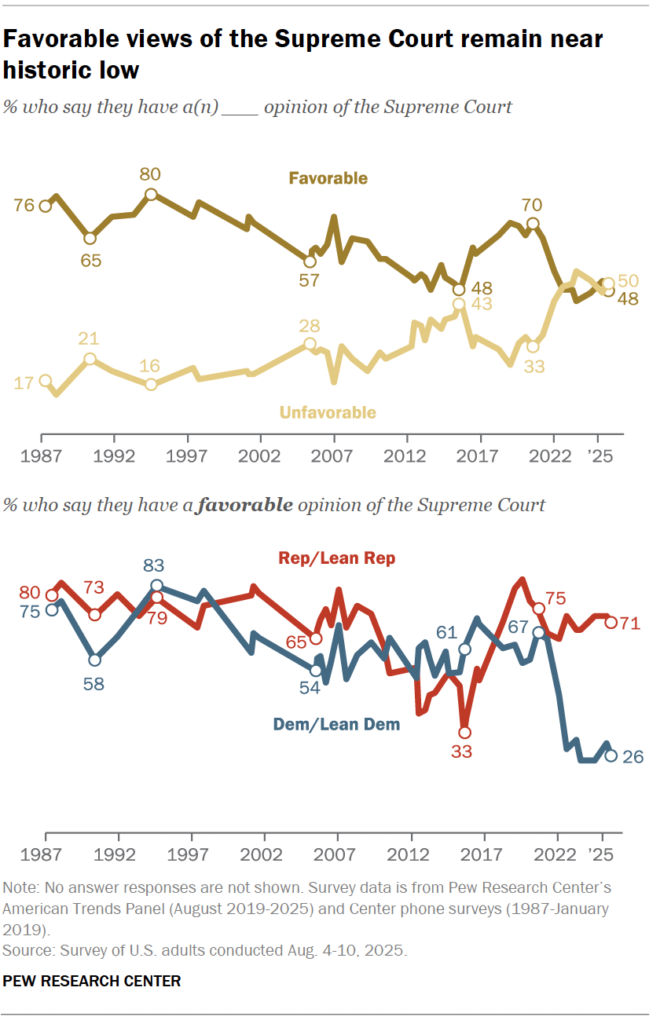
Another way the conservative justices retain their hold on a partisan court is through the deployment of the permissive Unitary Executive Theory, which states that the President of the US has sole authority over the executive branch. It is employed pretty exclusively to forgive overreach by Trump. But as a result, US public opinion of the US Supreme Court plunged by mid-2025 and, since then, has almost certainly fallen further.
The Supreme Court as a central issue in the 2028 election
“Fixing the Supreme Court” is, unsurprisingly, a central demand of Democratic voters and constituencies. Many of whom advocate for “court packing,” i.e., giving a presumably Democratic president in 2029 the opportunity to expand the Supreme Court and appoint enough liberal justices to reverse what are perceived as the many excesses of the Court of Chief Justice John Roberts’s decisions on abortion, voting rights, gerrymandering, campaign contributions, antitrust law and more.
The situation presents an interesting point from US political history. President Franklin D. Roosevelt (FDR) first presented the “court-packing” plan through the Judicial Procedures Reform Bill of 1937. This was a legislative initiative proposed on February 5, 1937, to expand the Supreme Court to as many as 15 justices. However, despite his control of the House and Senate, the bill failed to pass. Perhaps the primary reason FDR’s court-packing plan failed was that, despite the unpopularity of the right-wing Supreme Court by 1936, FDR had not even hinted at the possibility of court-packing in the 1936 elections. Thus, he lacked a political mandate.
By contrast, with more than three years to go, the current Supreme Court (packed by former Republican Senate leader Mitch McConnell) has openly gone too far. It’s a “racing certainty” that a Democratic Presidential candidate, as well as the vast majority of congressional candidates in 2028, will suggest court packing. Unless the Supreme Court performs a dramatic volte face, the Republican majority on the Court may be doomed.
To have upheld Trump’s facially unconstitutional tariffs seems to have struck Roberts, Gorsuch and Coney Barrett as going just too far. Supporting the tariffs risked creating too great a mandate for court-packing — so, abruptly, they decided that it was time to use the Major Questions Doctrine to thwart Trump. But given Trump’s rants and threats in response, it seems unlikely that the issues around the Court will go away.
[The editorial team updated this piece on March 13, 2026.]
The views expressed in this article are the author’s own and do not necessarily reflect Fair Observer’s editorial policy.
How the US Supreme Court’s Conservative Turn Is Reshaping LGBTQ+ Rights Jurisprudence in America
The Supreme Court’s recent and pending rulings signal a significant shift in LGBTQ+ rights, particularly affecting transgender individuals in sports,...
The US Legal System Is Being Hacked
The US legal system is being “hacked,” or acting non-functional as a result of bad inputs such as strict legal...

No Kings, the Second Time Around
Millions of Americans gathered in cities across the US to protest President Donald Trump’s authoritarian behavior and his self-styled image...

Support Fair Observer
We rely on your support for our independence, diversity and quality.
For more than 10 years, Fair Observer has been free, fair and independent. No billionaire owns us, no advertisers control us. We are a reader-supported nonprofit. Unlike many other publications, we keep our content free for readers regardless of where they live or whether they can afford to pay. We have no paywalls and no ads.
In the post-truth era of fake news, echo chambers and filter bubbles, we publish a plurality of perspectives from around the world. Anyone can publish with us, but everyone goes through a rigorous editorial process. So, you get fact-checked, well-reasoned content instead of noise.
We publish 3,000+ voices from 90+ countries. We also conduct education and training programs
on subjects ranging from digital media and journalism to writing and critical thinking. This
doesn’t come cheap. Servers, editors, trainers and web developers cost
money.
Please consider supporting us on a regular basis as a recurring donor or a
sustaining member.
Will you support FO’s journalism?
We rely on your support for our independence, diversity and quality.





Comment