


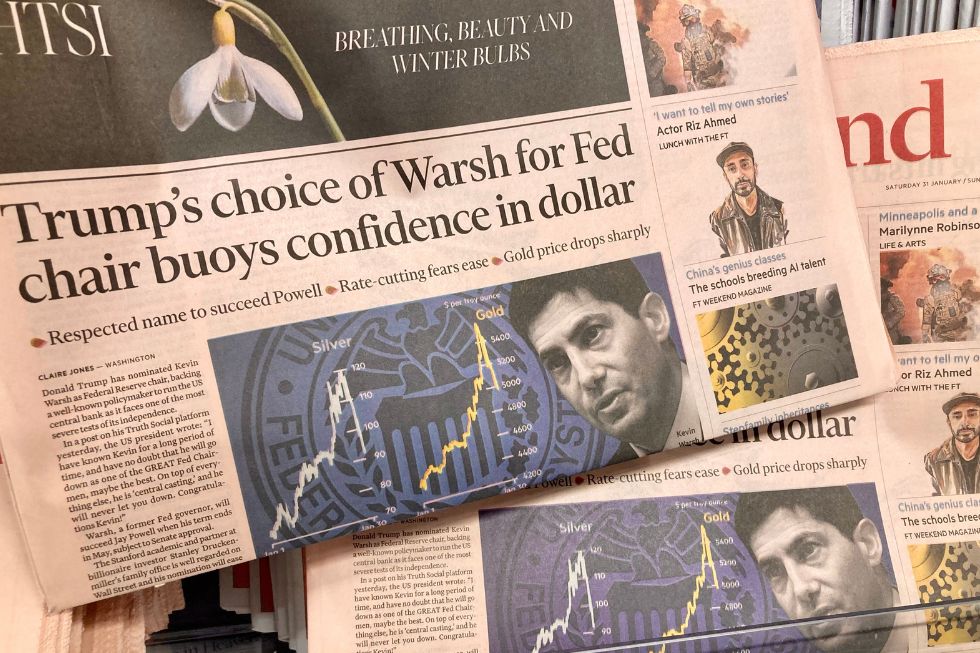


Two weeks after US President Donald Trump announced the nomination of Kevin Warsh as the next Federal Reserve Chair, risky assets are struggling to crawl back to their pre-announcement levels. Some market participants realized belatedly that Warsh is not as hawkish as his past views purport, while others still believe in the institutional robustness of the 12-member Federal Open Market Committee (FOMC).
However, this Warsh crash may have left a lasting dent in risky assets due to his potential impact on the Fed’s independence and financial stability. The time it takes to repair this dent may partly rest on current Chair Jerome Powell’s decision of whether to serve out his term as a regular member of the Board of Governors till 2028, after his term as Chair ends in May 2026.
Warsh’s monetary policy stance and its risks
Despite having criticized excessive quantitative easing in the past, Warsh was picked by Trump to lower policy rates as soon as possible. However, the latest median projections by the FOMC (two more rate cuts in 2026) is already dovish, considering that Personal Consumption Expenditures (PCE) inflation (2.8% in November 2025) has been above the Fed’s 2% target for the past 5 years, and the unemployment rate (4.3% in January 2026) is not far from the FOMC’s median long-term forecast of 4.4%. Advocating for lower rates under such economic environments may raise inflationary expectations and cause runaway inflation reminiscent of the 1970s.
Warsh also proposed to shrink the Fed’s balance sheet, but bank reserves at the Fed of $2.9 trillion (9% of GDP) may not provide enough regulatory liquidity to banks in practice, which was why the FOMC stopped Quantitative Tightening in December 2025. A workaround that would allow bank reserves to seem more ample from a regulatory standpoint is to relax the Liquidity Coverage Ratio (LCR), which would be easier to pass if Chair Powell were to leave the Board in 2026 and give the Warsh-led Board a simple majority of Trump appointees.
However, selling US Treasury and mortgage-backed securities from the Fed’s balance sheet would lead to higher long-term rates, which would not only exacerbate the current housing affordability crisis but also worsen the US national debt, where national debt interest as a percentage of GDP has surpassed annual GDP growth in 2025.
On balance, Warsh frames shrinking the Fed balance sheet as taking money away from Wall Street and cutting policy rates as putting money on Main Street. Ironically, if the FOMC decides to follow suit, then the ensuing effects of a steeper yield curve would actually benefit Wall Street banks while hurting consumers who need to take out long-term loans. Furthermore, Warsh’s dovish advocacy could extend to yield curve control, which undermines Federal Reserve independence and the global credibility of the US Treasury market, valued at $30 trillion.
The influence of the Fed Chair
On the surface, with only Warsh, Christopher Waller and Michelle Bowman on the decidedly dovish side of the Board of Governors, the FOMC — which includes seven members of the Board, the New York Fed president and four regional bank presidents that rotates annually — may still be able to achieve both of its dual mandates (stable prices and maximum employment) if Powell left the Board in 2026. No FOMC members’ terms will expire before 2028, except for the outgoing Stephen Miran (to be replaced by Warsh with Senate approval). Legally, Fed policy rate and asset purchase decisions are decided by the FOMC of 12, not the Chair or the Board alone.
However, as Chair Powell may well know, his influence on the FOMC as the Chair of the Board and FOMC goes beyond just building consensus before FOMC votes are counted. First, the Chair leads the broad agenda and may delegate certain issues to committees. It would be hard to discuss issues that go against the Chair’s views if they are not even listed on the agenda. Second, the Chair could dictate the direction of controversial decisions, such as policy rates under a stagflation scenario, by making staff appointments that align with his views. If the models and scenarios that the technical staff are asked to use become biased, then so will the forecasts and policy outcomes. Third, as the mouthpiece of the Fed at post-FOMC press conferences and congressional testimonies, the Chair has an asymmetric weight in communicating the Fed’s actions, both past and future.
Even if Powell stays on as a regular member of the Board and FOMC in 2026, it would be up to the entire Board and FOMC to ensure their decisions are made on behalf of the American people. Nobody else.
[Kaitlyn Diana edited this piece.]
The views expressed in this article are the author’s own and do not necessarily reflect Fair Observer’s editorial policy.
Trump vs. Powell: The War for the Federal Reserve Escalates
The escalating clash between US President Donald Trump and Fed Chair Jerome Powell threatens the Federal Reserve’s independence amid conflicting...
Trump’s Pressure on the Federal Reserve Risks a US Debt Crisis
The Federal Reserve faces pressure from US President Donald Trump to accelerate interest rate cuts ahead of the 2026 midterm...
Bridging the Divide: Inflation Expectations, Consumer Sentiment and the Fed’s Challenge
Despite slowing inflation rates, consumers remain concerned about high prices due to cumulative cost increases since the Covid-19 pandemic. This...

Support Fair Observer
We rely on your support for our independence, diversity and quality.
For more than 10 years, Fair Observer has been free, fair and independent. No billionaire owns us, no advertisers control us. We are a reader-supported nonprofit. Unlike many other publications, we keep our content free for readers regardless of where they live or whether they can afford to pay. We have no paywalls and no ads.
In the post-truth era of fake news, echo chambers and filter bubbles, we publish a plurality of perspectives from around the world. Anyone can publish with us, but everyone goes through a rigorous editorial process. So, you get fact-checked, well-reasoned content instead of noise.
We publish 3,000+ voices from 90+ countries. We also conduct education and training programs
on subjects ranging from digital media and journalism to writing and critical thinking. This
doesn’t come cheap. Servers, editors, trainers and web developers cost
money.
Please consider supporting us on a regular basis as a recurring donor or a
sustaining member.
Will you support FO’s journalism?
We rely on your support for our independence, diversity and quality.





Comment