


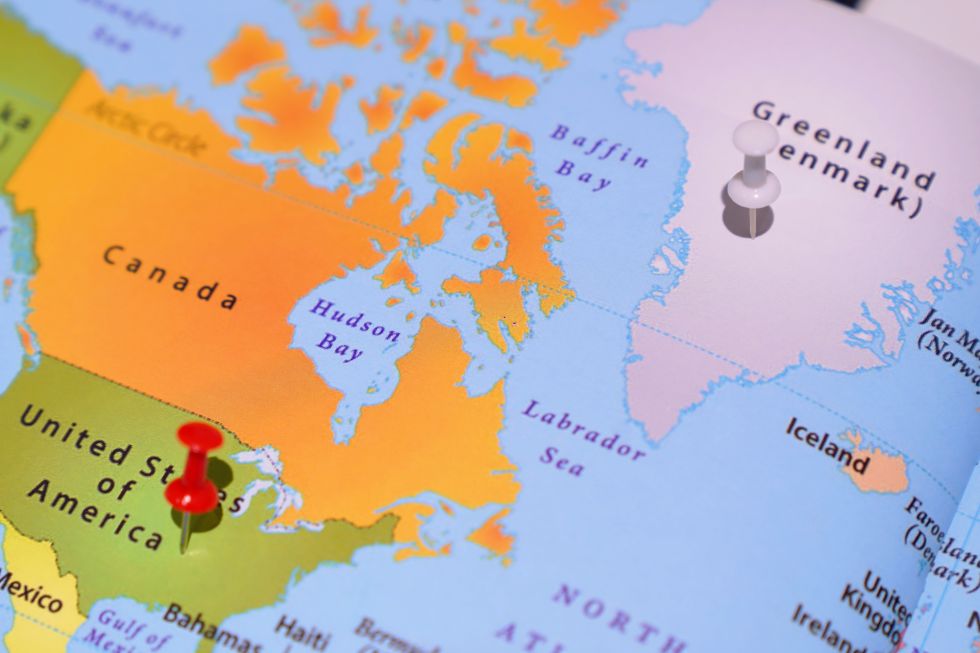



When Russian tanks crossed the Ukrainian border, the concussive force did more than shatter a sovereign frontier; it fractured the metaphysical foundation of the post-1945 world. It signaled a retreat from the rule of law back toward the rule of force. Today, this erosion of global norms finds a new, chilling epicenter in the Arctic. Greenland, once a peripheral concern of geography, has emerged as the contemporary focal point of a new Great Game. This shift is driven by a stark physical reality: as the Arctic ice sheet retreats at an unprecedented rate, it is revealing a treasure trove of critical minerals and rare earth elements essential for the global high-tech and green energy transition
This geological unlocking has directly fueled the Trump administration’s Arctic Agenda. By viewing Greenland through the lens of a revived Monroe Doctrine, the US seeks to assert total dominance over the Western Hemisphere, treating the island not as a sovereign partner but as a defensive Golden Dome against Russian and Chinese polar expansion. The recent March 2025 general election in Greenland highlighted the tension of this new reality. While the rise of the Demokraatit party signaled a population seeking economic pragmatism, they find themselves caught in a vice: the more valuable their land becomes to the global economy, the more it is targeted by a predatory “Realpolitik” that seeks to strip away their agency.
As Greenland opened its new international airport in Nuuk in late 2024, it symbolized a nation attempting to build its own future. Yet, this “Arctic Bridge” is being constructed under the shadow of an imperial script that demands ownership as a prerequisite for security. This transition from a climate-vulnerable territory to a high-stakes strategic prize leads us to a darker transformation: the systematic dehumanization of the Arctic theatre itself.
From partner to asset: the dehumanization of the Arctic
The renewed gaze toward Greenland represents a departure from the transactional rhetoric of a businessman; it is the language of Napoleon Bonaparte, a return to the era of territorial conquest and the establishment of a militarist mentality. By characterizing Greenland as a vast, empty expanse, a terra nullius, the President of the US, Donald Trump, ignores the democratic will of a living society. This rhetoric is the hallmark of high–tech military imperialism. It seeks to transform a nation into a theatre of operations, a strategic asset to be seized rather than a partner to be engaged.
The stakes reached a fever pitch in early 2026, when the threat of unilateral annexation and the imposition of massive tariffs on the European Union turned a diplomatic spat into a global security crisis. If a United States administration were to unilaterally occupy a territory belonging to a fellow NATO member, it would not merely be a diplomatic crisis; it would be the last nail in the coffin of international relations as we know them. Such an act would render the United Nations Charter obsolete, returning humanity to a state of nature where power is the only valid currency.
In this context, history offers a bitter lesson on the damage of occupation and the psychic scars of militarization. The tragedy of the 20th century taught us that when a state prioritizes strategic depth over the ethical recognition of other peoples, the result is the dehumanization of both the occupier and the occupied. Adolf Hitler’s expansionism began with the erasure of borders and ended with the erasure of human life.
Moreover, occupation does more than seize land; it installs a rigid, militarist curriculum into the culture. It replaces the organic development of a society with a “discipline” dictated by the needs of a foreign war machine. An instance in the case includes the establishment of bases and the influx of foreign troops slowly erodes the indigenous social fabric, leaving behind a dependent population whose primary function is to serve a logistics chain.
This trajectory towards annexation indicates a fundamental shift in the American psyche — a transition from a republic protected by oceans to an empire defined by its reach. When a superpower begins to view the Arctic not as an ecological sanctuary or a sovereign home, but as a high ground on a digital map, the human element is effectively deleted. This is the re-territorialization of the world, where the nuances of Greenlandic culture and the hard-won autonomy of the Naalakkersuisut, referred to as the Government of Greenland, are treated as minor obstacles to be bypassed by executive fiat.
The sovereignty trap: Resisting the Militarist Mentality in the high north
The philosophical dilemma of the 2025 political landscape is that Greenlanders seek independence to gain a voice, not to exchange one supervisor for a more aggressive master. Polling data suggests that while many wish to secede from Denmark, an overwhelming 85% of Greenlanders reject joining the United States.
Moreover, their alternative is a desire for a peaceful, multilateral existence alongside Canada or Norway, nations that respect the delicate equilibrium of Arctic cooperation. The prospect of an American security that looks like an occupation is not an alternative; it is an extinction of the Greenlandic political project.
If the world allows the military logic of the Great Powers to override the democratic aspirations of the Greenlandic people, we are entering a “newer version” of imperialism, one that uses the tools of modern technology to enforce ancient tyrannies. The people of Greenland may wake up to find their country ruled by a power that views their home as a stationary aircraft carrier.
On a concluding note, the future of humanity depends on our ability to reject this return to the “militarist mentality”. If international law cannot protect a peaceful island of 57,000 people from the whims of a superpower, then international law does not exist. The perennial question that remains, therefore, is whether or not the Arctic will be a bridge to a new era of global cooperation, or will it be the site where the ideals of human rights and sovereignty are finally buried in the ice.
[Ainesh Dey edited this piece.]
The views expressed in this article are the author’s own and do not necessarily reflect Fair Observer’s editorial policy.
Donald Trump’s “America First” Imperialist Mania
US President Donald Trump’s “America First” policy has intensified global instability and regional conflicts, particularly in the Middle East. Aggressive...
Trump’s Alternative Options for Greenland Post-Davos
As US President Donald Trump considers backing down from threats to take Greenland by force, more plausible peaceful options emerge...
Why Is Trump Choosing Greenland Over NATO?
As diplomatic tensions rise between the US and Denmark over Greenland, it is important to look back and understand the...
FO° Talks: Trump’s Art of the New Deal: Greenland, Russia, China and Reshaping Global Order
In this episode of FO° Talks, Atul Singh and Jean-Daniel Ruch explore US President Donald Trump’s “Art of the New...

Support Fair Observer
We rely on your support for our independence, diversity and quality.
For more than 10 years, Fair Observer has been free, fair and independent. No billionaire owns us, no advertisers control us. We are a reader-supported nonprofit. Unlike many other publications, we keep our content free for readers regardless of where they live or whether they can afford to pay. We have no paywalls and no ads.
In the post-truth era of fake news, echo chambers and filter bubbles, we publish a plurality of perspectives from around the world. Anyone can publish with us, but everyone goes through a rigorous editorial process. So, you get fact-checked, well-reasoned content instead of noise.
We publish 3,000+ voices from 90+ countries. We also conduct education and training programs
on subjects ranging from digital media and journalism to writing and critical thinking. This
doesn’t come cheap. Servers, editors, trainers and web developers cost
money.
Please consider supporting us on a regular basis as a recurring donor or a
sustaining member.
Will you support FO’s journalism?
We rely on your support for our independence, diversity and quality.





Comment