






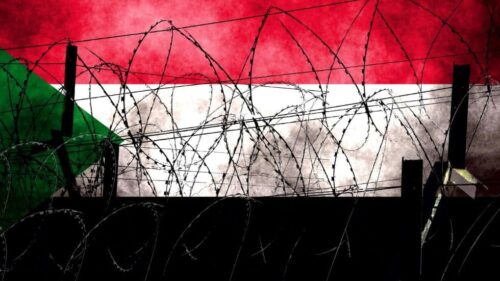
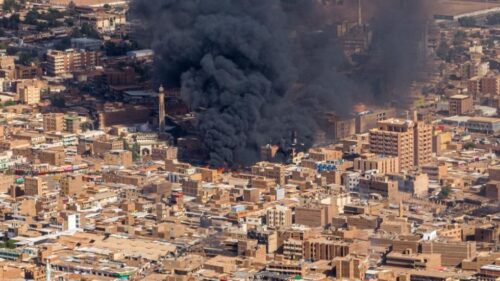
Sudan’s devastating civil war took another turn for the worse after the paramilitary Rapid Support Forces (RSF) captured El Fasher, the last major stronghold of the Sudanese Armed Forces (SAF) in Darfur, triggering reports of mass executions, ethnic cleansing and summary killings. The fall of the city trapped over 260,000 civilians, exposing them to starvation and violence, mirroring the events of the horrific 2003 Darfur genocide when the Janjaweed militias went on a killing spree.
El Fasher under siege
Since May 2024, El Fasher, the capital of North Darfur, has endured an RSF siege. SAF carpet bombing and famine conditions created a nightmarish scenario in the city, threatening the lives of civilians there. With its capture of the city, nearly all of Darfur is now under the control of the RSF.
Satellite imagery analyzed by Yale University’s Humanitarian Research Lab (HRL) provides chilling evidence of mass killings. According to the HRL, “these observations are consistent with reports of executions … and the killing of people attempting to flee the city…”
The UN Human Rights Office has also reported atrocities against unarmed civilians. UN High Commissioner for Human Rights Volker Türk said:
The risk of further large-scale, ethnically motivated violations and atrocities in El Fasher is mounting by the day. Urgent and concrete action needs to be taken urgently to ensure the protection of civilians in El Fasher and safe passage for those trying to reach relative safety.
Mohamed Hamdan Dagalo leads the RSF and is the successor to the Janjaweed militias responsible for over 300,000 deaths. Sudan’s war, raging since 2023, has witnessed repeated rape, burning of villages and ethnic massacres in West Darfur. The deadly power struggle has resulted in 30 million Sudanese in need of immediate aid.
Amnesty International has attempted to make headway in resolving the crisis and getting aid to civilians. It has demanded that the RSF halt its attacks and allow the opening of aid corridors. The UN has taken a different approach, urging pressure on the United Arab Emirates (UAE) — an RSF supporter supplying drones and weapons. Unfortunately, the global community’s tepid response and disinterest in this region mean no aid or pressure is forthcoming.
The role of the UAE
The UAE has emerged as a pivotal actor in this devastating crisis as it remains accused of prolonging the conflict and exacerbating the atrocities taking place. The UAE has been accused of enabling RSF horrors, including the massacres and ethnic cleansing that took place in El Geneina, Masalit, Zaghawa and El Fasher.
Abu Dhabi had invested billions in Sudan’s agriculture, mining, and shipping industries, in the hope that it would open a corridor to African resources and serve as a buffer against regional rivals like Turkey and Qatar. But when the conflict erupted in 2023 between the RSF and SAF, the UAE took sides with the former. RSF leader Hemedti controls key gold mines of interest to the UAE. The conflict has become a proxy battle, with Saudi Arabia backing the SAF to balance UAE influence across the Red Sea.
UN panels and leaked intelligence reports reveal hundreds of cargo flights from the UAE to Chad and Somalia, from whence weapons, including drones, ammunition and armored vehicles, are then transferred to Sudan. The UAE is also accused of recruiting Colombian mercenaries to assist in the fighting.
However, the UAE has dismissed these accusations as “politically motivated” and even canceled meetings in the UK over UN criticism. The UAE also challenged Sudan’s International Court of Justice (ICJ) genocide complicity case earlier this year. In May, Khartoum severed ties with the UAE.
A call for international action
Today, with the RSF consolidating control over vast swaths of territory, over 260,000 civilians face imminent genocide. Amnesty International, the UN and other organizations are urging an immediate ceasefire, monitored by the international community. They demand the immediate opening of aid corridors to deliver food, medicine and fuel.
The UAE must be held to account for its complicity in the genocide. RSF gold refinery assets should be frozen, and the EU and US should place secondary sanctions on firms complicit in dealing with the RSF.
The US-Saudi-UAE-Egypt “Quad” should move to enforce a 90-day humanitarian truce, a nationwide ceasefire and a path to negotiations. The international community must refer the RSF to the International Criminal Court for genocide, and support Sudan’s ICJ case against the UAE for its complicity in the genocide. The UN must also send a fact-finding mission to document the El Fasher crimes to be used for prosecutions.
Chad, Libya and Somalia can assist by sealing their borders and preventing flights from the UAE from landing in the region. A no-fly zone should be enacted to further prevent such activity. In the UK, for instance, Members of Parliament should demand a halt in arms sales to the UAE.
The fall of El Fasher does not necessarily mean defeat. Instead, it should be viewed as a clarion call to the international community to act. Silence equals complicity, and — while yesterday was the time to act — it is still not too late to save those civilians whose lives are in imminent danger.
[Kaitlyn Diana edited this piece.]
The views expressed in this article are the author’s own and do not necessarily reflect Fair Observer’s editorial policy.
The Sudan War: Why It Cannot Be Resolved
The Sudanese Armed Forces (SAF) and the Rapid Support Forces (RSF) are fighting for power amid deep ethnic and regional...
The Cost of Silence: Why Global Inaction Is Betraying the People of Sudan
After three years of civil war in Sudan between the Sudanese Armed Forces and the Rapid Support Forces military groups,...
The World Must Act Now to End Sudan’s Devastating Conflict
War in Sudan is raging between two rival factions: the Sudanese Armed Forces and the Rapid Support Forces. The conflict...
Support Fair Observer
We rely on your support for our independence, diversity and quality.
For more than 10 years, Fair Observer has been free, fair and independent. No billionaire owns us, no advertisers control us. We are a reader-supported nonprofit. Unlike many other publications, we keep our content free for readers regardless of where they live or whether they can afford to pay. We have no paywalls and no ads.
In the post-truth era of fake news, echo chambers and filter bubbles, we publish a plurality of perspectives from around the world. Anyone can publish with us, but everyone goes through a rigorous editorial process. So, you get fact-checked, well-reasoned content instead of noise.
We publish 3,000+ voices from 90+ countries. We also conduct education and training programs
on subjects ranging from digital media and journalism to writing and critical thinking. This
doesn’t come cheap. Servers, editors, trainers and web developers cost
money.
Please consider supporting us on a regular basis as a recurring donor or a
sustaining member.
Will you support FO’s journalism?
We rely on your support for our independence, diversity and quality.





Comment