


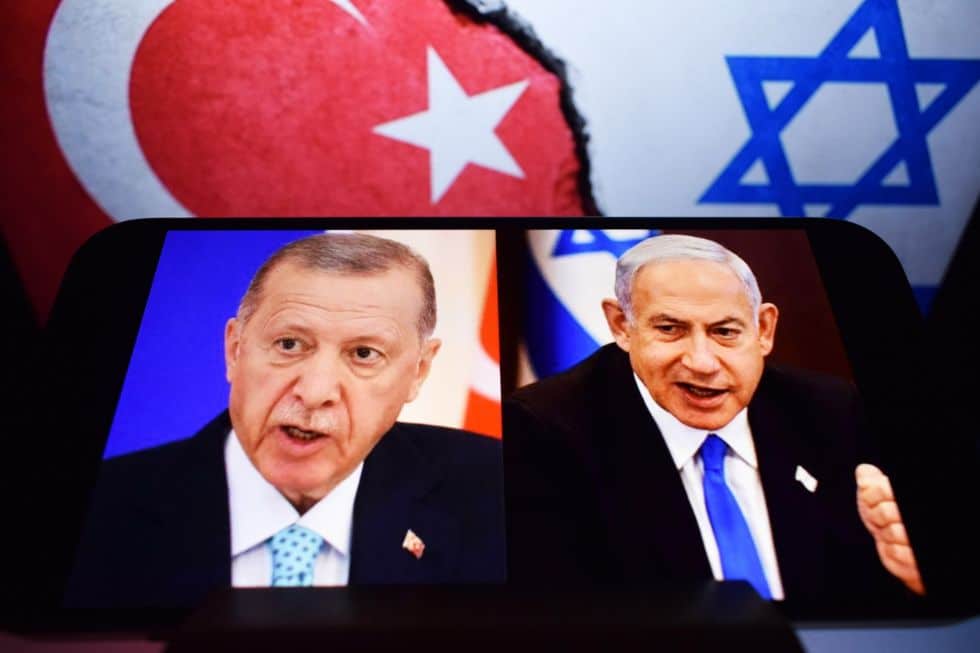


Turkish President Recep Tayyip Erdogan has recently denounced Israeli Prime Minister Benjamin Netanyahu for the “continued attacks on Palestinian civilians” and warned of a “humanitarian catastrophe in Gaza.” By presenting himself as a human rights defender, Erdogan seeks to position Turkey as a moral voice in the region. Yet for many Kurds, such remarks ring hollow — an example of the Kurdish saying, “the raven calls the other raven black,” the Kurdish equivalent of “the pot calling the kettle black.”
Erdogan’s hypocrisy
Since 2016, the Turkish government — now a self-styled champion of Palestinians — has carried out repeated military operations in the Kurdish-administered region of northern Syria, known in Kurdish as Rojava. Operations such as Olive Branch (2018) and Peace Spring (2019), among others, drew allegations from Amnesty International of “serious human rights violations,” including arbitrary detention, torture and enforced disappearances.
Erdogan’s rhetoric on Gaza often resembles political opportunism more than moral conviction. In 2017, he warned that Kurds in Iraq “must give up on independence or go hungry.” While just a year earlier, he had called for Palestinian statehood at the United Nations. Now, in 2025, he accuses Netanyahu of using famine as a “weapon” in Gaza — the very threat he once directed at Kurds pursuing the same right: self-determination.
The contradictions extend further. After Netanyahu’s recent strike on a hospital in Gaza, Erdogan condemned Israel for “relentlessly destroying humanity.” Yet Amnesty International documented in 2019 the civilian costs of Turkey-backed operations in Syria, describing “an utterly callous disregard for civilian lives,” including unlawful strikes on residential areas. The Human Rights Watch also noted in 2022 that Turkish strikes on civilian infrastructure “exacerbate the humanitarian crisis” and “endanger basic rights.”
These abuses are well-documented. The Human Rights Watch’s 2024 findings detailed abductions, arbitrary arrests, sexual violence and torture committed by factions of the Turkey-backed Syrian National Army. The report also notes “Human Rights Watch … found that Turkish Armed Forces and intelligence agencies were involved in carrying out and overseeing abuses.”
In addition, a preliminary 2025 report by the European Association of Lawyers for Democracy and World Human Rights accused Turkey of “committing war crimes and crimes against humanity in Rojava.”
To condemn the Israeli government, Erdogan warns that “those who shed innocent blood will drown in it,” yet his own government stands accused of shedding that same blood. In this regard, the deeper question is why Kurdish and Palestinian struggles receive such unequal treatment. The answer lies less in humanitarian principles than in political calculations.
Erdogan’s political maneuvering
Regarding Erdogan’s recent political statements, some explanations point to his long-standing hostility toward Israel, his ties to the Muslim Brotherhood and neo-Ottoman ambitions. This point recalls earlier warnings.
In 2015, the Institute for Strategic, Political, Security and Economic Consultancy in Berlin reported that Turkey “support[s] other countries’ designated terrorist groups [such as] Muslim Brotherhood, Hamas, ETIM/TIP, Al Nusra, and other Al Qaeda affiliates.”
In 2025, Israel’s Meir Amit Intelligence and Terrorism Information Center described Turkey as “a center for planning, funding, and directing terrorist attacks,” noting Erdogan’s ruling Justice and Development Party’s (AKP) ideological ties to Hamas.
In addition, the Counter Extremism Project observed that Turkey “maintains open relations with internationally sanctioned extremist groups and harbors internationally sanctioned and wanted extremists affiliated with the Taliban, the Muslim Brotherhood, and Hamas.”
At home, Erdogan faces mounting disillusionment. A 2025 Turkish Minutes poll showed that 67% of people in Turkey want the “Erdogan era to end.” A 2024 Pew Research Center survey found that 55% of Turkish adults hold an “unfavorable opinion” of him.
A similar distrust is also mirrored in Israel, where The Times of Israel reported that 70% of Israelis “do not trust” Netanyahu’s government. In such a condition that civilians are paying the price, Erdogan’s moral posturing toward Israel appears less like a principled stand than a striking case of the pot calling the kettle black.
[Kaitlyn Diana edited this piece.]
The views expressed in this article are the author’s own and do not necessarily reflect Fair Observer’s editorial policy.
Making of a Dictator: What the PKK’s Surrender Means for Turkey
On March 1, the insurgent Kurdish Workers’ Party (PKK) unilaterally announced that it was laying down arms against the Turkish...

World Powers Betray Kurds as Syria’s Political Future Takes Shape
With the overthrow of Syrian dictator Bashar al-Assad, the Sunni Arab militant group Hayat Tahrir al-Sham has seized power in...
The Syrian Revolution Is a Big Opportunity for Turkey
Turkey’s strategic influence in Syria has grown after dictator Bashar al-Assad’s fall, with cautious gains amid past setbacks. Turkish President...
Support Fair Observer
We rely on your support for our independence, diversity and quality.
For more than 10 years, Fair Observer has been free, fair and independent. No billionaire owns us, no advertisers control us. We are a reader-supported nonprofit. Unlike many other publications, we keep our content free for readers regardless of where they live or whether they can afford to pay. We have no paywalls and no ads.
In the post-truth era of fake news, echo chambers and filter bubbles, we publish a plurality of perspectives from around the world. Anyone can publish with us, but everyone goes through a rigorous editorial process. So, you get fact-checked, well-reasoned content instead of noise.
We publish 3,000+ voices from 90+ countries. We also conduct education and training programs
on subjects ranging from digital media and journalism to writing and critical thinking. This
doesn’t come cheap. Servers, editors, trainers and web developers cost
money.
Please consider supporting us on a regular basis as a recurring donor or a
sustaining member.
Will you support FO’s journalism?
We rely on your support for our independence, diversity and quality.





Comment