


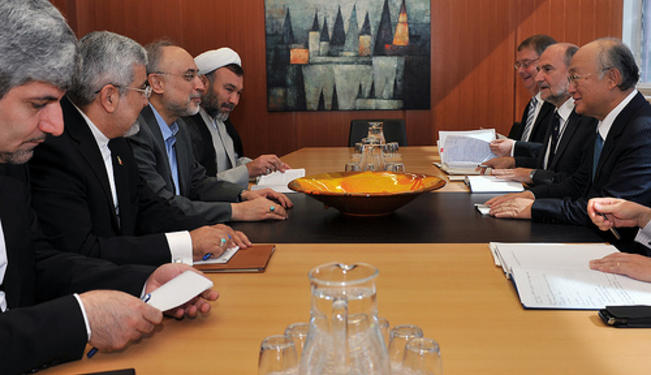


Shirin Shafaie presents an exclusive interview with Peter Jenkins regarding Iran’s nuclear issue and the failure of Western diplomacy in dealing with it. Mr. Jenkins was the UK Permanent Representative to the IAEA in Vienna from 2001 to 2006. This is the first of three parts.
Shafaie: It appears from your recent Chatham House lecture and from your recent article published in The Telegraph that you have some differences with the official Western policies with respect to Iran’s nuclear issue. Is this your view that neither the Nuclear Non-Proliferation Treaty (NPT) nor the International Atomic Energy Agency (IAEA) statute require Iran to suspend or abandon enrichment activities allowed under those treaties?
Jenkins: It is certainly my opinion that the NPT does not require Iran to suspend nuclear enrichment. Iran concealed parts of its nuclear program for 18 years but after 2002, as far as I can judge based on my work with the IAEA, Iran came back into compliance with its Safeguards Agreement under the NPT. So Iran is entitled to enjoy its NPT rights to peaceful nuclear energy. However, because of these years of concealment prior to 2003, Iran’s neighbours are understandably anxious and they hope that Iran can go beyond the strict letter of the NPT and volunteer some additional measures to restore confidence in the purpose of Iran’s nuclear programme, for example apply the Additional Protocol.
Another measure could be a permanent on-site IAEA inspector presence at sensitive plants. Back in 2005 when Iran was talking to the UK, France and Germany, the Iranian negotiators suggested that they might be ready to offer this at the Natanz enrichment plant.
In 2003 they voluntarily agreed to apply the Additional Protocol as part of the Tehran Agreement with the EU3 (UK, France and Germany). The problem with that agreement was that it contained ambiguities, like many diplomatic agreements. The EU3 wanted the Tehran Agreement to lead to the abandonment of enrichment by Iran. When Iran finally understood that this was the European objective, they ceased to honour the Agreement; in other words they resumed enrichment-related activities. That led the Europeans to feel entitled to arrange for Iran to be reported to the Security Council.
Shafaie: When Iran as you said stopped honouring the Additional Protocol…
Jenkins: They stopped honouring the Tehran Agreement. The Tehran Agreement had two important elements to it, one was the Additional Protocol and the other was suspension. So they were applying the Additional Protocol but they stopped suspension.
Shafaie: And that was why the Europeans reported Iran to the Security Council?
Jenkins: The Europeans said to themselves: “because Iran has broken its side of the Tehran bargain, our response must be to report them to the Security Council.” In Tehran, Europe had said to Iran: “if you apply the Additional Protocol and if you suspend, we will use our influence in the IAEA to ensure that you do not get reported to the Security Council.” What Iran had done wrong throughout that period when they failed to declare certain things to the IAEA – their “non-compliance” – should have been reported to the Security Council. But Europe undertook to avert that because some of us feared that, if the matter went to the Security Council in 2003, the US would react counter-productively. But in return we wanted the Additional Protocol and suspension. So when Iran gave up suspension we thought: “OK you’ve broken the deal, we are now going to break our side of the bargain and report you to the Security Council”. However, we didn’t just do this to be nasty, or to punish Iran; we did it because we wanted the Security Council, which has the legal right to impose obligations on states, to demand suspension from Iran, so that Iran would be denied the chance to master enrichment technology.
And then there was the counter-reaction from Iran which was to say that now you have reported us to the Security Council, we are not going to apply the Additional Protocol anymore. So the whole Tehran Agreement, which was a good agreement, unravelled.
Shafaie: So was this the first time that the demand for suspension was made of Iran? Why did the Europeans start by asking for an extra legal demand from Iran? And why did they want to make sure that Iran is bound by law (i.e. the Security Council) to eventually abandon its enrichment program, which you said Iran has a right to pursue? Was it because ultimately Europeans did not want Iran to have a national peaceful nuclear program? Do you regret having reported Iran to the Security Council while you could have solved the problem diplomatically with your European, IAEA and Iranian colleagues?
Jenkins: The West did not want Iran to have an enrichment capability. That is why the Security Council made a legally binding “demand” (which was indeed the first such demand). The Council is entitled to over-ride Iran’s or any other state’s treaty rights in the interest of maintaining the peace.
I do not regret it because at the time I believed Iran wanted to acquire nuclear weapons and I saw suspension as a way of preventing Iran from acquiring the enrichment capability it would need to manufacture these weapons, since EU/Iran diplomacy had failed. Now I see things differently, because since 2005 US and Israeli intelligence experts have said they have no evidence that Iran’s leaders have decided to make nuclear weapons. I believe that a change of threat assessment requires the West to change its policy response. Instead, to my regret Western policy-makers remain stuck in a groove, like a gramophone needle on an old record.
Shafaie: Going back to the issue of the Security Council and the UN Chapter VII which has been used by the Council’s permanent members to impose sanctions on Iran; do you think that such usage has been legitimate?
Jenkins: Well this is a very interesting point.
If you read very carefully Chapter VII, Article 39 suggests that the first thing the Security Council should do when a new issue is brought to its attention – the way the Iranian issue was brought to its attention in 2006 – is to determine whether this issue represents a threat to the peace. I don’t know, because I wasn’t serving in New York, whether the Security Council ever debated whether the situation with regards to Iran’s nuclear program represented a threat to the peace. But if they did debate it they clearly did not come to a conclusion, because none of the resolutions on Iran contains a determination that Iran’s nuclear activities represent a threat to the peace. Whereas if you read the resolutions of the Security Council on North Korea’s nuclear case, they all say that what North Korea has been doing is a threat to the peace.
In the absence of a ‘threat to the peace’ determination, it is questionable whether the Security Council was entitled to adopt binding measures under Article 41. Because if you read the Chapter, Article 39 appears to lead to Article 41 and if you have not taken action under Article 39 it is questionable whether you should be taking action under Article 41.
Shafaie: Now in the light of what you just said and according to the letter of the UN Charter, do you think that the sanctions against Iran by the Security Council are legal? How could the Security Council issue Resolution 1696 against Iran (which demands suspension for the first time) without ignoring the UN Charter? And didn’t the Europeans know that this was going to happen when they reported Iran to the Security Council? How are we supposed to deal with all these contradictions?
Jenkins: Well, the EU countries brought Iran to the Security Council to make suspension mandatory. They believed the Security Council could do that using the powers conferred on it under Chapter VII, since at the time they believed that Iran’s enrichment programme represented a threat to the peace. I do not know whether they still believe that. If they do, they seem to have been unable to persuade all members of the Council to share that view.
Shafaie: Doesn’t that make the Security Council Resolutions (and in effect UN sanctions) on Iran illegal?
Jenkins: The view of most British legal experts is that the Security Council ultimately can do what it wants. The Security Council is like a parliament: it is a sovereign body and if it chooses to ignore its own rules it can do so. So say these legal experts. I am not a legal expert and so I have to accept that these resolutions are “legal”. I feel entitled to say, however, that the absence of a determination under Article 39, that Iran’s nuclear activities constitute a threat to the peace, makes me ask myself whether the use of Chapter VII to impose “international obligations” on Iran is really just, or whether it is not rather what we British call “sharp practice”.
Shafaie: Yes, I understand. We have even seen some nations who are permanent members of the Security Council who themselves circumvent the Security Council as we saw in the case of Iraq. They felt entitled to invade Iraq in 2003 even without a Security Council resolution, so we have seen that the Security Council even circumvents its…
Jenkins: Its own rules!
Read Part 2 of “Diplomatic Miscalculations and the Threat of War” next week on February 29.
Support Fair Observer
We rely on your support for our independence, diversity and quality.
For more than 10 years, Fair Observer has been free, fair and independent. No billionaire owns us, no advertisers control us. We are a reader-supported nonprofit. Unlike many other publications, we keep our content free for readers regardless of where they live or whether they can afford to pay. We have no paywalls and no ads.
In the post-truth era of fake news, echo chambers and filter bubbles, we publish a plurality of perspectives from around the world. Anyone can publish with us, but everyone goes through a rigorous editorial process. So, you get fact-checked, well-reasoned content instead of noise.
We publish 3,000+ voices from 90+ countries. We also conduct education and training programs
on subjects ranging from digital media and journalism to writing and critical thinking. This
doesn’t come cheap. Servers, editors, trainers and web developers cost
money.
Please consider supporting us on a regular basis as a recurring donor or a
sustaining member.
Will you support FO’s journalism?
We rely on your support for our independence, diversity and quality.





Comment